Building Bridges for Government-Business Communication and Safeguarding Enterprises’ Compliant Development
Upholding the boundaries of “proactive and clean” interactions and building a defense line for integrity. The new-era proactive and clean government-business relationship serves as a “purifier” for the political ecosystem and business environment, as well as an “accelerator” for stimulating market vitality and promoting the high-quality development of enterprises. On the afternoon of December 26, the 12th session of the “Integrity and Compliance Lecture Hall”, themed “Building a Proactive and Clean Government-Business Relationship and Fostering an Integrity-Focused Enterprise Ecosystem”, was held at the Liby Center. Hosted by the Guangzhou Greater Bay Area Enterprise Integrity and Compliance Management Association (hereinafter referred to as the GBA Integrity and Compliance Association), this event gathered over 100 guests, including relevant responsible persons from the Municipal Commission for Discipline Inspection and Supervision, the Municipal State-owned Assets Supervision and Administration Commission, the Municipal Public Security Bureau, the Municipal Federation of Industry and Commerce, as well as representatives from industry associations, enterprises, academia and the legal sector, for learning and exchange.
Creating value through integrity and driving development through compliance. As the first national 5A-level social organization dedicated to enterprise integrity and compliance, the GBA Integrity and Compliance Association takes it as its mission to build a professional communication platform. It has launched the “Integrity and Compliance Lecture Hall” as its core brand event, which has been held for 12 consecutive sessions to date. It has become an important communication platform for the government and enterprises to jointly promote compliance construction, providing solid support for strengthening enterprises’ integrity risk prevention and consolidating the ideological and moral defense lines of practitioners, and empowering the high-quality development of enterprises.
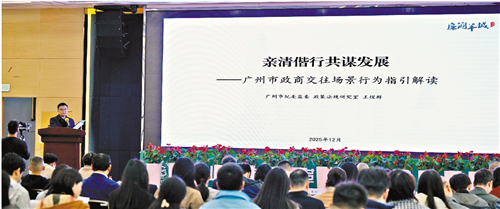
Drafting Committee Members Explain the Guidelines in Detail: Advancing Hand in Hand with Proactiveness and Cleanliness for Mutual Development
Government-business interactions have clear boundaries, and compliant cooperation follows established rules. How to grasp the boundaries between “what can be done” and “what cannot be done” to build a “proactive and clean” government-business relationship? Since last year, the Guangzhou Municipal Commission for Discipline Inspection and Supervision has issued two batches of the Guidelines and Q&A on Government-Business Interactions in Typical Scenarios in Guangzhou (hereinafter referred to as the Guidelines) for two consecutive years. At the lecture hall, Wang Yuqun, a member of the Guidelines drafting committee and a First-Class Principal Staff Member of the Policy and Regulation Research Office of the Municipal Commission for Discipline Inspection and Supervision, shared the background and considerations behind the formulation of the Guidelines in depth, elaborated on the main content and characteristics of the Guidelines, and put forward suggestions on how to effectively implement the Guidelines, helping enterprises and public officials clarify the boundaries of interactions and carry out cooperation in accordance with the rules.
“How to translate abstract policy requirements into perceptible and enforceable codes of conduct?” This was a key consideration in the drafting of the Guidelines. Wang Yuqun stated, “Although normative provisions are highly generalizable, they have limitations in terms of applicability and operability in specific scenarios. Especially with the in-depth development of research, we found that the grass-roots level is in urgent need of a guideline document that is ‘easy to understand and simple to apply’. To this end, we drew on the emerging ‘scenario-based’ format, introducing specific behavioral scenarios and typical cases on the basis of positive and negative lists. By transforming the form to drive the shift in thinking, and empowering through scenarios and restoring contexts, we made the abstract provisions more concrete, thus forming the ‘scenario + list + case’ format adopted by both batches of the Guidelines.”
Comparing the content of the two batches of the Guidelines, Wang Yuqun introduced that the first batch systematically responded to regular government-business interaction issues such as “what meals can be eaten and what vehicles can be taken”, reflecting more the concept of “proactive without overstepping the bounds and impartial without selfishness”. The second batch extended and expanded the dimensions of government-business relationship manifestations, focusing on the development of new productive forces and highlighting the substantive content of current enterprise-related services. It centered on the full-cycle services for enterprise development from investment promotion to project landing, addressing how to “maintain cleanliness without alienation and take action with prudence”, realizing the iterative upgrade from “moderate government-business interactions” to “effective service for enterprises”, and promoting government-business interactions from the “form” level to the “substance” level.
With the continuous development of social economy, the connotation of government-business interactions is constantly enriched, and the 33 scenarios covered in the two batches of the Guidelines cannot encompass all situations. Then, when encountering confusion in government-business interactions, how should we effectively use the Guidelines? Wang Yuqun said that the core of judging various possible situations is to distinguish between “acting for the public good” and “acting for personal gain”, and the key is whether the actions can be “put on the table”. He added that when consulting the Guidelines to judge whether relevant behaviors conform to the requirements of a proactive and clean government-business relationship, it is necessary to specifically grasp three sets of dialectical relationships: First, the unity of the reform spirit and strict standards. The Guidelines are not intended to “relax discipline”, but to prevent grass-roots units from imposing excessive restrictions, setting unnecessary barriers and adopting a “one-size-fits-all” approach. Second, the unity of an effective market and a capable government. The core of a proactive and clean government-business relationship is a correct view of power. Finding the optimal balance between “regulating” and “deregulating” is an important factor in judging whether actions are taken with public interests and work purposes in mind. Third, the unity of proactiveness with moderation and cleanliness with effectiveness. As Party members and cadres, they should keep disciplinary requirements in mind while taking proactive actions, achieving proactiveness with effectiveness and without overstepping the bounds. In government-business interactions, they should not only adhere to the bottom line but also show sincerity, truly work with enterprises with one heart and one mind, achieving proactiveness with effectiveness and cleanliness without alienation. Only when “proactiveness” and “cleanliness” support each other and are organically unified can a sound and upright business environment be cultivated.
Participating Enterprises Heap Praise on the Guidelines: Effectively Preventing Integrity Risks and Facilitating Focus on Development
“This training is full of practical insights and has strong educational and guiding significance.” “The training content includes both policy interpretation and case warnings, enabling us to clearly grasp the ‘do’s and don’ts’ in government-business interactions.” “Such training not only helps us effectively prevent integrity risks but also facilitates us to develop with confidence and operate with peace of mind.”… Participating enterprises have expressed that through this lecture hall training, they have gained an in-depth understanding of the connotation and role of the Guidelines, and deeply recognized the importance of integrity culture construction for the long-term development of enterprises. In the future, they will actively promote the organic integration of integrity culture and compliance culture, and strive to create a sound and upright compliance culture atmosphere.
Xiong Ying, Chairman of Red Sea Human Resources Group and Vice President of the GBA Integrity and Compliance Association:
Solving the Dilemma of “Clean but Not Proactive” to Facilitate Smoother Government-Enterprise Collaboration
For enterprises, the Guidelines are a “reassurance pill” and “navigation compass” that strongly support enterprise development. They clearly define the boundaries of government-enterprise interactions, reflecting the governance wisdom of balancing “service” and “supervision”, and more importantly, solving the long-standing dilemma of “wanting to connect but fearing overstepping the bounds, hoping for support but daring not to act”—the problem of being “clean but not proactive”. In particular, by refining the error-tolerant and liability exemption mechanism and encouraging cadres to provide proactive services, we no longer have to worry about normal communication, and can focus on technological innovation and market expansion with peace of mind. This pragmatic and inclusive support is crucial for enterprises to stabilize expectations and pursue long-term development.
This session of the “Integrity and Compliance Lecture Hall” is by no means a “formality”. The detailed interpretation of the two batches of the Guidelines by the drafting committee members, which clarifies practical issues such as “ways of government-enterprise docking” and “traceability of cooperation processes”, provides our management team with a “practical compliance course”, enabling us to interact with the government in accordance with the rules and with confidence.
We have personally felt that under the strong protection of the Guidelines, government-enterprise collaboration has become smoother, resource integration more efficient, and enterprise development more stable. At the same time, the Guidelines also constantly remind us that compliance is the bottom line, and we must never cross the red line of interest transfer. We need to jointly safeguard the proactive and clean government-business relationship, which can boost corporate confidence, activate market momentum, and serve as a powerful positive guide. In the future, we will closely follow the Guidelines, take the initiative to participate in integrity and compliance learning, operate in accordance with the law, develop with integrity, grow together with the city, and build a stable and successful enterprise.
Chen Lin, Secretary of the Commission for Discipline Inspection of Guangzhou Liby Enterprise Group Co., Ltd. and Secretary-General of the GBA Integrity and Compliance Association:
Building a Path for Development with a Covenant of Proactiveness and Cleanliness and Strengthening Confidence in Practical Work with Precise Safeguards
The introduction of the Guidelines has made us feel greatly encouraged and heartened. The first batch of the Guidelines clearly defines the boundaries of regular government-business interactions, addressing standardization issues in daily docking. On this basis, the second batch focuses on full-cycle services for enterprise development, targeting key nodes from investment promotion to project landing. It uses institutional innovation to promote the iteration of government-business interactions from “moderate” to “effective”, fully demonstrating Guangzhou’s determination and wisdom in optimizing the business environment.
The second batch of the Guidelines directly addresses the concerns of enterprises. For example, shifting the focus from investment promotion to enterprise retention and development, the Guidelines clearly stipulate that as long as the investment promotion process is carried out with due diligence and compliance, relevant personnel will not be held blindly accountable even if the project fails to meet expectations. If an enterprise fails to complete its targets due to objective reasons, it can negotiate adjustments and enjoy a grace period; if an agreement cannot be fulfilled due to policy changes, procedures can be rectified or a transition period can be set… These provisions have completely dispelled our worries, allowing enterprises to dare to invest in high-potential projects and make long-term plans with confidence. Especially at critical stages of enterprise development, the innovative measures in the Guidelines have injected strong impetus, enabling enterprises to engage in model innovation and technological research and development without fear of “one-size-fits-all” penalties.
In conclusion, the introduction of the Guidelines not only “reduces the burden and relaxes restrictions” for public officials, encouraging them to take the initiative to provide proactive services, but also “empowers and encourages” enterprises, allowing us to operate with peace of mind and focus on development wholeheartedly. We firmly believe that under the protection of the Guidelines, Guangzhou’s business environment will continue to optimize, and private enterprises will definitely resonate with the city and jointly write a new chapter of high-quality development.
Wang Xiaobin, General Manager Assistant of Guangzhou Metro Group and Supervisor of the GBA Integrity and Compliance Association:
No Longer Making Mechanistic Loss-Stop Decisions for Fear of Taking Responsibility, Facilitating More Precise Services for Project Construction
Looking at the second batch of the Guidelines, its core significance lies in providing a “safety zone” for compliant investment decision-making. The Guidelines clearly state that if an investment made with due diligence and through compliant decision-making procedures incurs losses due to objective factors such as market risks, the relevant personnel may be exempted from liability. This directly addresses the concern of state-owned asset managers about “fear of taking responsibility”.
For Guangzhou Metro, our investment and financing work is facing new challenges. The Guidelines encourage state-owned capital to become “patient capital”, which means that in the investment of rail transit industry or the development and application of new technologies, for projects with sound fundamentals but may not meet short-term expectations, we can choose to “accompany them with patience” based on compliant processes and professional judgments, instead of making mechanistic loss-stop decisions for fear of taking responsibility, thus providing more precise services for the construction of Guangzhou’s “12218” modern industrial system.
In recent years, under the policy orientation of encouraging innovation, Guangzhou Metro has continuously innovated its investment and financing models. However, these innovations involve complex financial and commercial arrangements, which may not be fully covered by the group’s compliance management and decision-making system. Through scenario-based Q&A, the Guidelines clarify the boundary between “innovation for the public good” and “overstepping the bounds for personal gain”, supporting managers to “provide proactive and effective services” in contributing to the group’s development. This means that as long as the procedures are compliant and the actions are based on public interests, flexible financing decisions and risk control measures adopted to adapt to such innovative models will be understood and accommodated by the system, thereby ensuring the smooth progress of major infrastructure projects.
Zhang Xin, General Manager of the Audit and Supervision Center of Capitalogics Inc. and Deputy Secretary-General of the GBA Integrity and Compliance Association:
Providing Precise Full-Cycle Safeguards for Enterprise Innovation and Enabling Enterprises to Focus More on Technological Breakthroughs
The Guidelines accurately respond to the core concerns of technology enterprises in their development. For example, by establishing a scientific error-tolerant mechanism, the Guidelines clearly stipulate that “due diligence and compliance are grounds for liability exemption”, which has greatly alleviated the pressure on enterprises to “fear failure and accountability” in innovation investment and technology transformation. At the same time, the “inclusive and prudent supervision” and “observation period” system advocated by the Guidelines provide valuable trial-and-error space and development patience for new business formats such as artificial intelligence, allowing enterprises to focus more on technological breakthroughs.
What is even more encouraging is that the Guidelines translate the principles of “proactiveness and cleanliness” into specific, operable scenario-based guidelines, providing a clear basis and confidence for government personnel to “provide proactive services”, effectively resolving the dual dilemma of “ambiguous boundaries” and “daring not to act” in government-business interactions.
From the flexible introduction of talents to the green channel for approval, the Guidelines directly address the pain points of enterprise operations. As a technology enterprise rooted in Guangzhou and a “super partner” of the city, Capitalogics Inc. deeply feels Guangzhou’s determination and wisdom in building a world-class business environment, and will continue to work together to promote the high-quality development of the industry.
Cheng Jinyuan, Director of the Audit Department of Guangzhou Pharmaceutical Holdings Ltd. and Expert of the Compliance Think Tank of the GBA Integrity and Compliance Association:
Effectively Solving the Dilemma of State-Owned Enterprises “Daring Not to Invest” and Promoting High-Quality Investment of State-Owned Enterprises
With the core of implementing the “three distinctions”, the second batch of the Guidelines has solved the dilemma of state-owned enterprises “daring not to invest”. From the perspective of audit risk control, the failure of state-owned enterprise investment projects to meet expectations or their failure does not necessarily lead to accountability. It mainly analyzes from three aspects: “compliance review, due diligence identification, and risk screening”, distinguishing whether the losses are caused by normal operational risks, and ultimately achieving a balance between error tolerance and accountability.
The core of audit risk identification closely follows the “three distinctions”. On the one hand, it distinguishes between compliant decision-making and dereliction of duty in violation of regulations. In addition, it distinguishes between objective risks and man-made loopholes. If losses are caused by inherent risks such as policy adjustments, market changes, and technological exploration, and due measures have been taken to stop losses, error tolerance will be granted; if losses are expanded due to lack of post-investment control, misappropriation of funds, or concealment of risks and delayed disposal, those who are derelict in their duties must be held accountable.
In summary, the accountability principle of audit risk control follows the rule of “exempting liability for due diligence and holding accountable for dereliction of duty”. We can learn from the risk tolerance mechanisms in some regions, encourage state-owned enterprises to explore and innovate on the premise of compliance, not only strictly adhering to the bottom line of state-owned asset security, but also severely investigating violations of regulations. Through precise audit supervision, we will implement the “three distinctions”, optimize the business environment, and promote high-quality investment of state-owned enterprises.
GBA Integrity and Compliance Association: Building a Proactive and Clean Government-Business Relationship and Creating a First-Class Business Environment
Only with integrity can we gather talents, and only with compliance can we thrive. As the first national 5A-level social organization dedicated to enterprise integrity and compliance, the GBA Integrity and Compliance Association was established in 2021. It is a non-profit social organization jointly promoted by the Municipal Commission for Discipline Inspection and Supervision, the Municipal State-owned Assets Supervision and Administration Commission, and the Municipal Federation of Industry and Commerce. It is also a 5A-level social organization in Guangzhou and a grassroots contact point for municipal government legislation.
Upholding the core philosophy of “Creating Value through Integrity and Safeguarding Development through Compliance”, the GBA Integrity and Compliance Association focuses on building an integrity and compliance ecosystem for enterprises in the Greater Bay Area. Relying on the strength of specialized committees such as the Compliance Think Tank, Legal Services, Finance and Taxation, Human Resources, Data Compliance, Internal Audit and Supervision, and Overseas Compliance, it promotes enterprises to consolidate their core competitiveness of “operating in accordance with the law and with integrity, managing in compliance, and conducting business with credibility” through various initiatives including demonstration and guidance, education and training, and resource integration. It helps the Greater Bay Area build a proactive and clean government-business relationship and continuously optimize the market-oriented, law-based, and internationalized business environment.
Member Composition
The GBA Integrity and Compliance Association brings together benchmark enterprises in integrity and compliance from the Greater Bay Area, including various ownership types such as state-owned enterprises, private enterprises, and overseas-invested enterprises, as well as large and ultra-large enterprises such as Fortune Global 500, China Top 500, Guangdong Top 500, and listed companies. It covers 29 industry sectors including biomedicine, automobile manufacturing, transportation, daily chemicals and fast-moving consumer goods, e-commerce platforms, investment and finance, and information technology.
Expert Think Tank
The Compliance Think Tank is composed of professionals from various fields such as CPPCC members, university scholars, enterprise executives, and professional institution personnel, as well as specialized committees including Legal Services, Finance and Taxation, Human Resources, Data Compliance, Internal Audit and Supervision, and Overseas Compliance.
Featured Services
- Integrity and Compliance Lecture Hall: Building the brand event of the Integrity and Compliance Lecture Hall, providing customized education and training, policy interpretation, compliance training, and risk early warning services.
- Enterprise Compliance Health Check: Offering professional services such as customized compliance health checks and anti-fraud investigations for enterprises, helping them build an integrity and compliance management system.
- Integrity and Compliance Guidelines: Collaborating with government agencies, industry organizations, and benchmark enterprises to formulate enterprise compliance standards and integrity and compliance construction guidelines.
- Integrity and Compliance Promotion: Enhancing the visibility and reputation of member enterprises that operate in accordance with the law, comply with regulations, and conduct business with integrity by shooting enterprise compliance popularization videos and launching the “Integrity and Compliance Innovation Project” collection activity.
- Government-Enterprise Communication Platform: Building a government-enterprise communication platform, and organizing targeted exchange activities between members and government agencies, economic organizations, civil organizations, and well-known enterprises in other “9+2” cities, serving as a bridge and link for deepening regional cooperation among the “9+2” cities.
Milestones of the GBA Integrity and Compliance Association
- April 16, 2021: The Guangzhou Greater Bay Area Enterprise Integrity and Compliance Management Association was established.
- November 2021: Held the Forum on the Practice and Exploration of Integrity and Compliance of Guangzhou Enterprises under the “Belt and Road” Initiative.
- March 2022: Held the first session of the “Integrity and Compliance Lecture Hall” and the “Enterprise Compliance Management Practice Sharing Session” (From June 2022 to October 2025, a total of 10 sessions of the “Integrity and Compliance Lecture Hall” were held).
- May 2022: Held the Forum on the Frontiers and Responses of Enterprise Compliance.
- August 2022: Held a Tax Compliance Exchange Salon.
- March 2023: Released the Guangzhou Enterprise Integrity and Compliance Governance Index Survey Report (2022), and established the Compliance Expert Think Tank and Specialized Committees.
- June 2023: Held the Exchange Meeting on Promoting High-Quality Economic Development through Enterprise Compliance.
- October 2023: Launched a series of enterprise compliance popularization videos.
- November 2023: Held the Hong Kong Exchange Activity themed “Learning Integrity and Clarifying Regulations for Development, Mutual Learning for Sustainable Growth”.
- January 2024: Was rated as a 5A-level social organization in Guangzhou.
- March 2024: Released the Guangzhou Enterprise Integrity and Compliance Governance Index Survey Report (2023) and the Guidelines for Enterprise Integrity and Compliance Construction (2023 Edition).
- May 2024: Held the Chongqing Study and Exchange Activity themed “Integrating Law into Business and Advancing Together with Compliance”.
- June 2024: Launched the “2023 Annual Integrity and Compliance Innovation Project” collection activity.
- June 2024: Held the 8th session of the “Integrity and Compliance Lecture Hall” and the Entrepreneur Health Care Day Activity.
- November-December 2024: Carried out ESG training and ESG exchange salons.
- April 2025: Was included in the national and provincial training pools for “Four Good” Chambers of Commerce, and its cases Promoting Suggestions through Surveys and Supporting Enterprise Compliance through Data and Promoting “Enterprise Compliance” to Build “Integrity Guangzhou” were selected as excellent cases for participation in politics and deliberation of state affairs.
- July 2025: Was selected as a grassroots contact point for municipal government legislation in Guangzhou.
- September 2025: Released the Compilation of the First Batch of “Integrity and Compliance Innovation Projects”, launched the second session of the “Integrity and Compliance Innovation Case” collection activity, and issued the country’s first compliance guidelines for the social live streaming industry.
- December 2025: Held the 12th session of the “Integrity and Compliance Lecture Hall” and the “Understanding Day”.