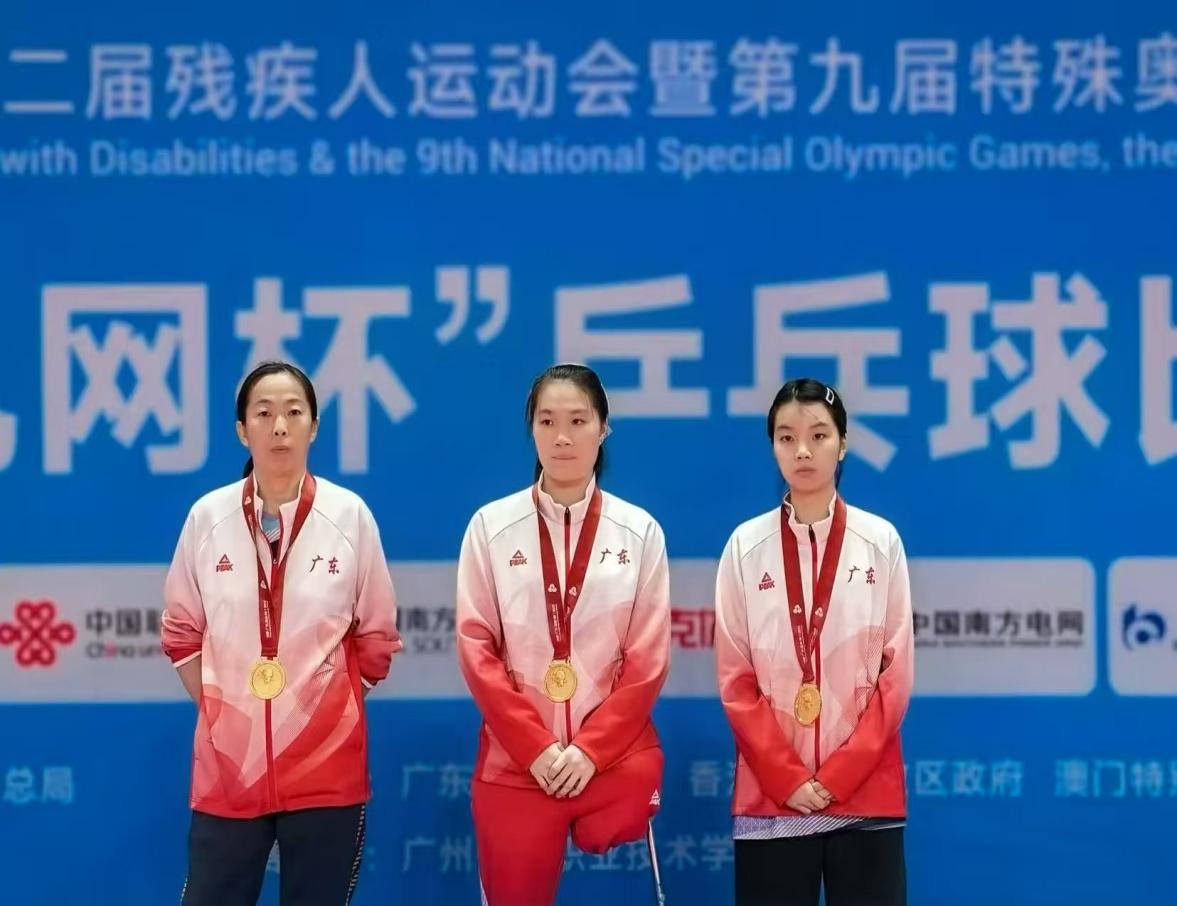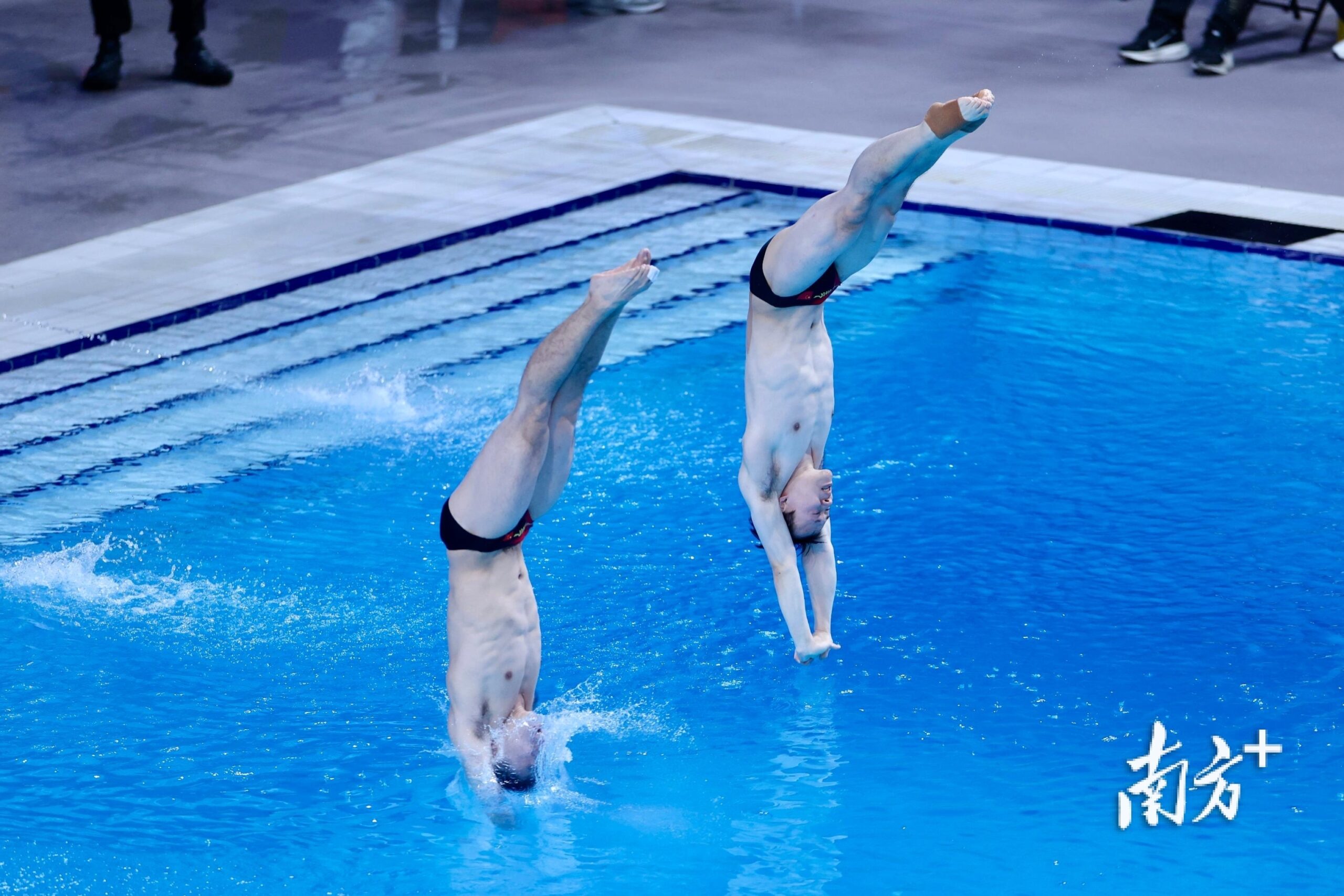
The 12th National Games for Persons with Disabilities and the 9th National Special Olympic Games of the People’s Republic of China concluded in Shenzhen on the evening of the 15th. This marks the first time that Guangdong, Hong Kong and Macao have jointly hosted the national Games for Persons with Disabilities and Special Olympic Games, fully reflecting the great attention paid by the Party Central Committee with Comrade Xi Jinping at its core to the cause of persons with disabilities and its profound care for persons with disabilities themselves.
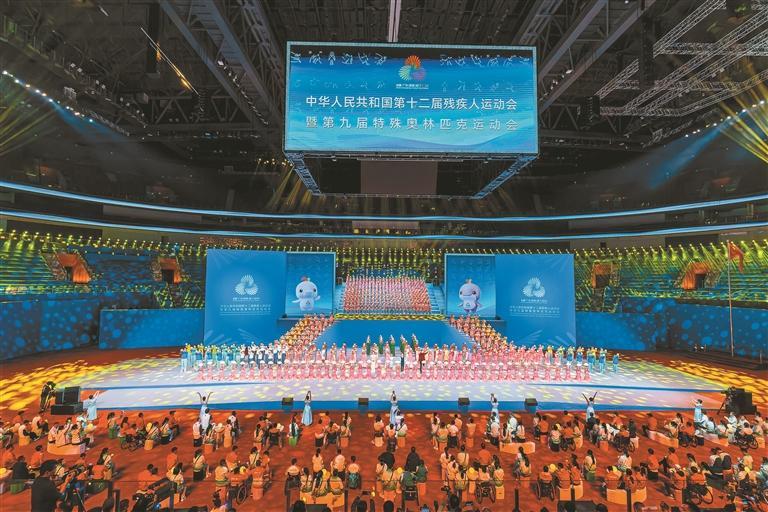
At 8 p.m., the closing ceremony of the Games kicked off at the Shenzhen Sports Center Gymnasium. Huang Kunming, Secretary of the CPC Guangdong Provincial Committee, attended the event. Shen Yiqin, Member of the State Council, announced the conclusion of the 12th National Games for Persons with Disabilities and the 9th National Special Olympic Games of the People’s Republic of China.
During the closing ceremony, Meng Fanli, Deputy Secretary of the CPC Guangdong Provincial Committee, Governor of Guangdong Province and Secretary of the CPC Shenzhen Municipal Committee, Chan Kwok-ki, Chief Secretary for Administration of the Hong Kong Special Administrative Region, Ao Lan, Secretary for Social Affairs and Culture of the Macao Special Administrative Region, and Cheng Kai, Chairman of the China Disabled Persons’ Federation, delivered speeches in succession. Gao Zhidan, Minister of the General Administration of Sport of China, was also present at the ceremony.
The Games featured a total of 46 major events, with 7,824 athletes from 34 delegations across the country participating. Both the scale of the delegations and the number of athletes registered for public events reached an all-time high. As a concentrated display of the new achievements in the development of China’s sports cause for persons with disabilities during the 14th Five-Year Plan period, the Games witnessed the breaking of 15 world records and 156 national records. The competitive performance of the athletes with disabilities, who constantly surpassed themselves and strived for excellence, together with their spirit of self-improvement and optimism, inspired and moved every person present.
At the closing ceremony, Wang Xi, Member of the Standing Committee of the CPC Guangdong Provincial Committee and Director of the United Front Work Department, along with Chan Kwok-ki and Ao Lan, returned the flags of the two Games to Zhou Changkui, President of the China Disabled Persons’ Federation, and Tong Lixin, Vice Minister of the General Administration of Sport of China. Subsequently, Zhou Changkui handed over the flags to Wang Daoxi, Member of the Standing Committee of the CPC Hunan Provincial Committee and representative of the host province of the next Games. The 13th National Games for Persons with Disabilities and the 10th National Special Olympic Games will be held in Hunan in 2029.
Guangdong Delegation Achieves Historic Best with Top Gold and Total Medal Counts Nationwide
On December 15, a press conference on the overall operation of the 12th National Games for Persons with Disabilities and the 9th National Special Olympic Games was held at the Shenzhen Civic Center. Responsible persons from the China Disabled Persons’ Federation and the organizing committees of the Guangdong, Hong Kong and Macao venues gathered at the conference to comprehensively introduce the achievements in organizing the event. It is reported that the Guangdong delegation sent 561 athletes with disabilities to compete in 532 sub – events across 26 major events. In the end, the delegation ranked first in the country in both the total number of gold medals and the total number of medals, achieving a historic best result.
The press conference invited Chang Zheng, Deputy Director of the Games Organizing Committee and Member of the Party Leadership Group of the China Disabled Persons’ Federation; Chen Xuejun, Deputy Director of the Executive Committee of the Guangdong Venue and Chairman of the Guangdong Disabled Persons’ Federation; Yang Deqiang, Director of the Coordination Office of the Hong Kong Venue; and Pan Yongquan, Director of the Preparation Office of the Macao Venue. They jointly presented a comprehensive picture of the organization and participation of this year’s Games to the public.
At the conference, Chang Zheng stated that as the first national comprehensive sports event for persons with disabilities co-hosted by Guangdong, Hong Kong and Macao, this year’s Games have fully demonstrated the advantages of the “One Country, Two Systems” policy and the new look of integrated development of the cause of persons with disabilities in the Guangdong – Hong Kong – Macao Greater Bay Area. The Games achieved remarkable competitive results, with athletes in the Paralympic and Deaflympic events breaking more than 15 world records and setting 156 national records. Among the 34 participating units, 32 won gold medals and 33 won medals in the Paralympic and Deaflympic events.
The host regions of Guangdong, Hong Kong and Macao delivered outstanding performances. Guangdong participated in all events and ranked among the top in the total number of gold medals; Hong Kong set a record in both the scale of its delegation and the number of events participated in; and Macao sent its largest-ever delegation to the Games. This event not only tested the development effectiveness of sports for persons with disabilities in various regions and reserved talents for subsequent international events, but also deepened regional sports exchanges through the joint efforts of Guangdong, Hong Kong and Macao in event organization, service guarantee and cross-border cooperation. It has thus provided valuable experience for the coordinated regional development of the national cause of persons with disabilities.
As one of the hosts, Guangdong took the initiative and efficiently implemented the preparation work, and also achieved the best-ever competition results, which became a highlight of this year’s Games. At the conference, Chen Xuejun detailed the brilliant performance of the Guangdong delegation and demonstrated the depth, height and warmth of sports for persons with disabilities in Guangdong through solid data.
Chen Xuejun said that Guangdong promoted its work around three core goals: “a splendid event, excellent competition results and boosted development of the cause”, among which the competition results far exceeded expectations. The Guangdong delegation fielded 561 athletes with disabilities to compete fiercely in 532 sub – events across 26 major events. By the time of the press conference, the delegation had won 143 gold medals, 109 silver medals and 75 bronze medals, ranking first in the country in both total gold medals and total medals, which is the best historical result of Guangdong since it participated in the Games.
Meanwhile, the delegation made significant breakthroughs in setting records. A total of 315 athletes ranked among the top 8 in their events 705 times; 10 athletes broke 18 national records 21 times; and 1 athlete surpassed 2 world records twice. These achievements fully demonstrated the strong competitiveness of competitive sports for persons with disabilities in Guangdong.
In terms of event performance, Guangdong showed distinct characteristics: “traditional strong events maintaining steady progress, new events achieving surprising breakthroughs, and team events yielding fruitful results in multiple areas”. Cycling, a traditional dominant event, remained strong, winning 60 gold, 29 silver and 19 bronze medals, and becoming the main contributor of gold medals for the delegation. The two basic events of swimming and athletics achieved remarkable results, winning 27 gold, 31 silver and 18 bronze medals, and 27 gold, 13 silver and 9 bronze medals respectively. Both set the best results for Guangdong in these events at the Games and laid a solid foundation for the delegation to take the lead.
Newly added events also made a brilliant debut. Triathlon won 6 gold, 3 silver and 4 bronze medals, topping the gold medal table of the event. Wheelchair fencing, participating for the first time, claimed 6 gold, 6 silver and 6 bronze medals, showing great potential for development.
In team events, three teams from Guangdong – the men’s deaf football team, the men’s blind football team and the women’s wheelchair basketball team – won the championship. The men’s deaf basketball team and the men’s wheelchair basketball team also successfully advanced to the finals and were ready to strive for higher honors, highlighting the strong teamwork spirit of disabled athletes in Guangdong.
Notably, athletes from 21 cities in Guangdong participated in the public Special Olympic events, winning 44 gold, 65 silver and 72 bronze medals in total. This has promoted the balanced development of competitive sports and mass sports, and the smiles of the athletes on the field became the warmest scenes of the Games.
The sound development of the talent echelon is the core strength supporting the sustainable development of sports for persons with disabilities in Guangdong. The delegation presented a sound pattern of “the alternation of the old and new generations with abundant successor talents”. Veteran Paralympic champions such as Lin Furong and Wang Xiaomei maintained a high competitive level. They interpreted the spirit of sports for persons with disabilities with their perseverance and passion, setting an excellent example for young team members.
At the same time, young athletes born after 2000 and 2005 have emerged as a new force on the field. Among the 131 gold medalists, 15% were born after 2005 and 17% after 2000, accounting for more than 30% of the total. Zhong Yingjie, a 15-year-old wheelchair fencer, celebrated his birthday at the Hong Kong venue and successfully won the gold medal in the Men’s Epee Individual Class C event.
Wu Wenxi, 18, claimed two championships in the Women’s Cycling T22 10km Individual Time Trial and 25km Mass Start events. Li Sishuang, also 18, won the gold medals in the Athletics T36 800m and 1500m events and surpassed the world records in both. The emergence of these young athletes has not only injected vitality into the Guangdong delegation, but also reserved high-quality talents for the national sports cause for persons with disabilities.
Chen Xuejun stated that in the future, taking this Games as a new starting point, Guangdong will continue to promote the high-quality development of sports for persons with disabilities and contribute Guangdong’s strength to building a province and a country strong in sports, as well as a Healthy China.
“Tonight, We Are All Dream Chasers”
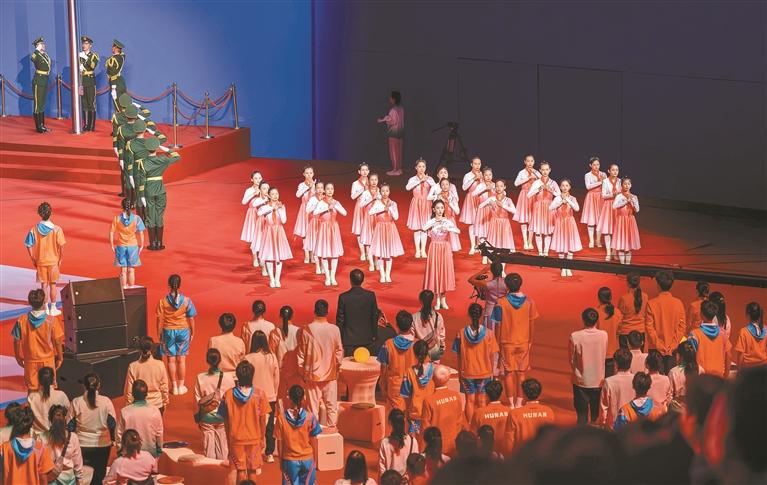
As the lights in the venue dimmed, a beam of light shone beside the national flagpole, where Wang Yimei, a girl with hearing impairment, and her partners stood quietly. The solemn prelude of the national anthem began to play, and all the audience stood up as the familiar melody echoed resoundingly. At the same time, another “song” rose solemnly – dozens of arms were raised in unison, with palms spreading like white doves, drawing firm and smooth arcs in the air.
Every bend and stretch of the fingers, and every turn of the wrists transformed the passionate melody into visible dignity. With calm expressions and clear eyes, they seemed to concentrate all their emotions in their fingertips. The audience stared at the synchronized sign-language movements, as if hearing the resonance between the melody and the gestures. The patriotic feelings surged between the sound of the anthem and the silence of the gestures.
Before the lingering reverberation of the national anthem faded away, another kind of spiritual ascent had already begun. The stage for the situational poetry recital “Dream Chasers” resembled a spiritual mountain peak. The powerful voice of Xia Boyu – the first Chinese person to reach the summit of Mount Everest with a prosthetic limb – rang out. Every word he spoke was as firm and forceful as gravel crushing through wind and snow.
Subsequently, Tai Lihua (with hearing impairment), Jing Xiaodi, and Yu Yang Zhiying (with intellectual disability) wove the context of dreams with their sincere emotions. Ye Yiting and Wei Guoping, both with physical disabilities and champions in the cycling events of this Games, interpreted another form of “speed” through poetry. In addition, Wang Haoran and Chen Rongtian, who have mental disabilities, played piano music with their fingers. The gentle tones of the guzheng blended with the clear sounds of the piano. Although the performance was not flawless, it was filled with genuine warmth.
Just as the Games have shown: true victory lies in surpassing oneself; the height of a dream is never defined by a sound body, but only by an unyielding heart.
After this spiritual ascent came the grand journey of collective progress. Visually impaired singers Jiang Can, Wang Qi, Liu Tao and Li Guangzhou supported each other and performed the song “Marching Towards the Mountains and Seas”, turning the stage into a vast and boundless realm. Though they could not see, their voices depicted the most magnificent scenery; their harmonious chorus was like the rising sun breaking through clouds, warm and bright.
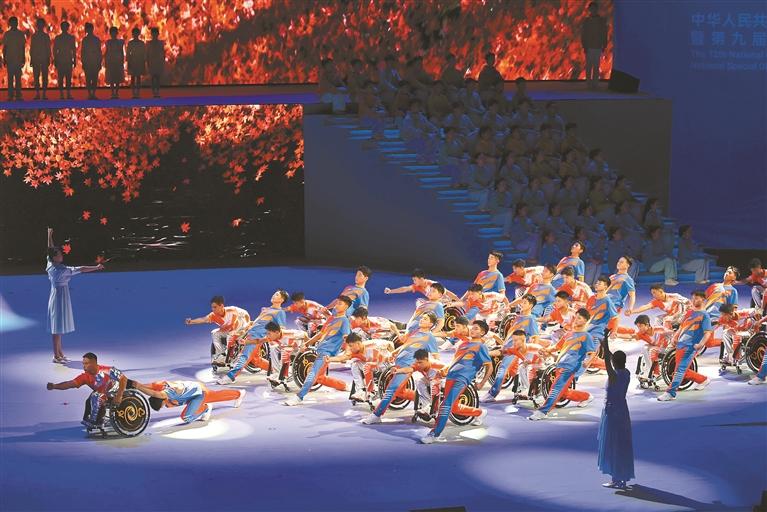
Shortly after, Ruan Cheng (with physical disability) and his partners glided onto the stage in wheelchairs and performed the dance “Moving Forward Hand in Hand”. The metal wheelchairs were no longer just mobility aids, but extensions of their bodies and rotating wings, drawing arcs that combined strength and grace.
The closing theme song “Singing for the Greater Bay Area” was played triumphantly. The voices of four visually impaired singers – Chen Jiani, Zhao Juncheng, Liu Nuoyi and Wang Xuyao – echoed like the surging rivers merging in the Greater Bay Area. The melody embodied the warm friendship of Guangdong, Hong Kong and Macao working together to pursue dreams, and resounded with the powerful voice of the times forged by the sweat of athletes with disabilities.
The dance “Ode to Life”, performed by Luo Wenbo and other dancers, gradually built up to an emotional climax. On the stage, there was no distinction between “leading roles” and “supporting roles” among dancers with and without disabilities. Each dancer became an indispensable note in this ode to life. At that moment, the stage was just like a grand arena of life, where every life strived to win its own “gold medal” in its unique way.
Though the Games have come to an end, the great spirits of perseverance, equality and self-transcendence forged on the field, like the touching performances at the closing ceremony, will surely go beyond the stadium and resound endlessly in a broader field.
100% Green Power Supply for All Venues in Shenzhen During the Games
On December 15, as the 12th National Games for Persons with Disabilities and the 9th National Special Olympic Games concluded at the Shenzhen Sports Center Gymnasium, Shenzhen Power Supply Bureau of China Southern Power Grid successfully completed the power guarantee task with 100% green and highly reliable electricity.
“In the past, diesel generator microgrids were usually used as the main power source for major events to prevent external interference to the power grid. However, for this Games, we continued the power guarantee technical approach adopted in the closing ceremony of the 15th National Games. Breaking the traditional model, we relied mainly on electricity from the public power grid,” introduced Deng Shicong, person in charge of the Power Guarantee Office of Shenzhen Power Supply Bureau.
In addition to the regular power guarantee for sports events, the closing ceremony required additional power supply for performance equipment, and no mistakes were allowed at any power load point. The power guarantee team worked continuously for more than 50 hours to complete tasks that would normally take about a month.
To ensure smooth movement for athletes with disabilities, the team adopted a highly difficult cable connection plan combining existing cables and temporary cables, which required delicate manual operations similar to precision surgical procedures on the cables.
In the end, the team successfully completed the connection of 260 cables, laid a total of 21,000 meters of cables, and installed and commissioned 45 power distribution boxes, automatic transfer switches and uninterruptible power supply devices. This plan achieved an optimal line layout, maximized resource utilization, minimized the impact on the venue, and avoided obstacles to movement caused by temporary cables.
Notably, through the integration of local clean energy and purchased green power, all venues in the Shenzhen venue achieved 100% green power supply throughout the Games. During the nearly six-month event, China Southern Power Grid deployed 5,307 person-times of power guarantee personnel and 1,001 service vehicles, completing power guarantee work for 6 events and the closing ceremony. It illuminated every effort made by the athletes with stable and warm green electricity.