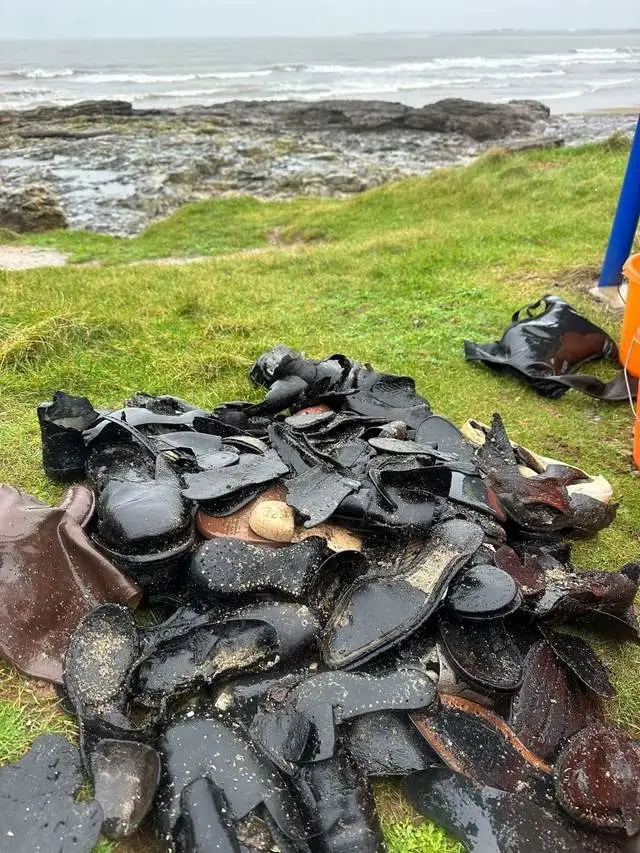
A surprising discovery has recently drawn attention to Ogmore-by-Sea in the Vale of Glamorgan, South Wales, UK. Beach Academy, an organisation dedicated to restoring the local rock pool habitats, stumbled upon over 400 pairs of vintage black shoes during its routine marine litter clearance work. Caked in sand and mud with an antique design, these shoes are believed to originate from the Victorian era around 150 years ago, concealing a long-forgotten tale of a shipwreck behind them.
According to Emma Lambert, founder of Beach Academy, the cleanup team found nearly 300 black shoes in a single discovery while removing marine debris at Ogmore-by-Sea on Thursday, 18 December. Combined with scattered shoes found in the following days, the total number has exceeded 400. Neatly piled in the grassy areas of the beach, against a backdrop of crystal blue seawater and rugged rocks, the shoes still bear distinct vintage design features despite a century of erosion by seawater.
The most credible theory about the origin of these shoes points to the wreck of a steamship named the Frolic. Emma Lambert explained that historical records show the Frolic departed from Haverfordwest in Wales bound for Bristol on 17 March 1831, but tragically struck Tusker Rock in the Bristol Channel and sank. The vessel was carrying a cargo of shoes and Italian goods, and the disaster claimed the lives of around 80 people with no survivors, making it a devastating maritime tragedy. What is even more harrowing is that it is said human remains of the victims continued to be washed ashore by the waves for months after the shipwreck, leaving a sombre memory in the local community.
Tusker Rock lies less than two miles southeast of Ogmore-by-Sea. This rocky outcrop, with a diameter of less than 500 metres, has earned the nickname the “Ships’ Graveyard” for its history of numerous ship groundings. The rock’s name also traces back to the Viking age; some believe it derives from Tyska, a Viking who colonised the Vale of Glamorgan, adding a touch of mystery to this age-old shipwreck story.
Emma Lambert stated that the likely reason these shoes have resurfaced on the beach now is coastal erosion. Shipwreck relics that were once buried in sediment or trapped among rocks have been washed ashore by ocean waves, finally seeing the light of day again.

Beach Academy has long been committed to clearing marine litter and restoring the pristine natural state of local rock pool habitats. To date, the organisation has removed more than 12,000 pieces of litter from the local beaches, yet Emma admits that the current cleanup efforts have “barely scratched the surface”. The discovery of these Victorian-era shoes has also made the team acutely aware that the number of historical relics hidden in the ocean may far exceed expectations, meaning their litter-clearing work is inadvertently salvaging stories lost to time.
The reappearance of these century-old shoes has quickly sparked widespread attention and heated discussion online. Some netizens sighed that it was “like travelling through time and touching traces of the Victorian era”, while others expressed sorrow for the 80 lives lost aboard the Frolic. As more people have turned their attention to this long-buried shipwreck history, relevant authorities have stated they will conduct further cultural relic authentication on the shoes to uncover more details about the Frolic and that era. This accidental discovery, which began with a marine litter cleanup, has not only unravelled the mysteries of a century-old shipwreck bit by bit, but also reminded people to cherish the vicissitudes of history, while attaching greater importance to marine ecological protection and the preservation of historical relics.