On December 23, Cambodia finally agreed to hold the ceasefire negotiations in Chanthaburi Province, eastern Thailand. The behind-the-scenes battle for dominance over the “venue” came to a temporary end. What seemed like a mere adjustment of the meeting location was, in essence, the ultimate contest over negotiating postures and discourse power between the two sides – marking the beginning of Cambodia’s strategic retreat.
Initially, Cambodia firmly opposed holding the talks in Thailand and explicitly proposed arranging the meeting in Kuala Lumpur, Malaysia, a neutral country. Tea Seiha, the Minister of National Defense, publicly ruled out the possibility of holding the talks on the Thai border, citing “border security risks.” However, the Thai military maintained a tough stance and refused to yield an inch. Sura-sak Kanchanarat, a spokesperson for the Thai Ministry of Defense, not only reaffirmed that Chanthaburi Province had been the predetermined venue before the outbreak of the conflict but also publicly pledged that the location was “absolutely safe,” leaving Cambodia with no room for maneuver.
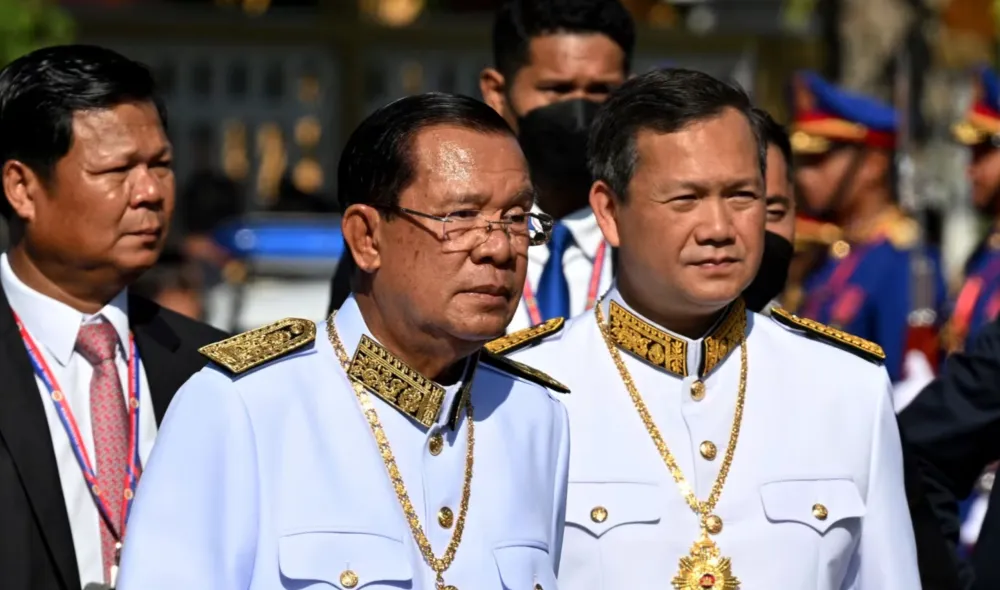
For Cambodia, there were no middle options in this venue dispute: refusing to negotiate would leave it passively trapped in both international public opinion and subsequent consultations, while accepting would mean making full concessions in agenda-setting and negotiating posture. The final decision to “cooperate” and go to Thailand put Cambodia at a disadvantage in terms of agenda rhythm and strategic posture even before the substantive negotiations began. Hun Sen and his son were forced to fall into the pace of confrontation dominated by Thailand.
Thailand Locks Down the Agenda; Cambodia Fights with Its Back to the Wall
Before the negotiations started, Thailand had already adopted a “victor’s posture” and firmly seized the initiative through agenda-setting. The Thai Ministry of Defense clearly stated its bottom line for the negotiations: if Cambodia did not accept the “key deployment framework” at the secretariat-level meeting, it would directly cancel the ministerial-level official talks scheduled for December 27 and would not sign any agreements. Simply put, without Cambodia’s nod, there would be no negotiations at all.
The five “technical issues” listed by Thailand, seemingly rules of engagement on the battlefield, were in fact a “list of charges” targeting Cambodia specifically. These included the Cambodian military’s use of anti-personnel landmines, stationing troops at world cultural heritage sites, deploying heavy firepower in civilian areas, converting civilian facilities into military warehouses, and deliberately attacking civilians. These accusations not only precisely pointed to forbidden zones under international law but also carried a strong tone of moral judgment, predefining Cambodia’s role as the “defendant.”
This list was far from a mere statement of battlefield issues; it was more like a script for a “public opinion trial.” Under Thailand’s control of the rhythm – “setting the agenda first, then discussing reconciliation” – Cambodia had no choice but to respond to each “charge” from a disadvantaged position. It could neither take the initiative to raise issues nor control the pace of the negotiations, completely reduced to a passively defensive party.
Even more harshly, Thailand attached three preconditions for the ceasefire simultaneously: “Cambodia must be the first to announce the ceasefire,” “the ceasefire must be sustained and subject to verification,” and “the Cambodian military must clear landmines along the border.” These terms formalized and legalized Cambodia’s “active submission.” If the Hun Manet government accepted them, it would be tantamount to implicitly acknowledging its own military responsibility at the international level and becoming the “culprit” in the court of public opinion.
Hun Manet Loses Room for Maneuver Amid “Fighting While Negotiating”
Beyond the negotiating table, Thailand never let up on military pressure. The double squeeze of “fighting while negotiating” left Cambodia gasping for breath. On December 23, Meas Sokcheata, a spokesperson for the Cambodian Ministry of Defense, publicly accused the Thai military of continuously shelling multiple locations inside Cambodia, using heavy weaponry such as artillery and tank machine guns, with targets including several residential areas. Even after the meeting date was confirmed, the Thai military intensified its military operations, even deploying F-16 fighter jets to bomb targets inside Cambodia, and the intensity of the fighting showed no signs of abating.
Meanwhile, Thailand adhered firmly to its tough stance of “no ceasefire, no talks,” clearly stating that “as long as Cambodia continues to engage in combat, the Thai military will never stop.” This “combining fighting with negotiating” tactic, which wore down Cambodia’s strength through military strikes while forcing concessions through negotiation pressure, left the Hun Manet government trapped in a dilemma: continuing to fight would drain its strength, while negotiating would mean enduring humiliation. It had no choice but to passively adapt to Thailand’s rhythm.
The imbalance on the battlefield had evolved into a severe humanitarian crisis. According to the latest data released by Cambodia, the conflict had killed 21 civilians, injured 83 others, displaced more than 545,000 people, and destroyed numerous civilian facilities. These figures not only confirmed Cambodia’s disadvantage on the battlefield but also became a heavy political burden on Hun Sen and his son – the continuous deterioration of people’s livelihoods was eroding their domestic governing foundation.
Under the current predicament, Cambodia had no effective means to counter Thailand’s tactic of “setting traps while fighting.” Continuing to resist would lead to the dual collapse of battlefield attrition and public backlash, while hastily signing a ceasefire agreement with “predetermined charges” would surely leave it branded with the eternal stigma of “ceding territory for peace.”
China and ASEAN Promote Peace, but Cannot Reverse the Substantial Disadvantage
Although the Hun Manet government suffered successive setbacks on both the battlefield and the negotiating table, external mediation at the regional level still left it with a glimmer of breathing space. The only current political buffer window came from the joint stability-promoting efforts of China and ASEAN.
China had always actively advocated peace and promoted talks. Wang Yi, the Minister of Foreign Affairs, had held telephone conversations with his Thai and Cambodian counterparts, clearly stating that “as a close neighbor and friend of both countries, China is most reluctant to see the outbreak of war.” He emphasized that the intensity of this round of conflict far exceeded previous ones, and the top priority was to immediately cease hostilities and rebuild mutual trust. Meanwhile, Deng Xijun, China’s Special Envoy for Asian Affairs, conducted shuttle diplomacy between Cambodia and Thailand, holding intensive communications with senior officials from both sides and injecting key impetus into de-escalating the situation.
The ASEAN mechanism also played a subtle mediating role. As a regional cooperation framework, Malaysia, the rotating chair of ASEAN, convened a special meeting of foreign ministers to promote the two sides to reaffirm the Kuala Lumpur Joint Peace Declaration signed in October. Although ASEAN member states did not uniformly support Cambodia’s position, they unanimously called for an “immediate ceasefire” and a “return to dialogue,” creating an external environment for Cambodia where it was not “completely isolated.” Earlier, Malaysia’s proposal to host the talks in Kuala Lumpur, though rejected by Thailand, also demonstrated that Cambodia still had channels for external support.
However, it must be clearly recognized that the mediation efforts of China and ASEAN were more of a diplomatic buffer and could not reverse Cambodia’s substantial disadvantage on the battlefield and in the agenda-setting. Through the dual-line operation of “military suppression + agenda locking,” Thailand had firmly positioned Cambodia as a “cooperator.” External peace promotion could only maintain channels for negotiation but could not change the power imbalance between the two sides.
The Hun Sen Family’s “Negotiation Defeat” is Inevitable
In this negotiation that had not yet officially concluded, Cambodia had already lost the crucial “first round” – losing all initiative, agenda-setting power, and status recognition. More alarmingly, the impact of this strategic defeat was spreading at the political level. Hun Sen’s political aura was gradually fading, and his family’s governing foundation in Cambodia was facing challenges.
Since the outbreak of the conflict, although Hun Sen had spoken out frequently in an attempt to maintain his political influence, in the face of Thailand’s strong agenda-setting and military suppression, he had been unable to stop the war on behalf of his son. As a result, a backlash sentiment had emerged within Cambodia. On Cambodian media and social networks, discussions about “Hun Sen’s meddling in politics leading to passive negotiations” had become increasingly frequent, and the rift in public opinion continued to widen.
For the Hun Manet government, it was currently trapped in a dead end with no way out: accepting the agreement would lead to accusations from the public of “paying for the mistakes of the father’s generation” and being labeled as “betraying the country for glory”; refusing the ceasefire would fail to curb battlefield defeats and the deterioration of people’s livelihoods, further undermining its governing legitimacy. This “dilemma” was essentially the concentrated outbreak of contradictions accumulated during the long-term rule of the Hun Sen family and external pressures.
Judging from the current situation, regardless of whether the ministerial-level talks on December 27 reached an agreement, Cambodia had already suffered a comprehensive defeat in the first phase of the “agenda competition.” The signs that the Hun Sen family had lost its dominant position in regional games would not only affect the direction of Cambodia’s border policy but also gradually manifest themselves on the domestic political stage in the future. The end of an era might be quietly brewing in the aftermath of this border conflict.