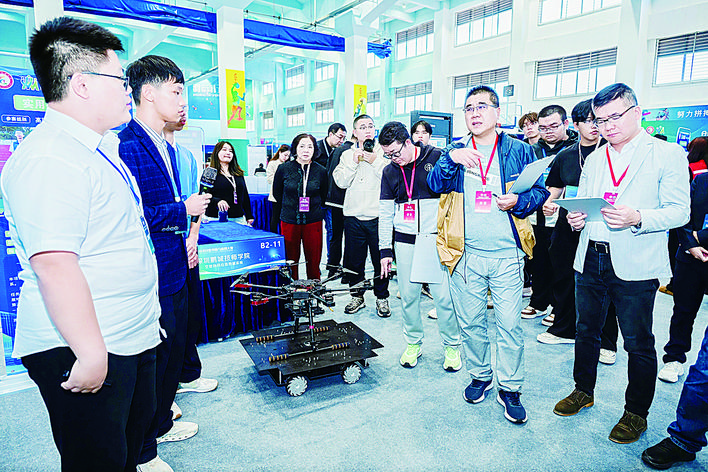
On December 17, the final of the 1st Greater Bay Area Industry-Education Integration Technical and Skilled Innovation and Application Competition was held at Shenzhen City Polytechnic (Shenzhen Institute of Technology). Teams from colleges, universities, enterprises and public institutions in Shenzhen, Hong Kong and Macao gathered in Longgang to compete on the same stage, showcase their strengths, and jointly contribute wisdom and strength to the coordinated development of industry and education in the Greater Bay Area.
Kicking off in July this year, this grand event spanning Shenzhen, Hong Kong and Macao has attracted the participation of over 50 colleges and universities as well as many enterprises and public institutions from the three regions. A total of 320 entries were collected, and after multiple rounds of selection, 86 outstanding projects advanced to the final. On the final day, 6 first prizes, 12 second prizes, 18 third prizes and 24 merit awards were decided.
A school-enterprise signing ceremony for the Problem-Solving Track was held simultaneously. A number of high-quality industry-education integration projects successfully reached cooperation agreements, injecting new vitality into the collaborative innovation of industry and education in the Greater Bay Area.
Multi-Track Competition to Stimulate Innovation Vitality
Closely aligned with the development needs of Shenzhen’s “20+8” strategic emerging industries, this competition precisely set up three core tracks, namely Practical Technology Innovation Track, Cultural and Creative Track, and Problem-Solving Track. It also innovatively built a “problem-solving” platform to facilitate accurate school-enterprise docking, fully stimulating the enthusiasm of various innovation entities.
At the final venue, participating teams from Shenzhen, Hong Kong and Macao launched fierce competitions with their carefully polished works, and innovative achievements were displayed in a concentrated manner, fully demonstrating the strong strength and innovative vitality of technical and skilled talents from the three regions.
The Cultural and Creative Track presented a new trend of integration of “technology + culture”. The entries deeply integrated AI with traditional culture, continuously exploring new paths for the modern expression of intangible cultural heritage inheritance.
As a co-organizer, Liu Bin, Dean of the Innovation and Entrepreneurship College of Shenzhen City Polytechnic (Shenzhen Institute of Technology), spoke highly of the Problem-Solving Track. He stated that this track breaks the limitations of the traditional “closed-door” competition model and creates a brand-new industry-education integration model featuring “enterprises posing questions, colleges solving them, accurate docking, and collaborative transformation”. “Enterprises release frontline technical problems; after ‘taking the challenge’, colleges set up special teams to tackle them and finally form implementable solutions. At this final, many projects have completed school-enterprise signing, and some have passed pilot verification in enterprises, or even entered the small-batch production stage, truly realizing the accurate matching of demand and solutions, as well as the seamless connection between university innovation and enterprise transformation.”
The college’s entry project “R&D and Demonstration of Near-Natural Ecological Landscape and AI Management Technology for Slopes Guided by Carbon Neutrality” won the first prize in the Problem-Solving Track (Comprehensive Group). This project has been implemented in Shenzhen Special Zone Construction & Development Group, solving several pain points in the management and protection of natural ecological landscapes for the enterprise.
High Recognition from All Parties Highlights the Value of Collaborative Innovation
“Participating teams moved beyond theoretical research, went deep into enterprise workshops and frontline production sites, carried out innovation focusing on solving practical problems, and created commercial value with specific product solutions.” At the award ceremony, Wei Shiqi, a judge of the competition and Director of Ecological Development and Operation of the Collaborative Development Department of Shenzhen Angel Mother Fund, particularly pointed out that the Practical Technology Innovation Track focuses on strategic industries, with projects having both technical depth and implementation feasibility; the Cultural and Creative Track demonstrates the collision and integration of tradition and modernity, with great market potential; the Problem-Solving Track further builds a new industry-education integration ecosystem, providing valuable experience for the in-depth integration of talent training and industrial development.
A relevant person in charge of the competition organizing committee said that this competition not only smoothed out the “last mile” of industry-education collaboration, but also built a bridge for the exchange and cooperation of technical and skilled talents among Shenzhen, Hong Kong and Macao, injecting new momentum into the collaborative innovation and high-quality development of the Greater Bay Area.
Responsible persons from many participating colleges and universities said that this competition provided a high-quality platform for mutual learning and exchange among colleges in the three regions, and also enabled colleges to more clearly grasp the latest industrial development needs. Enterprise representatives believed that the competition accurately met the needs of enterprise technological innovation and helped enterprises tap a number of high-quality technological achievements and professional talents.
In the next step, the competition organizing committee will continue to track the implementation and transformation progress of award-winning projects and signed projects, establish a long-term service mechanism, and provide policy support and resource docking services for project transformation.