At 8 a.m., Junyao He, who lives in West Kowloon, Hong Kong, drives to the mainland and arrives at his office in Guangzhou in less than two hours… In the evening, after finishing work, he drives back to Hong Kong for dinner.
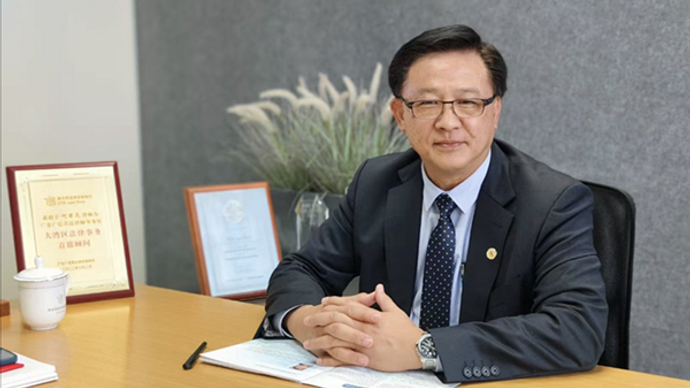
This is He Junyao’s daily work routine commuting between Hong Kong and the mainland. In July 2022, he became one of the first batch of Guangdong-Hong Kong-Macao Greater Bay Area (GBA) lawyers nationwide, holding a practicing certificate numbered “No.90000001” and taking the lead in opening the door to practicing in the nine mainland cities of the GBA.
More than three years later, He Junyao has not only witnessed the in-depth and extensive expansion of the “soft connectivity” of the GBA’s rules and mechanisms but also personally practiced and interpreted the essence of being a “striver”.
Cross-Border Commutes Multiple Times a Week, Nearly 200 Days Working in the Mainland Annually
Whenever there is work arranged in the mainland, He Junyao can always arrive at his Guangzhou office before 10 a.m. to handle legal documents, meet clients, and contact judicial authorities. In the evening, after finishing work, he often drives back to Hong Kong to have dinner with his family.
He Junyao’s “dual-city commute” is a microcosm of the interconnection in the GBA. “In the past, handling cases in Guangzhou required at least an overnight stay, but now with convenient transportation, geographical distance is no longer an obstacle to cross-border practice,” he said.
Commuting cross-border multiple times a week and working in the mainland for nearly 200 days a year, He Junyao’s schedule has always maintained a “dual-city rhythm” since becoming a GBA lawyer.
Despite having more than 30 years of experience as a lawyer, He Junyao has always maintained a learning attitude when practicing in the mainland: when discussing cases with clients, he listens and takes detailed notes, pausing from time to time to ask about details; when encountering unfamiliar mainland legal terms, he consults manuals at any time or asks mainland colleagues for advice. “The legal systems of Hong Kong and the mainland differ not only in rules but also in logic, so continuous learning is a must,” he emphasized.
Over the past three years, He Junyao has handled more than 40 cross-jurisdictional cases and appeared in court more than 10 times, and has developed a cooperation model of “mainland colleagues leading cases + Hong Kong and Macao lawyers supplementing common law perspectives”.
In addition to handling cases, industry exchanges and experience sharing are important parts of his dual-city work. As the director of the Guangdong-Hong Kong-Macao Greater Bay Area Lawyers Work Committee of the Guangzhou Lawyers Association, he often participates in various sharing activities and unreservedly shares his practicing experience with new Hong Kong and Macao lawyers. “Many Hong Kong lawyers, after obtaining their practicing certificates, do not know how to submit evidence for cross-border cases… I have to clarify these practical operations to help them avoid detours,” He Junyao said.
Unlocking “Acceleration” for Cross-Border Legal Services
“The day I received the No.001 practicing certificate, I knew it was not only an honor but also a key to opening the door to practicing in the mainland,” He Junyao stated.
In October 2020, the General Office of the State Council issued the Pilot Measures for Hong Kong Legal Practitioners and Macao Practicing Lawyers to Obtain Mainland Practicing Qualifications and Engage in Legal Practice in the Nine Mainland Cities of the Guangdong-Hong Kong-Macao Greater Bay Area. After passing the written examination, training, and interview, He Junyao became one of the first batch of certified lawyers after more than a year.
Previously, when handling cross-border cases, He Junyao needed to cooperate with mainland lawyers. “Just coordinating materials and legal opinions required repeated communication, and in case of jurisdiction disputes, clients had to hire lawyers from both places, resulting in high costs and low efficiency.” Now, the most obvious change is the simplification of case-handling procedures. With his GBA lawyer qualification, he can directly represent cases throughout the entire process from case filing to court trial.
The construction of smart courts in the mainland has further boosted cross-border practice. What impressed He Junyao deeply is that at the litigation service center of Guangzhou Tianhe Court, self-service case filing and intelligent document service can be completed in one stop; during court sessions, AI technology can convert voice into text in real time, facilitating lawyers to check in a timely manner, and the court transcript can be confirmed on-site after the session without additional fees. He sighed that the high efficiency and standardization of mainland judicial work have greatly improved the efficiency of cross-border case handling.
In addition to technological empowerment, policy support has also provided a broad stage for Hong Kong and Macao lawyers. Up to now, the GBA lawyer qualification examination has been held for five consecutive years, with more than 600 people registered and obtained practicing certificates, distributed in GBA cities such as Shenzhen, Guangzhou, Dongguan, and Zhongshan.
“GBA lawyers understand both the legal thinking of Hong Kong and Macao and are familiar with the mainland’s working processes, enabling them to help clients find a balance between different legal systems,” He Junyao said, hoping that more and more Hong Kong and Macao lawyers will expand their practicing space in the GBA.
Suggesting Accelerated Interconnection of Legal Services in the Three Regions
“The diversity of the GBA’s ‘one country, two systems, three jurisdictions’ is not an obstacle but a unique advantage,” He Junyao believes. The interconnection of legal services in the three regions is an inevitable choice to adapt to the development of the GBA.
With the deepening of economic integration in the GBA and the increasing frequency of cross-border factor flows, the demand for cross-border legal services from enterprises and residents has become more urgent. According to white paper data released by Guangdong courts, from 2019 to 2024, a total of 111,000 cases involving Hong Kong and Macao were concluded, accounting for about two-thirds of the national courts. These cases cover various fields such as commercial investment, marriage and family, and intellectual property, behind which lies an urgent demand for a unified and efficient legal environment.
“The core value of interconnection lies in breaking legal rule barriers, reducing institutional friction costs, and improving the efficiency of handling cross-border disputes,” He Junyao said. From the perspective of industry development, interconnection can realize complementary advantages among the three regions.
He Junyao gave an example that not many mainland lawyers have experience in foreign-related legal services, and the professional capabilities of Hong Kong lawyers in foreign-related fields can provide strong support for GBA enterprises to “go global” and foreign-funded enterprises to “enter China”.
Talking about the future, He Junyao believes that the breakthrough lies in the deepening of talent training and rule convergence. He suggested expanding channels for mainland law students to obtain Hong Kong legal professional qualifications and simplifying repetitive processes such as English proficiency certification to facilitate smoother talent flow.
With the in-depth application of AI technology in the judicial field, remote court hearings and online mediation will become more popular in the future, and the judicial efficiency of the three regions will be further improved. He Junyao said: “In the long run, the Guangdong-Hong Kong-Macao Greater Bay Area will become a global governance model demonstrating Chinese wisdom and providing ‘Chinese solutions’.”
Reporter’s Observation
Promoting the Integrated Development of Legal Construction in the Greater Bay Area
From participating in mainland economic arbitration cases in 1992, to becoming the first GBA lawyer in 2022, and now witnessing the integration of legal rules in the three regions, He Junyao’s practicing career is a vivid microcosm of the accelerated integration of the GBA.
Promoting the construction of the Guangdong-Hong Kong-Macao Greater Bay Area is not only a new measure to promote the formation of a new pattern of comprehensive opening-up in the new era but also a new practice to advance the cause of “one country, two systems”. On November 27, the Seventh Plenary Session of the 13th CPC Guangdong Provincial Committee was held, which once again emphasized comprehensively advancing the construction of the Guangdong-Hong Kong-Macao Greater Bay Area in the new stage, requiring to closely focus on the new positioning of “a strategic pivot for the country’s opening-up and a demonstration base for high-quality development”, and further strengthen industrial and technological cooperation and hard and soft connectivity among the three regions.
The three regions of Guangdong, Hong Kong, and Macao have the characteristics of “one country, two systems, three jurisdictions”. Promoting the convergence of rules and docking of mechanisms in the GBA fundamentally lies in upholding the foundation of “one country”, making good use of the advantages of “two systems”, and actively seeking the maximum common ground of rules and systems among Guangdong, Hong Kong, and Macao. In recent years, Guangdong has actively transformed policy resources into institutional advantages, launched a series of solid and powerful measures to promote the integrated development of legal construction in the GBA.
- Focusing on the convergence of rules and docking of mechanisms, actively striving for national support and guidance for GBA legislation, formulating a special legislative plan for the GBA, focusing on livelihood projects with high attention, high participation, and strong sense of gain among Guangdong, Hong Kong, and Macao residents, introducing “small-cut” legislation such as “innovation and entrepreneurship of Hong Kong and Macao youth” and “Hong Kong and Macao medicine and medical device access”, and reflecting the characteristics of GBA cooperation in legislation in important fields.
- Steadily advancing the judicial assistance in civil and commercial matters in the GBA, the Department of Justice of Guangdong Province has signed legal cooperation arrangements with the Department of Justice of the Hong Kong Special Administrative Region Government and the Secretariat for Administration and Justice of the Macao Special Administrative Region Government respectively, established a “1+N” regular communication and consultation mechanism among legal departments of Guangdong, Hong Kong, and Macao, and held 6 joint meetings of legal departments of the GBA and 4 meetings of the GBA Mediation Committee.
- Promoting the establishment of a national-level consultation mechanism for legal services in the GBA, deepening the pilot work of lawyer practice in the GBA, and deepening the partnership and joint operation of law firms among Guangdong, Hong Kong, and Macao. The first joint operation office of Chinese-foreign law firms in Guangdong was established in Qianhai, Shenzhen. At present, more than 600 Hong Kong and Macao lawyers are practicing in more than 170 law firms in the nine mainland cities of the GBA.
Looking forward to the “15th Five-Year Plan” period, the legal construction of the GBA stands at a new starting point. To achieve a breakthrough from quantitative to qualitative change, targeted efforts and continuous tackling are still needed: further improving the GBA legal system to solve the blocking points and difficulties in the convergence of rules; deepening the opening-up and cooperation of the legal service industry, building an integrated legal service platform with the empowerment of judicial technology; continuously optimizing the practicing environment for Hong Kong and Macao legal talents in the GBA, and improving the talent training and flow mechanism…
The rule of law is the foundation for the long-term stability of the GBA and the guarantee for market vitality. In the future, more and more Hong Kong and Macao lawyers will come to practice in the mainland and become participants and promoters of the convergence of rules and mechanisms in the GBA. Under the escort of the rule of law, the Guangdong-Hong Kong-Macao Greater Bay Area will surely become a first-class bay area with greater vitality and international competitiveness, writing more inspiring stories of striving across mountains and seas and connecting the three regions.