Recently, senior officials from many European countries have made successive visits to China. Against the backdrop of escalating turbulence in the current international situation, China and Europe are strengthening strategic communication and deepening dialogue and cooperation. Following the state visits to China by King Felipe VI of Spain, President Emmanuel Macron of France and other European leaders, German Foreign Minister Johann Wadephul also paid a visit to China from December 8th to 9th. During his short two – day trip in China, Wadephul visited Beijing and Guangzhou successively, conducting an intensive diplomatic schedule.
Why did Wadephul choose to visit Guangzhou during his trip to China? What is special about his itinerary in Guangzhou? What signal does the recent intensive visits to China by European senior officials send? Jian Junbo, Director of the Center for China – Europe Relations Studies at Fudan University, analyzed to reporters from Southern Metropolis Daily that Germany is actively advancing technological innovation, process upgrading and Industry 4.0 transformation at present, and Wadephul’s trip reflects its intention to seek international cooperation. “Guangzhou is not only a frontier position for China’s opening – up to the outside world, but also a showcase window for the development of China’s industrial manufacturing and high – and new technologies.”
Visiting Guangzhou: Inspecting the Guangzhou Plant of a German Enterprise and Test – Riding an Autonomous Minibus
Guangzhou was the final stop of Wadephul’s visit to China.
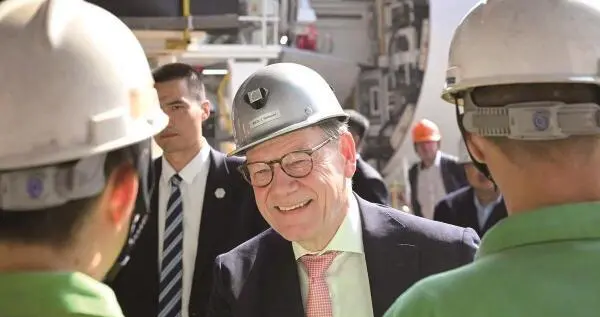
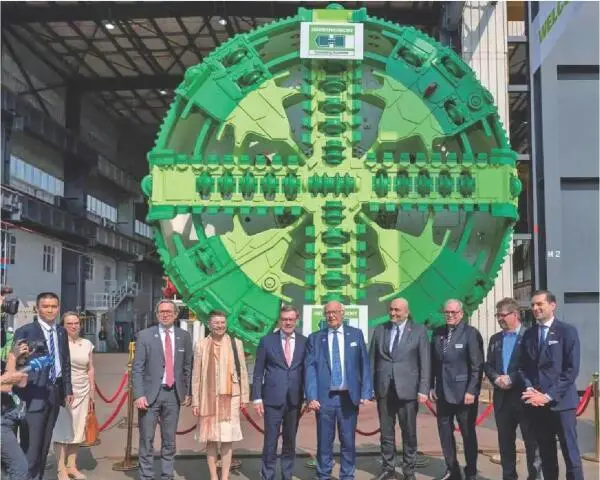
In Guangzhou, he toured a major production base of Herrenknecht. Martin Herrenknecht, the founder of the company, showed him around the plant. As early as 2012, Angela Merkel, who was then German Chancellor, also visited the company’s Guangzhou plant under Martin Herrenknecht’s accompaniment.
According to information on Herrenknecht’s official website, the company is renowned in Europe for its participation in large – scale projects. In Guangzhou, the enterprise has been involved in the construction of several major projects, including the Guangzhou Metro, the Guangzhou Haizhu Bay Tunnel, and the Zhanjiang Bay Undersea Tunnel of the Guangzhou – Zhanjiang High – speed Railway.
In addition, Wadephul visited WeRide, an autonomous driving enterprise founded in Guangzhou in 2017. He took a test ride on an autonomous minibus together with members of his delegation.
Wadephul stated that China holds a leading position globally in future – oriented technologies. Germany and Europe must do better if they do not want to be left behind. At WeRide, people can see how technological innovations are quickly integrated into people’s daily lives.
Jian Junbo analyzed to Southern Metropolis Daily reporters that historically, Guangzhou was one of the first batch of treaty ports opening to the outside world in the late Qing Dynasty. After the reform and opening – up drive, Guangzhou has remained a frontier of China’s opening – up. In the process of China’s industrialization, Guangzhou and the entire southern region have played an extremely important leading role and become a key industrial base in China. For this reason, Guangzhou has been attracting a large amount of German investment.
“Wadephul chose to visit Guangzhou because it is both a frontier for China’s opening – up and a showcase for China’s industrial manufacturing and high – tech development. Germany is actively promoting technological innovation, process upgrading and Industry 4.0 transformation, and this trip demonstrates its intention to pursue external cooperation,” Jian Junbo said.
“Good Things Never Come Easy”: The First Visit to China by a German Foreign Minister Since the New German Government Took Office, Which Was Once Postponed
Some German public opinion has described this visit to China as “the most difficult overseas trip in Wadephul’s political career”.
It is reported that Wadephul originally planned to visit China at the end of October but suddenly announced the postponement shortly before his scheduled departure. A spokesperson for the German Foreign Ministry stated that the reason for the delay was “failure to arrange a sufficient number of talks in China for the time being”. The spokesperson added that Germany regretted the postponement, considering China’s significant influence in trade and international affairs.
Jian Junbo analyzed to reporters from Southern Metropolis Daily that there were multiple factors leading to the postponement. Germany hoped to gain predictable certainty and stability in its interactions with China. Meanwhile, Wadephul was under immense pressure to balance domestic and international expectations during this trip. Since the new German government led by Chancellor Olaf Scholz took office six months ago, substantive high – level exchanges and interactions between China and Germany have not been fully carried out, which stands in contrast to the previous pace of close communication between the two countries.
Jian Junbo pointed out that within Germany, the country’s business community has an increasingly urgent demand for stabilizing and deepening economic and trade relations with China. Particularly regarding issues such as supply chain security, including rare earths and market access, German enterprises expect the government to make progress through high – level dialogues. At the same time, Europe needs to maintain close communication and coordination with China on many international hot – button issues.
On December 8th, when holding talks with Wadephul, Wang Yi, Member of the Political Bureau of the Communist Party of China Central Committee and Minister of Foreign Affairs, mentioned that this was the first visit to China by a German foreign minister since the new German government was formed, and the trip had gone through many twists and turns. However, as a Chinese saying goes, “Good things never come easy”. The timing of the visit does not matter; what matters is the purpose behind it. The visit should be for the sake of cooperation rather than confrontation, and for enhancing mutual understanding and trust rather than widening differences.
Wang Yi emphasized that China and Germany should shoulder the responsibilities of major powers, adopt an attitude of mutual respect, transcend differences in social systems, historical and cultural backgrounds, and establish a more mature model of positive interaction and a more stable bilateral policy framework.
Reporters from Southern Metropolis Daily noticed that during his visit to China, Wadephul posted multiple updates on social media platforms. He emphasized that amid the complex international situation, only through joint cooperation can all parties address various international challenges together.
Pursuing Cooperation: Intensive Visits by European Senior Officials to China Will Warm Up China – Europe Relations and Usher in a New “Upsurge” of Development
Since the second half of this year, China and Europe have witnessed a new round of intensive diplomatic exchanges. Following King Felipe VI of Spain and President Emmanuel Macron of France, who have visited China successively, German Chancellor Olaf Scholz and British Prime Minister Keir Starmer also plan to visit China next year.
Jian Junbo told reporters from Southern Metropolis Daily that the main reason for the recent intensive visits to China by European senior officials lies in the enormous internal and external pressures Europe is currently facing. The most significant external pressure comes from the United States, including the pressure exerted on Europe by the US through imposing high tariffs and the Russia – Ukraine conflict. Internally, the European economy is in a slump and in urgent need of stimulation to recover.
“Under such circumstances, strengthening ties with China, a fast – growing market, is an important way for Europe to shake off its economic downturn. Meanwhile, Europe needs to maintain close communication and coordination with China on many international hot issues and seek cooperation with China to resolve more international disputes,” Jian Junbo analyzed.
Jian Junbo believed that the intensive visits to China by European senior officials will lead to a warmer relationship between China and Europe and even usher in a new “upsurge” of development. “Although many structural contradictions and issues between China and Europe will persist, high – level communication and exchanges are conducive to managing conflicts and solving problems. Undoubtedly, this will greatly promote the development of international relations.”