Guangzhou Grand Buddha Temple: An Age-old Buddhist Sanctuary Quietly Nestled in a Bustling Metropolis

Amidst the towering buildings of the Beijing Road business district, an ancient temple stands quietly in a corner. The crimson walls and blue-tiled roofs exude the rich fragrance of history.
Tucked away between the skyscrapers and neon lights in Guangzhou’s busiest Beijing Road Commercial Area lies the serene Buddhist sacred site – Guangzhou Grand Buddha Temple. First founded during the Southern Han Dynasty, this millennium-old temple has weathered numerous vicissitudes and still enjoys thriving incense today, serving as a rare pure land in the modern metropolis.
As one of the “Five Major Buddhist Monasteries” in the Guangfu region during the early Qing Dynasty, it is also the only ancient temple among the existing “Twenty-Eight Temples of the Southern Han Dynasty” in Guangzhou with a clear and verifiable historical lineage. It was designated as a Guangzhou Municipal-level Cultural Relic Protection Unit in 1993 and promoted to a Guangdong Provincial-level Cultural Relic Protection Unit in 2008.
01 Historical Evolution: From an Ancient Temple of the Southern Han to a Modern Buddhist Cultural Center
The history of Grand Buddha Temple dates back to the Southern Han Dynasty (917 – 971 AD) during the Five Dynasties and Ten Kingdoms period. At that time, Liu Yan, the ruler of the Southern Han Dynasty, had seven Buddhist temples built in each of the four directions (east, west, south, and north) of Guangzhou to correspond to the Twenty-Eight Lunar Mansions in the sky. Collectively known as the “Twenty-Eight Temples of the Southern Han Dynasty”, the predecessor of Grand Buddha Temple, named “Xinzang Temple”, was one of them.
The temple underwent several name changes during the Yuan and Ming Dynasties. In the Yuan Dynasty, the temple buildings were reconstructed on the original site and renamed “Futian Nunnery”. After expansion in the Ming Dynasty, it was renamed “Longzang Temple”, which established its status as one of the “Five Major Buddhist Monasteries” of Buddhism in Guangzhou.
In the sixth year of the Shunzhi reign in the Qing Dynasty (1649), the Qing army marched south to attack Guangzhou, and the original temple was destroyed in the war. In the second year of the Kangxi reign (1663), Shang Kexi, the Prince of Pingnan, donated his royal salary to rebuild the temple. It was officially named “Grand Buddha Temple” because it enshrined three giant Buddhas, each 6 meters tall and weighing 10 tons.
At its peak, the temple covered a vast area of over 30,000 square meters, stretching from today’s Beijing Road in the east to Longzang Street in the west, connecting Huifu Road in the south and Xihu Road in the north.
Since modern times, Grand Buddha Temple has witnessed many historical events. Lin Zexu once set up the Anti-Opium General Bureau here; Sun Yat-sen personally inscribed and presented the plaque inscribed with “Promote the Three Esoteric Practices”; Zhou Enlai held an advanced political training class here.
02 Architecture and Art: A Model of Lingnan Buddhist Architecture
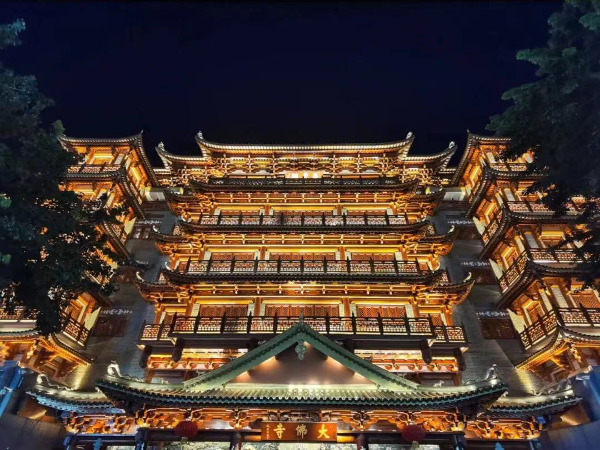
The architectural layout of Grand Buddha Temple is rigorous. Its main buildings are symmetrically arranged along the central axis, perfectly integrating the official architectural style of the imperial capital with the local Lingnan style.
The Mahavira Hall, the core building, was first built in the Qing Dynasty and is the largest Buddhist hall in the Lingnan region. With a width of 36.32 meters spanning seven bays and a depth of 25.36 meters across five bays, the hall adopts a single-eave gable and hip roof design.
The nineteen giant nanmu pillars inside the hall are particularly precious. Gifted by the King of Vietnam, they have been well-preserved for more than 350 years.
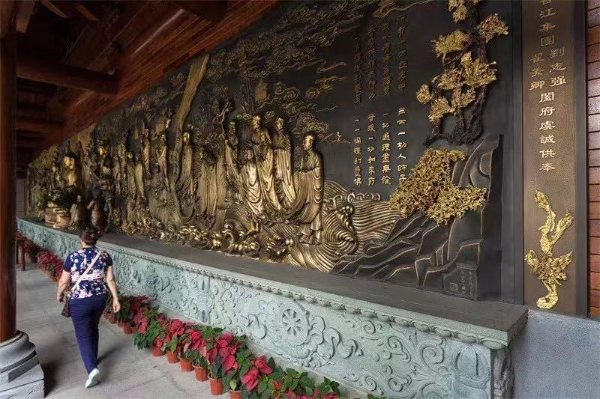
The three exquisitely cast bronze Buddhas enshrined in the center of the hall, each 6 meters tall and weighing 10 tons, are the largest existing ancient bronze statues in Guangdong Province. Among the three Buddhas, Sakyamuni Buddha stands in the middle, Amitabha Buddha on the left, and Medicine Buddha on the right, representing the present, the past, and the future respectively.
The recent reconstruction project of Grand Buddha Temple took more than 20 years to complete. A comprehensive Buddhist cultural building (Pujue Building) was newly constructed, along with other halls such as the Guanyin Hall, Ksitigarbha Hall, Bell and Drum Towers, Heavenly Kings Hall, and the Mountain Gate. The total construction area exceeds 30,000 square meters, which is similar to the scale of the temple at its heyday.
03 Cultural Characteristics: The Integration of Buddhism and Urban Civilization
Grand Buddha Temple not only plays a significant role in the dissemination of Buddhism but also is deeply integrated into the urban culture and citizens’ daily life of Guangzhou.
The temple houses Guangdong’s first modern Buddhist library open to the public, with a collection of more than 200,000 books, serving as an important platform for promoting Buddhist culture.
In addition, the temple has set up a vegetarian restaurant, a meditation center, and Pujue Guqin Club, providing comprehensive Buddhist cultural experiences for believers and tourists.
Notably, Grand Buddha Temple adopts a policy of free admission and does not force visitors to offer incense money, embodying the generosity and tolerance of Buddhism. The temple has also launched public welfare projects such as an anti-cancer fund and a charity merit society, demonstrating Buddhism’s spirit of helping the world and relieving people’s sufferings.
04 Visitor Guide: A Peaceful Journey in the City
If you plan to visit Grand Buddha Temple, the following information may be helpful for your trip:
The temple is open year-round from 8:00 to 19:30 with free admission, making it a peaceful retreat easily accessible at any time in the Beijing Road business district.
The transportation is very convenient. You can take Guangzhou Metro Line 1 to Gongyuanqian Station, Line 6 to Beijing Road Station, or take multiple bus routes to Danan Road Station.
The vegetarian restaurant in the temple offers exquisite vegetarian dishes, among which the vegetarian buffet has more than 200 kinds of dishes, making it an excellent choice to experience Buddhist dietary culture.
If time permits, you can arrange your visit on weekends or Buddhist festivals. During these periods, activities such as Buddhist scriptures lectures and meditation sessions are often held in the temple, allowing you to have a deeper experience of Buddhist culture.
When night falls, the lights of Grand Buddha Temple are lit up, interweaving with the neon lights of Beijing Road to form a picture that blends ancient and modern elements. Local elderly people often linger in the courtyard to enjoy the rare tranquility of the day, while tourists from afar take photos to record the unique scene where the ancient temple and the modern metropolis coexist harmoniously.
The morning bells and evening drums of Grand Buddha Temple still echo in the bustling city, reminding people that amid the fast-paced modern life, they can still find a spiritual home where their souls can rest.
Frequently Asked Questions about Grand Buddha Temple
What is the specific address of The Grand Buddha Monastery? No. 21 Huixin Middle Street, Huifu East Road, Yuexiu District, Guangzhou.
What are the official name and historical names of The Grand Buddha Monastery? Its official name is The Grand Buddha Monastery, and its historical names include Xinzang Temple, Futian Nunnery, and Longzang Temple.
When was The Grand Buddha Monastery first built? During the Southern Han Dynasty (917-971 AD).
What important changes has The Grand Buddha Monastery undergone in history? It was destroyed by fire in 1649 and rebuilt in 1663. It was designated as a Guangzhou Municipal Cultural Relic Protection Unit in 1993, and its Mahavira Hall became a Provincial-level unit in 2008. The second-phase reconstruction was completed in 2023.
Why is it called “The Grand Buddha Monastery”? It houses three large bronze Buddha statues, each 6 meters tall and weighing 10 tons, the largest of their kind in Lingnan.
What is the English name of The Grand Buddha Monastery? The Grand Buddha Monastery or Dafo Temple.
What are the opening hours of The Grand Buddha Monastery? Daily from 8:00 to 19:30 (hours may extend to 21:30; please check for updates).
Does The Grand Buddha Monastery have fixed closing days? It is open every day without fixed closing days.
Is a ticket required to visit The Grand Buddha Monastery? What is the price? Admission is free for all visitors.
Is advance reservation necessary? Generally, no reservation is required for individuals. Groups are advised to contact the monastery in advance.
How long is the recommended visiting time? Approximately 1 to 2 hours.
Will the opening hours be adjusted on special festivals? Hours may be extended for special events like the Spring Festival or Buddha’s Birthday; it is best to verify beforehand.
What are the characteristics of the architectural style of The Grand Buddha Monastery? It combines imperial temple architecture with Lingnan local styles and retains Ming Dynasty features like dougong brackets and nanmu pillars.
What are the architectural features of the Mahavira Hall? It is seven bays wide and five bays deep, with a single-eave gabled and hip roof supported by massive nanmu pillars.
What important cultural relics or works of art are there in the monastery? The three large bronze Buddha statues, century-old nanmu beams and pillars, a plaque inscribed by Sun Yat-sen, and a stone tablet recording the monastery’s construction.
What is the layout structure of The Grand Buddha Monastery? It includes the Mountain Gate, Heavenly Kings Hall, Mahavira Hall, Vairocana Hall, Guanyin Hall, Ksitigarbha Hall, and Bell and Drum Towers. Modern sections house a meditation hall, library, and vegetarian restaurant.
What are the lighting hours and effects of The Grand Buddha Monastery at night? Lights are typically on from 19:00 to 21:30, creating a spectacular display often called the “Guangzhou version of Hongyadong.”
Does The Grand Buddha Monastery provide prayer services? What is the specific process? Yes, prayer services including incense offering and scripture recitation are available, following the monastery’s guidelines.
Can visitors get incense sticks in the monastery? Are there any relevant regulations? Incense sticks are provided free of charge, with restrictions on quantity and length to prevent waste.
What etiquette requirements should visitors abide by when visiting? Dress modestly, keep quiet, use respectful language, and avoid loud noises.
What taboos are there in the monastery? Do not step on thresholds; obtain permission for photography indoors; and avoid touching cultural relics.
Can women enter the monastery during their menstrual period? Yes, they can, though participation in certain rituals might be discouraged.
Are there activities such as making wishes and offering lamps in the monastery? How can one participate? Yes, activities like making wishes and offering lamps are available through donations or by following monastery instructions.
Does the monastery provide guided tour services? Free volunteer-guided tours are available, subject to scheduling.
Are there any audio guides or audio tour devices available? No audio guide devices are provided.
What convenient facilities are there in the monastery? Restrooms, rest areas, and drinking water stations are available.
Is there a vegetarian restaurant in the monastery? Yes, a vegetarian restaurant operates during monastery hours with moderate prices.
Is there a library or cultural exhibition area in the monastery? Yes, there is a Buddhist library and a cultural exhibition area.
Is there a souvenir shop or any cultural and creative products sold? Cultural and creative products like Buddha statue souvenirs are sold.
Are there barrier-free facilities? Basic barrier-free facilities such as ramps are provided.
Is there WiFi coverage in the monastery? No public WiFi is available.
How to get to The Grand Buddha Monastery by public transport? Take Metro Line 1 to Gongyuanqian Station or Line 6 to Beijing Road Station and walk. Multiple bus routes also serve Beijing Road.
What is the nearest metro station? Beijing Road Station, about a 5-10 minute walk away.
Is it convenient to drive to the monastery? Are there parking lots nearby? An underground parking lot is available with hourly fees typically ranging from 5 to 10 yuan.
What is the approximate cost of taking a taxi? Approximately 20 to 50 yuan from the city center, depending on distance.
What recommended delicacies are there nearby? Local snacks on Beijing Road, such as rice rolls, beef offal, and boat congee.
What other scenic spots are there nearby? The Nanyue King Museum, Ruins of the Millennium Ancient Road, and Chen Clan Ancestral Hall.
What are the shopping and leisure venues like in the surrounding area? Grandbuy Department Store and Beijing Road Commercial Street offer shopping and leisure options.
Is there a recommended one-day tour route? Visit the monastery in the morning, have lunch on Beijing Road, and explore the Nanyue King Museum and Millennium Ancient Road in the afternoon.
Does The Grand Buddha Monastery hold special activities? It holds Buddhist ceremonies, lectures, and meditation sessions.
What is the historical status of The Grand Buddha Monastery? It is one of Guangzhou’s five major Buddhist monasteries and a provincial-level cultural relic protection unit.
Are there resident monks in the monastery? Can visitors communicate with them? Yes, resident monks are present, and visitors may communicate with them politely about religious topics.
Does the monastery provide religious books or materials? A library offers religious books and materials for borrowing.
What are the special experiences of visiting the monastery at night? The night lighting creates a serene and magnificent atmosphere, ideal for quiet reflection.
What are the best spots for taking photos? In front of the Mahavira Hall, near the three Buddha statues, and areas with night views.
What safety precautions should visitors pay attention to? Watch your step on stairs, be mindful of crowds, and keep personal belongings secure.
How is The Grand Buddha Monastery different from other Buddhist monasteries in Guangzhou? It is renowned for its large bronze Buddha statues and modern integrated functions, whereas Guangxiao Temple is more ancient and simple, and Hualin Temple emphasizes garden landscapes.
What do the three Buddha statues represent? They represent Sakyamuni (present world), Kasyapa (past world), and Maitreya (future world). Cast in the Qing Dynasty, they are fine examples of craftsmanship.
What special meanings do the bell rings have? Bells ring at fixed morning and evening times for gatherings and prayers, symbolizing peace.
What role has the monastery played in the development of Buddhism in Guangzhou? As one of the five major monasteries, it has promoted Buddhism through reading clubs and its library.
Are there any little-known historical stories or legends? Lin Zexu established an opium prohibition bureau here in 1839; Sun Yat-sen inscribed a plaque in 1921; Zhou Enlai conducted a political training class here in 1926.