Guangzhou Capital City God Temple: A Sacred Shrine Guarding the Millennium-Old Commercial Metropolis and Witnessing the Soul of Lingnan Culture
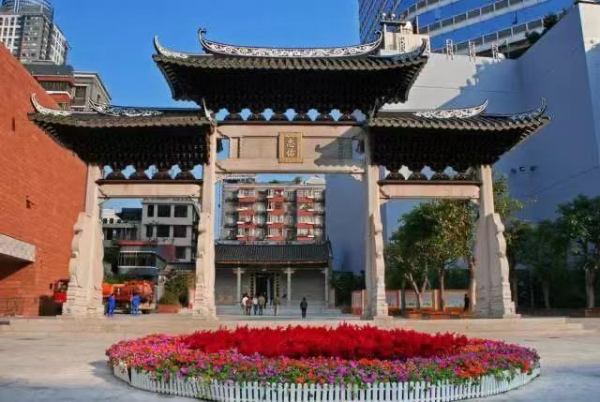
Next to the bustling commercial street of Zhongshan Fourth Road, turn into Zhongyou Street, and you will instantly step from the busy traffic into a peaceful place. Among the red walls and dark tiles stands an ancient temple quietly—this is the Guangzhou Capital City God Temple, the largest and highest-ranked City God Temple in the Lingnan region during the Ming and Qing dynasties.
A saying circulates among Guangzhou locals: “The City God Temple existed before Guangzhou City was built.” This ancient temple, located at No. 48 Zhongyou Street, Zhongshan Fourth Road, is not only a witness to the city of Guangzhou but also an important carrier of folk beliefs and culture in the Lingnan region. As the only remaining Capital City God Temple in Guangzhou, it embodies the essence of the millennium-old Cantonese culture and quietly tells the historical changes of this city.
I. Historical Evolution: The Vicissitudes from Prefectural City God Temple to Capital City God Temple
The history of the Guangzhou Capital City God Temple can be traced back to the third year of the Hongwu reign in the Ming Dynasty (1370), when it was initially the Guangzhou Prefectural City God Temple. During the Ming and Qing dynasties, it had already become the largest and most magnificent City God Temple in the Lingnan region.
During the Yongzheng reign of the Qing Dynasty, the Guangzhou Prefectural City God Temple underwent a major transformation—it was upgraded to the Capital City God Temple governing the entire province, and the temple was also renamed the Guangdong Capital City God Temple accordingly. This promotion made its status equal to that of the Beijing Capital City God Temple, while the Shanghai City God Temple at that time was only a “county-level” one.
In the Republic of China period, the City God Temple faced challenges. In 1920, most of the front hall of the temple was demolished to expand the road, and a 280-meter-long street was paved. Only the main hall and the worship pavilion remained. In the following decades, the City God Temple gradually fell into oblivion and even disappeared from the collective memory of Guangzhou people for a time.
A turning point came in 2009, when the Guangzhou Municipal Government decided to carry out a comprehensive restoration of the City God Temple in accordance with the principle of “restoring the old as it was”. On October 31, 2010, this ancient temple, which had experienced many vicissitudes, reopened to the public, and the number of visitors on the first day exceeded 10,000. In 1993, it was announced as a Guangzhou Municipal Cultural Relics Protection Unit, formally establishing its status as an important historical and cultural heritage of Guangzhou.
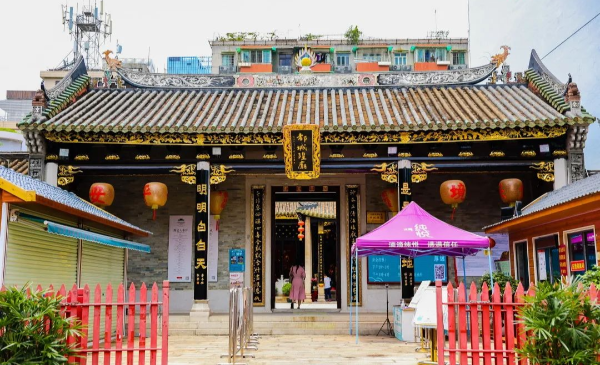
II. Architectural Features: A Treasure of Lingnan Architecture
The restored architectural complex of the City God Temple integrates the traditional Lingnan craftsmanship of “three carvings, two sculptures and one painting” (wood carving, brick carving, stone carving, gray sculpture, pottery sculpture, and mural painting), making it an excellent place to appreciate Lingnan architectural art.
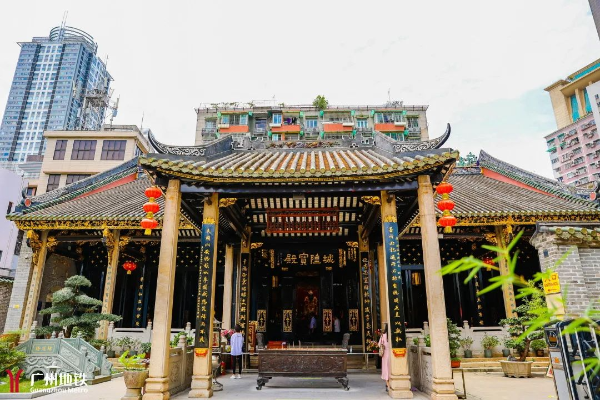
In front of the temple stands the only antique archway in Guangzhou built in the style of the Ming and Qing dynasties. This archway, with three bays, four columns, and a three-story stone-wood structure with Ruyi brackets, has a magnificent momentum. The worship pavilion has a resting roof covered with green glazed tiles, with 8 granite columns inside and outside, and the beam frames are exquisitely carved. The most eye-catching feature is a large abacus hanging from the top of the worship pavilion, which implies that “humans make thousands of calculations, but heaven makes only one; those who plot and scheme will eventually miscalculate”. It symbolizes the fair judgment of good and evil in the world by the gods.
The main hall is the core building of the City God Temple. It is 11 meters high, 24.7 meters wide (covering five bays), 20.2 meters deep (covering five bays), and has a construction area of nearly 500 square meters. Inside the hall, there are 4 redwood palace lanterns of the Eight Immortals, each 2 meters high, and a nearly 6-meter-long wooden worship table. This table is made of a single piece of kapur wood and weighs more than 3 tons.
The gray sculpture “Three Pagodas Locking the Pearl River” on the roof ridge is another highlight. This three-dimensional scene shows the three famous pagodas along the Pearl River—the Lotus Pagoda, the Pazhou Pagoda, and the Chigang Pagoda, as well as the Zhenhai Tower on Yuexiu Mountain, forming a vivid “Along the Pearl River During the Qingming Festival”.
III. Artistic Treasures: The Lacquer Murals That Do Not Fade for a Millennium
The most amazing work of art in the City God Temple is the lacquer mural The Creation of the World · The Scroll of Immortals on the walls on both sides of the main hall, covering an area of more than 240 square meters.
This masterpiece was created by more than 30 painters under the overall artistic guidance of the famous painter Lu Yanguang. It depicts 132 Taoist immortals, including Pangu, Nüwa, the Three Pure Ones, and the Jade Emperor. The creation used 150,000 pieces of gold foil and cost 20 million yuan.
What is even more remarkable is that all the materials used in the painting are pure natural plant materials such as plant lacquer, raw lacquer (namely lacquer), and cashew nut lacquer. It is said that these materials can keep the painting from fading for a millennium, making it a precious artistic heritage handed down from generation to generation.
IV. The Three City Gods: A Unique Belief Culture
The most striking feature of the Guangzhou Capital City God Temple is the three City God statues enshrined in the main hall. This phenomenon of “governance by three City Gods” is extremely rare across the country.
In the middle is Liu Yan, the founder of the Southern Han Dynasty (honored as Emperor Liu). The lacquer statue is 3.2 meters high and is the main god of the Guangzhou City God Temple. Although historical records describe Liu Yan as extravagant and cruel, he made great contributions to the stability and development of the Lingnan region during the war-torn period, so he was revered as the City God.
To the right of Emperor Liu is Hai Rui (1514-1587), the famous “Honest Hai”. He was from Qiongshan, Guangdong (now part of Hainan) and was famous for his integrity and uprightness, as well as his punishment of corrupt officials. When the City God Temple was reopened in 2010, even a leader of Guangzhou prayed in front of Hai Rui’s statue, saying “May there be no corrupt officials in our construction system”, which fully shows the profound influence of his image as an honest official.
To the left of Emperor Liu is Yang Jisheng (1516-1555), a famous remonstrating official in the Ming Dynasty. He was persecuted to death for impeaching the powerful minister Yan Song. After his death, he was revered by the people as the City God of Beijing and is also worshipped in Guangzhou.
V. City God Culture: From “A Water Ghost Promoted to City God” to the City God’s Birthday
There is a famous saying among Guangzhou people: “A water ghost promoted to City God”, which describes an unusual promotion in personal career. This allusion comes from a story of repaying kindness: a water ghost who could have found a substitute to be reincarnated was moved by the Jade Emperor because he could not bear to harm people twice, so he was appointed as the City God.
As the patron god of ancient cities, the City God has a variety of functions. It was like a charity, often providing money, rice, medicine, clothes, and coffins for the poor. It was also like a “folk court”, upholding justice and resolving disputes for people. Moreover, it was like a grand theater, staging stories of loyal ministers, filial sons, chaste women, and martyrs with joys and sorrows. At the same time, it was the last refuge for the poor—homeless people could get a meal and a night’s stay here.
The 24th day of the seventh lunar month every year is the City God’s Birthday, which is said to be the day when the construction of Guangzhou City began. On this occasion, the City God Temple holds a series of celebration activities, including traditional rituals such as “tapping the earth’s qi”, “divine merit operas”, and worshiping with the first incense. The temple also holds Taoist rituals for the City God, public free medical consultations, and distributes longevity noodles, attracting a large number of citizens to participate.
VI. Visiting Guide: Exploring the Modern Charm of the Ancient City God Temple
Practical Information
- Address: No. 48 Zhongyou Street, Zhongshan Fourth Road, Yuexiu District, Guangzhou City
- Opening Hours: 8:00-17:00 daily
- Admission Fee: Free for the public
- Recommended Visiting Time: 1-2 hours
Transportation Guide
- Subway: Take Line 1/Line 2 to Gongyuanqian Station and exit from Exit E, or take Line 1 to Nongjiangsuo Station and exit from Exit D.
- Bus: Take a bus to nearby stops such as Zhongshan Fifth Road, Caiting, or Wende Road.
Tourist Highlights
- Appreciate the archway, worship pavilion, and main hall with Lingnan architectural features.
- Observe the 240-square-meter lacquer mural The Creation of the World · The Scroll of Immortals in the main hall.
- Learn about the historical stories and cultural connotations of the three City Gods.
- Experience the giant abacus hanging in the temple and the educational significance it contains.
- If you visit on the 1st or 15th day of the lunar month or during important divine birthdays, you can watch Taoist rituals.
Nearby Attractions to Visit Together
The City God Temple is located in the cultural core area of Beijing Road, and you can visit it together with the following nearby attractions:
- Nanyue Royal Palace Museum: A heritage museum showcasing the more than 2,000-year history and culture of Guangzhou.
- Beijing Road Millennium Ancient Road: China’s first millennium-old road, which completely preserves the road surfaces from the Tang Dynasty to the Republic of China period.
- Wende Road Cultural Street: A traditional street for selling calligraphy and paintings, as well as four treasures of the study (writing brush, ink stick, ink slab, and paper).
The Guangdong Capital City God Temple is not only a religious site but also a living fossil of Guangzhou’s urban memory. It has witnessed the evolution of Guangzhou from an ancient city to a modern metropolis and carries rich cultural connotations and historical information. Whether you are a religious believer, a culture enthusiast, or an ordinary tourist, this place allows you to feel the profound historical heritage and unique cultural charm of Guangzhou.
Standing in front of the City God Temple, the scene where the ancient and modern meet is impressive: inside the red walls is the historical accumulation of more than 600 years, and outside the red walls is the prosperity and hustle and bustle of a modern metropolis. This unique experience of the integration of time and space is precisely the most attractive charm of the Guangzhou Capital City God Temple.
Frequently Asked Questions about Guangzhou Capital City God Temple
1. Basic Information and Historical Evolution
- What is the specific address of the City God Temple (Ducheng Huangmiao)?No. 48, Zhongyou Street, Zhongshan Fourth Road, Yuexiu District, Guangzhou City, Guangdong Province (near Wende Road Intersection).
- How long is the history of the City God Temple? Why is there the saying “Guangxiao Temple existed before Guangzhou City”?It was first built in the 3rd year of the Hongwu reign of the Ming Dynasty (1370 AD) and has a history of over 650 years. The saying “Guangxiao Temple existed before Guangzhou City” refers to Guangxiao Temple (built during the reign of Emperor Wu of the Liang Dynasty in the Southern Dynasties, around 526 AD), which was established earlier than the founding of Guangzhou City. Hence, Guangxiao Temple came into existence before Guangzhou City.
- What was the original purpose of the City God Temple? When was it upgraded to a provincial-level City God Temple (Ducheng Huangmiao)?Initially, it was the City God Temple of Guangzhou Prefecture, dedicated to worshipping the god that protects the city and its people. During the Yongzheng reign of the Qing Dynasty (1723-1735 AD), it was upgraded to a provincial-level City God Temple in charge of the whole province.
- What is the status of Guangzhou’s City God Temple in China?It is one of only 5 provincial-level City God Temples in China (the others are in Beijing, Shanghai, Nanjing, and Kaifeng). It is also the largest and most magnificent City God Temple in Lingnan.
- What is the connection between the City God Temple and the “Eight Scenic Spots of Guangzhou”?It was once praised as one of the “Eight Scenic Spots of Guangzhou” in the Qing Dynasty, reflecting its historical grandeur and cultural influence.
- What is the architectural layout of the City God Temple?The original layout faces south with its back to the north. Along the central axis are the Yi Gate (Ceremonial Gate), Middle Gate, Worship Pavilion, and Main Hall. On both sides are corridors, fasting quarters, reception rooms, Taoist priests’ rooms, and animal sacrifice areas.
- What changes has the City God Temple experienced in history?It was built in the 3rd year of the Hongwu reign of the Ming Dynasty and upgraded during the Yongzheng reign of the Qing Dynasty. In 1920, most of its buildings were demolished to build streets, leaving only the Main Hall and Worship Pavilion. It underwent a major renovation in 2009 and reopened in October 2010.
2. Opening and Visiting Information
- What are the opening hours of the City God Temple?It is open daily from 8:00 to 17:00 throughout the year.
- Is a ticket required? What is the ticket price?It is open to the public for free.
- Is advance reservation needed? What are the regulations for group visits?No reservation is required for individual visitors, who can visit freely. For group visits, the group must contact the temple in advance (tel: 020-83378036). Each group is limited to 20 people, and group visitors must abide by the guided tour regulations.
- How long is the recommended visiting time? How to plan the tour route?The recommended visiting time is 1-2 hours. The suggested route is: enter through the memorial archway into the Mountain Gate → Worship Pavilion → pray in the Main Hall → view murals in the surrounding corridors.
- Are there any adjustments to the opening hours on special festivals (such as the 1st and 15th days of the lunar month)?On festivals like the Lantern Festival, the opening hours are extended to 20:00. On the 1st and 15th days of the lunar month, it is open as usual but with a large number of visitors.
3. Architectural Features and Layout
- What are the characteristics of the architectural style of the City God Temple?It adopts the traditional Lingnan architectural style, featuring upturned eaves, wish-fulfilling dougong (wooden brackets) archways, and the main hall roof decorated with giant salamander (aoyu) ornaments and glazed tiles.
- What is the overall layout of the City God Temple? What are the main buildings along the central axis?It covers an area of approximately 1,500 square meters. Along the central axis are the memorial archway, Mountain Gate (Front Hall), Worship Pavilion, and Main Hall. On both sides are auxiliary corridors.
- What is the cultural implication of the “giant salamander (aoyu)” decoration in the City God Temple?It symbolizes fire prevention and evil warding off, representing the divine protection for the temple’s safety.
- What are the land area and construction area of the City God Temple respectively?The land area is approximately 1,500 square meters, and the construction area is approximately 500 square meters.
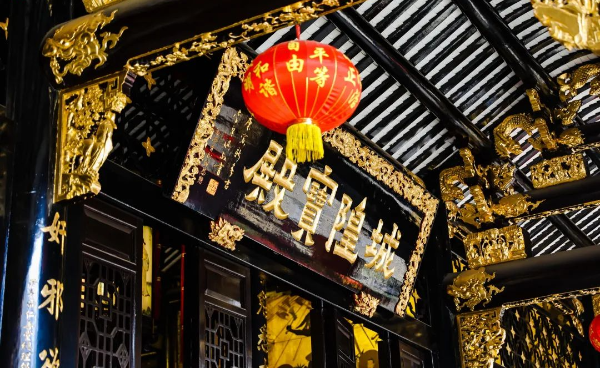
- What is the official name on the horizontal tablet of the City God Temple?“Ducheng Huangmiao” (Provincial-level City God Temple).
- Who are the main deities worshipped in the City God Temple?The main deity is the City God of Guangzhou (the statue is of Liu Yan, the king of the Southern Han Dynasty, with a height of 3.2 meters). It is also accompanied by the statues of Hai Rui and Yang Jiaoshan.
4. The Provincial-level City God and Folk Culture
- What does “Ducheng Huang” (Provincial-level City God) in the City God Temple mean? What is the difference between it and an ordinary City God Temple?“Du” refers to the highest level at the provincial level, so the Provincial-level City God is in charge of the City Gods of the entire province. An ordinary City God Temple only governs the City God of one prefecture or county.
- What are the legendary stories about the City God of Guangzhou?Legend has it that the City God was Liu Yan, the founding emperor of the Southern Han Dynasty, who was enshrined as the City God after his death to protect Guangzhou. There is another story about Cui Wei, a man in the Tang Dynasty, who was helped by the “messenger of Guangzhou City” to escape danger and later offered sacrifices to the City God.
- What are the main sacrificial activities of the City God Temple?They include the blessing ceremony on the City God’s Birthday, court-style Taoist rituals, the City God’s parade, and sacred operas.
- When is the City God’s Birthday? What special celebration activities are there?It falls on the 11th day of the 5th lunar month and the 24th day of the 7th lunar month. The celebration activities include the City God’s parade, “touching the earth” (lying on the ground to pray the night before), offering the first incense, and Cantonese opera performances.
- What is the connection between the City God Temple and Guangzhou’s folk beliefs?It is a core site for local people to pray for blessings, ward off disasters, and seek peace. It integrates Taoism and Guangfu (Cantonese) folk customs, such as praying for rain and mediating disputes.
- What are the characteristics of the blessing culture in the City God Temple?It features environmental-friendly incense for blessing and writing down wishes to make promises. It emphasizes filial piety and the protection of the family and the country, presenting a simple and solemn style with Lingnan characteristics.
5. Special Activities and Temple Fairs
- What special activities does the City God Temple hold?It holds blessing ceremonies, cultural performances, intangible cultural heritage (ICH) handcraft experiences, and Cantonese opera performances.
- What is the connection between the City God Temple and the Guangfu Temple Fair?It is the main venue of the Guangfu Temple Fair. Since 2011, the fair has been held every year during the Lantern Festival, integrating a Guangfu cultural carnival.
- What special activities are held in the City God Temple during the Guangfu Temple Fair?They include the City God’s parade, ICH exhibitions, lion dances, food markets, and comedy shows.
- What are the “Happiness Post Office” and “Blessing Wall” in the City God Temple? How to participate?The Happiness Post Office allows visitors to send blessing cards or envelopes to pray for blessings. The Blessing Wall is for pasting wish notes. To participate, visitors can write their wishes on a card or note, then drop it into the post office or paste it on the wall.
- What cultural experience activities does the City God Temple offer?It offers ICH handcraft making (such as Guangzhou-style wife cakes and Chakeng stone carvings), Cantonese storytelling, and martial arts flash mobs.
6. Visiting Etiquette and Notes
- What are the dress code requirements for visiting the City God Temple?Visitors should dress neatly and appropriately, avoiding revealing clothing and slippers.
- What are the behavioral taboos in the City God Temple?Making loud noises, smoking, eating and drinking, and touching cultural relics are prohibited.
- Is photography allowed? Are there any restrictions?Photography is allowed, but the use of flash and close-up shots of the deity statues are prohibited.
- How to pray in the City God Temple? What etiquette should be followed?Visitors can get three sticks of environmental-friendly incense, light the incense, bow three times to pray, recite their wishes silently, and then insert the incense into the incense burner.
- What should be noted when communicating with the staff in the temple?Visitors should politely address the staff as “Taoist Priest” (Daozhang), avoid arguing about religious beliefs, and respect their guidance.
7. Transportation and Surrounding Information
- How to reach the City God Temple by public transportation?Take the subway to Gongyuanqian Station (Line 1/Line 2) and exit from Exit E, or take Line 1 to Nongjiangsuo Station and exit from Exit D, then walk for 5 minutes.
- Which bus routes are available nearby?The nearby bus stops include Zhongshan Fifth Road Station, Caiting Station, and Wende Road Station. The available bus routes are B4, 5, 6, 7, 8, 23, 24, etc.
- Is it convenient to drive there? Are there any parking lots nearby?Driving is convenient, but there may be traffic jams during peak hours. There are parking lots nearby, such as the Wende Road Parking Lot and the Nanyue King Museum Parking Lot.
- What recommended local foods are available near the City God Temple?Local foods include Guangzhou rice noodles (changfen), boat congee (tingzai zhou), beef offal, and snacks from the Beijing Road Pedestrian Street.
- What other scenic spots are there around the City God Temple?They include the Nanyue King Museum, Beijing Road Pedestrian Street, and Yuexiu Park.
- Is there a recommended one-day tour route combining the City God Temple and its surrounding areas?The recommended route is: pray in the City God Temple in the morning → enjoy food on Beijing Road at noon → visit the Nanyue King Museum in the afternoon → take a walk in Yuexiu Park in the evening.
8. Practical Suggestions and Service Facilities
- What is the best time to visit the City God Temple?The best time is 8:00 in the morning to avoid crowds, or during the Lantern Festival Temple Fair when it is lively.
- What are the best photo spots in the City God Temple?They include the wish-fulfilling dougong archway, the Worship Pavilion in front of the Main Hall, and the Blessing Wall.
- What should be noted when visiting with the elderly and children?Avoid peak hours. There are wheelchair ramps for the elderly. Keep an eye on children to prevent them from running around, and supervise them around the incense.
- How to understand the essence of the City God Temple in a short time?Head straight to the Main Hall to see the main deity statue and murals, read the inscriptions on the steles, and get incense to pray (about 30 minutes).
- Does the City God Temple provide guided tour services? Are there any audio guides available?Free guided tours are available (on weekends), and audio guides can be rented (10 yuan per hour).
- What convenience facilities are there in the City God Temple?There are rest areas, restrooms, barrier-free access, and water dispensers.
- Is there a souvenir shop? What kinds of characteristic cultural and creative products are sold?Yes, there is a souvenir shop. It sells City God statue ornaments, Lingnan-style wind chimes, and ICH handcraft sachets.
9. Historical Figures and Stories
- What is the legend about the City God Temple and Liu Yan, the founding emperor of the Southern Han Dynasty?After Liu Yan (also known as Liu Yan) died, he was enshrined as the City God to protect Guangzhou, and the main statue in the temple is modeled after him.
- What is the story of “the water ghost being promoted to City God” related to the City God Temple?Derived from a folk saying, it tells the story of a water ghost (a person who died an unnatural death by drowning) who accumulated virtues and did no harm to others. As a reward, the King of Hell promoted him to be the City God. The story implies the meaning of repaying kindness and doing good deeds.
- What is the connection between the City God of Guangzhou and the City God of Hangzhou (Zhou Xin)?There is no direct connection. The City God of Guangzhou generally refers to Liu Yan or Yang Jiaoshan, while the City God of Hangzhou refers to Qin Yu or Zhou Xin. Both were loyal officials enshrined as City Gods, reflecting the personification of the City God.
- Who inscribed the horizontal tablet of the City God Temple? What is its historical background?The horizontal tablet “Zhongyou” (Loyal and Blessing) was inscribed by an official of the Qing Dynasty. The background is that after the temple was upgraded during the Yongzheng reign, the tablet symbolized the protection of the country and the people.
10. Cultural Value and Significance
- What is the status of the City God Temple in Lingnan culture?As the largest City God Temple in Lingnan, it embodies the essence of Guangfu folk customs and architecture. It is also a cultural relic protection unit of Guangzhou City.
- How does the City God Temple reflect the urban spirit of Guangzhou?It reflects the spirit of inclusiveness, blessing-seeking, and protection. It integrates Taoism and folk beliefs, symbolizing the prosperity of Guangzhou (Yangcheng).
- What value does the City God Temple have for the study of Guangfu folk culture?It provides living materials for the study of the City God’s Birthday, parades, and other folk activities, as well as for the research on the evolution of blessing customs, temple fairs, and folk traditions.
- What is the difference between the City God Temple and other religious sites in Guangzhou (such as Guangxiao Temple and Sanyuan Palace)?The City God Temple focuses on the protection of the City God and folk blessing-seeking, mainly based on Taoism. Guangxiao Temple is a Zen Buddhist temple, and Sanyuan Palace is a Taoist temple dedicated to the Three Pure Ones, focusing on meditation and worship of celestial beings respectively.
- What cultural inheritance functions does the City God Temple have in modern times?It holds temple fairs and ICH exhibitions to promote Guangfu culture. It integrates culture and tourism, and promotes filial piety and community cohesion.