Strategic Emerging Industries’ Added Value Exceeds One Trillion Yuan
On December 17, the Press Office of the Guangzhou Municipal People’s Government held a press conference. Responsible comrades from the Municipal Development and Reform Commission, Municipal Science and Technology Bureau, Municipal Bureau of Industry and Information Technology, Municipal Bureau of Commerce, Municipal Administration of Government Services and Data, and Municipal Federation of Trade Unions introduced the progress and achievements of Guangzhou in building a modern industrial system during the 14th Five-Year Plan period.
Highlights Review
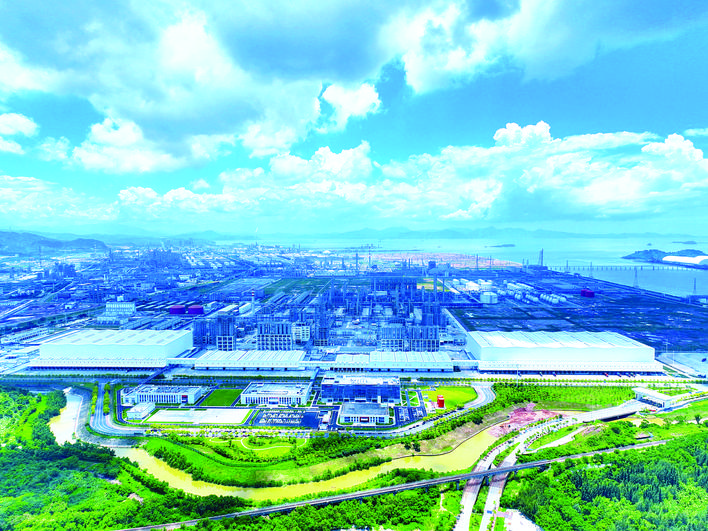
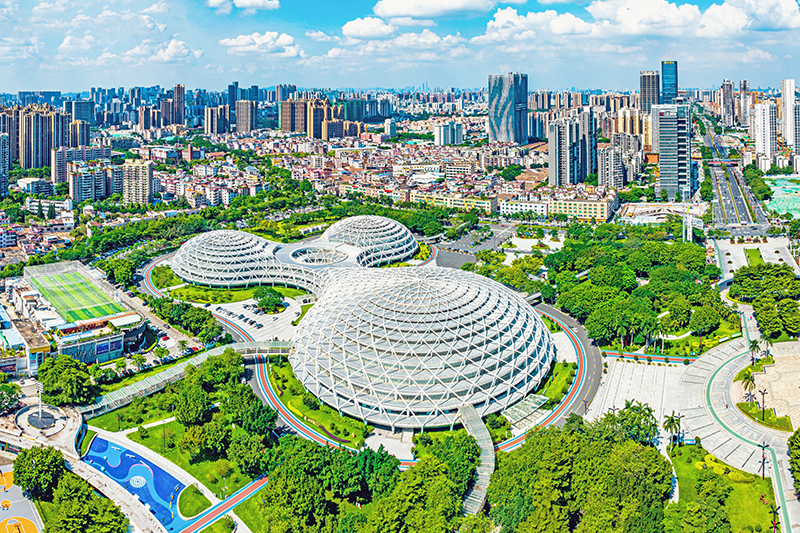
Over the past five years, Guangzhou has focused on developing the real economy as the cornerstone of economic growth, delivering a solid and impressive report card. The city’s industrial investment maintained a double-digit annual growth rate; 6 advanced manufacturing clusters and 10 service industry clusters each with an output value exceeding 100 billion yuan have been formed; the added value of strategic emerging industries exceeded one trillion yuan, accounting for more than 30% of the city’s GDP; national strategic scientific and technological strength has been accelerated in transformation, producer services have been improved in quality and efficiency, and an industry-friendly business environment has been accelerated, fostering an open and innovative ecosystem for industrial development.
Municipal Development and Reform Commission: 22 New National-Level Manufacturing Single Champion Enterprises Added
At the press conference, Yang Xiaoyan, Deputy Director of the Guangzhou Municipal Development and Reform Commission, stated that currently, Guangzhou is advancing the construction of the “12218” modern industrial system, focusing on industry as the top priority and manufacturing as the foundation of the city, continuously consolidating the solid foundation for new productive forces. Over the past five years, the proportion of the added value of advanced manufacturing in the total industrial added value of above-scale industrial enterprises has increased to 60%. Guangzhou has successfully cultivated 2 national-level strategic emerging industry clusters and 4 national-level advanced manufacturing clusters, with an increase of 482 national-level specialized, sophisticated, distinctive and innovative “little giant” enterprises and 22 national-level manufacturing single champion enterprises.
Guangzhou has continuously promoted digital transformation, intelligent upgrading, and network connection, accelerated the integration of manufacturing and service industries, and reconstructed new advantages in industrial development. During the 14th Five-Year Plan period, Guangzhou was approved to build two national-level artificial intelligence application pilot test bases, added 57 registered large models and more than 30 AI professional parks, with a comprehensive computing power exceeding 39,000 petaflops. By reorganizing development factors with digital and intelligent technologies, Guangzhou has empowered 510 specialized markets and 70,000 consumer goods manufacturing enterprises in the city, spawning “phenomenal” enterprises such as Shein and TEMU, and invigorating and strengthening traditional industries such as apparel, cosmetics, food and home furnishing.
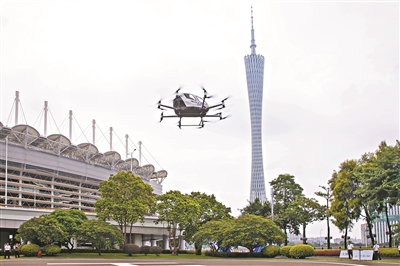
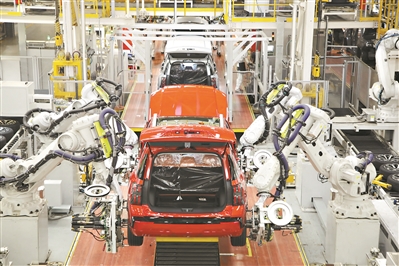
Guangzhou has strengthened the in-depth integration and mutual promotion of industrial development and scientific and technological innovation. Over the past five years, the strategic emerging industries in Guangzhou have grown significantly, with their added value exceeding one trillion yuan, accounting for more than 30% of the city’s GDP. More than 3,300 industrial projects worth over 100 million yuan each have been implemented, including 34 projects worth over 10 billion yuan each. Major projects such as GXC Semiconductor, LG Display and Huaxing Optoelectronics have been completed and put into operation. The first domestic bio-manufacturing mycelial protein factory has started construction, and the world’s first flying car mass production factory has undergone trial production. Unicorn enterprises have sprung up rapidly. GXC Semiconductor has become the first enterprise in the Guangdong-Hong Kong-Macao Greater Bay Area to mass-produce 12-inch wafers; GAC Aion has been selected as the world’s only “lighthouse factory” in the new energy vehicle sector; EHang Intelligent has become the world’s first eVTOL operator with four complete certificates.
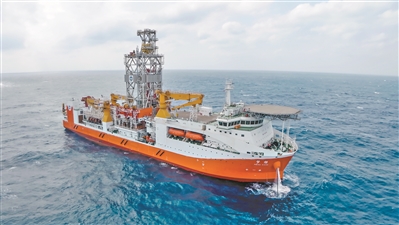
Guangzhou has made forward-looking arrangements for future industries, and the transformation of national strategic scientific and technological strength has been accelerated. The Guangzhou Laboratory has produced dozens of key achievements, and 8 drugs and vaccines, including the world’s first new anti-influenza A PB2 drug, have been approved for marketing. The solid-propellant carrier rocket “Lijian-1” was successfully launched; China’s first independently developed ocean drilling vessel completed its sea trial; and China’s first deep-sea operation robot and submersible were developed and manufactured in Guangzhou.
Guangzhou has promoted the quality and efficiency improvement of producer services and enhanced the level of the service industry. Focusing on “customer flow”, Guangzhou has developed modern commerce and exhibition industries, put the fourth phase of the Canton Fair into use, and the city’s exhibition area ranks second in China, with trade connections reaching more than 210 countries and regions. Focusing on “logistics flow”, it has developed logistics and supply chain industries, built a “four-type” national logistics hub city, and its express delivery handling volume has remained the first in China. Focusing on “technology flow”, it has developed scientific and technological services and professional services, deepened the pilot project of technological achievement transformation around the Hong Kong University of Science and Technology, and added 57 convenient practice measures for overseas professional qualifications in 10 fields including judicial and accounting services for Hong Kong and Macao. Focusing on “capital flow”, it has developed modern finance, with the city’s premium income and the balance of deposits and loans in both domestic and foreign currencies ranking fourth in China, and the balance of green loans ranking first in Guangdong Province.
Guangzhou has implemented the “Guangzhou Talent Gathering” plan, been approved as a pilot city for the identification of foreign high-level, sophisticated, and urgently needed talents. The number of full-time academicians of the Chinese Academy of Sciences and Chinese Academy of Engineering working in Guangzhou has increased to 71, and the number of foreign talents working in the city ranks third in China. It has set up a 200 billion yuan infrastructure industry fund, a 150 billion yuan industrial investment mother fund, a 50 billion yuan venture capital mother fund, a 10 billion yuan angel mother fund and a 5 billion yuan sci-tech innovation mother fund. It has built a national university regional technology transfer and transformation center and a Greater Bay Area scenario innovation center, and launched more than 100 first-test and first-application scenarios.
Municipal Science and Technology Bureau: Over 3,000 High-Tech Enterprises Emerged from the Sci-Tech Innovation and Entrepreneurship Competition in 5 Years
The Guangzhou Science and Technology Innovation and Entrepreneurship Competition is an important brand for Guangzhou to build an innovation and entrepreneurship ecosystem, and has become a key engine for the city to cultivate and expand emerging industrial clusters and promote the in-depth integration of scientific and technological innovation and industrial innovation. Lei Jin, Deputy Director of the Guangzhou Municipal Science and Technology Bureau, introduced that during the 14th Five-Year Plan period, the competition has attracted nearly 20,000 enterprises to participate, with 586 winning enterprises receiving nearly 400 million yuan in awards and subsidies, driving the vigorous development of science and technology-based small and medium-sized enterprises in the city. The competition has built a “Guangzhou Model” featuring “government guidance, market leadership, financial catalysis, and open collaboration”, promoting the mutual promotion and strengthening of scientific and technological innovation and industrial development, and has become an “accelerator” and “connector” for industrial innovation.
During the 14th Five-Year Plan period, the competition has fully covered Guangzhou’s strategic industries and future industries. Under the continuous incubation of the whole-chain cultivation mechanism, a high-quality enterprise echelon has been formed, including 3,056 high-tech enterprises, 171 national-level specialized, sophisticated, distinctive and innovative “little giant” enterprises, 10 unicorn enterprises and 6 listed companies. Outstanding enterprises emerging from the competition include Cloud-Clone, Guangzhou’s first biotech unicorn; Galactic Energy, a leading commercial aerospace enterprise in China; Aifoton Technologies, which has achieved localization of key equipment; and Techwing Technology, which has broken the foreign monopoly in narrowband Internet of Things. The competition has also helped more than 1,000 participating enterprises obtain over 50 billion yuan in investment and financing, solving development problems for many enterprises.
Municipal Bureau of Industry and Information Technology: Guangzhou Basically Realized Full-Area Opening of Autonomous Driving Demonstration Operation
Advanced manufacturing is the backbone of the modern industrial system. How has Guangzhou built itself into a strong city in advanced manufacturing? Wang Yuyin, Deputy Director of the Guangzhou Municipal Bureau of Industry and Information Technology, introduced that since the 14th Five-Year Plan period, Guangzhou has adhered to the strategy of “industry first, manufacturing-based city”, further promoted new-type industrialization, driven the transformation and upgrading of traditional industries, the leading development of emerging industries, and the rooting of future industries, and the pace of building a strong advanced manufacturing city has become more steady.
In terms of building new platforms, Guangzhou has highlighted the main position of enterprises in scientific and technological innovation, promoted multiple entities such as enterprises and universities to establish the first batch of 48 municipal-level manufacturing innovation centers, and the “2+14+N” national, provincial and municipal three-level manufacturing innovation center matrix has continued to expand. In terms of supporting the development of innovative drugs and medical devices, Guangzhou has planned and constructed four major biomedical value parks and a number of characteristic parks such as hospital-prepared preparations, in vitro diagnostics (IVD), nuclear medicine and medical simulation equipment. The country’s first clinical application of gene therapy for thalassemia and the first clinical application of allogeneic stem cell therapy for acute-on-chronic liver failure have been successfully implemented. In terms of expanding new scenarios, based on the advantages of its ultra-large-scale urban scenarios, Guangzhou has promoted the construction and opening of various scenarios such as production, life and services, basically realizing the full-area opening of autonomous driving demonstration operations, and opening 19 demonstration operation routes from airports and high-speed railway stations to the city center, allowing citizens to conveniently experience autonomous driving travel services.
During the 14th Five-Year Plan period, Guangzhou has produced a total of 2.25 million intelligent connected new energy vehicles, gathered the world’s only two autonomous driving technology enterprises listed on both the US stock market and Hong Kong stock market, and bred Asia’s largest flying car company. Embodied intelligent enterprises have launched a number of complete machine products that can “enter the competition arena”, “go to the factory workshop” and “step into the shopping mall”. Guangzhou has also vigorously promoted a new round of technological transformation focusing on digitalization and intelligence, been approved as a national pilot city for new-type technological transformation of manufacturing industry and a pilot city for digital transformation of small and medium-sized enterprises, cultivated 3 global “lighthouse factories”, 8 excellent-level intelligent factories and 33 national 5G factories, and promoted the intelligent upgrading and digital transformation of 5,100 above-scale industrial enterprises in total.
Guangzhou has also firmly grasped the strategic orientation of carbon peaking and carbon neutrality, and steadfastly taken the path of green and sustainable industrial development. In terms of green industrial development, Guangzhou has been approved to build the only national-level manufacturing innovation center in the field of new energy storage.
Municipal Bureau of Commerce: Guangzhou’s Exhibition Industry Ranks Second in China Steadily
The international convention and exhibition center is an important city card of Guangzhou, and also a strong support for Guangzhou as an important national central city and an international business center. Luo Zheng, Deputy Director of the Guangzhou Municipal Bureau of Commerce, introduced that during the 14th Five-Year Plan period, Guangzhou’s exhibition industry has maintained a steady growth momentum, showing strong resilience and vitality. In the past three years, the city’s exhibition area has exceeded 10 million square meters annually, with an average annual growth rate of about 5%, ranking second among cities in China.
Luo Zheng said that during the 14th Five-Year Plan period, Guangzhou has newly established the Guangzhou International Convention and Exhibition Group to build a leading domestic one-stop comprehensive service platform for “industrial exhibitions”. From January to October this year, the city held 131 exhibitions focusing on the “21+8” industries, with outstanding advantages in 6 fields including fashion consumption, intelligent connected and new energy vehicles, and biomedicine and health, and successfully filled the gaps in exhibition themes such as medical devices, aerospace and intelligent construction, forming a diversified exhibition ecosystem of “world-class comprehensive exhibitions + professional exhibitions in segmented fields”.
Guangzhou has also vigorously improved the internationalization level of the exhibition industry, connected domestic and foreign trade, and smoothed the dual circulation. In 2025, the number of international exhibitions is expected to exceed 90, with an exhibition area of over 7 million square meters, both doubling compared with 2021; the number of overseas exhibitors and buyers attending the exhibitions has exceeded 3 million person-times, a 140% increase compared with 2021, among which the number of overseas buyers at the 138th Canton Fair exceeded 300,000 for the first time. The number of enterprises going overseas to hold exhibitions has also grown rapidly, increasing from 6 enterprises holding 15 overseas exhibitions in 2023 to 16 enterprises holding 54 overseas exhibitions this year, with the scale and coverage of overseas exhibitions expanding significantly.
Led by the Canton Fair, Guangzhou has implemented the “exhibition plus” model to continuously stimulate new consumption vitality. Looking forward to the 15th Five-Year Plan period, Guangzhou will make precise plans around the “12218” modern industrial system, support exhibitions to strengthen the function of launching new products, link commercial, tourism and cultural venues to create new consumption scenarios, and promote the integrated development of exhibitions, industries and cities. Guangzhou will also accelerate the legislation on exhibitions, optimize supporting services such as customs clearance and logistics, build a world-class business environment characterized by marketization, rule of law and internationalization, and continuously enhance Guangzhou’s status as an “international convention and exhibition center” city.
Municipal Administration of Government Services and Data: Over 2,000 Above-Scale Enterprises in the Data Industry
Data has become the fifth major factor of production following land, capital, labor and technological innovation. Liang Wenqian, Deputy Director of the Guangzhou Municipal Administration of Government Services and Data, introduced that during the 14th Five-Year Plan period, Guangzhou has taken the reform of market-oriented allocation of data elements as the main line and public data authorized operation as the forerunner, built a development pattern with improved systems, sound facilities and active ecology, and driven the construction of the “12218” modern industrial system through digitalization and intelligence.
“Guangzhou has a solid foundation in digital government and high-value public data. We have seized the key link of public data authorized operation and established a comprehensive support system for data resource supply and development and utilization, making the Guangzhou model a national typical example.” Liang Wenqian said that in terms of data resource supply, Guangzhou has comprehensively carried out public data resource registration, established a city-wide public data “master list” relying on the municipal government big data center, gathered more than 1,000 billion pieces of public data resources, with an average daily sharing and exchange of nearly 5 billion pieces, solving the problem of insufficient data supply.
In terms of data development and utilization, Guangzhou has built a public data authorized operation platform, constructed a trusted environment with technologies such as privacy protection, AI intelligent agents and blockchain, included more than 5,800 public data resources in the authorization scope, and the amount of data available for authorized operation has exceeded 18 billion pieces. It has promoted more than 40 registered entities to complete the registration of more than 400 public data resources in total, with the number of registrations ranking first in Guangdong Province.
In terms of accelerating data circulation, Guangzhou has established the Guangzhou Data Exchange, set up 16 service bases, 8 service zones and 4 joint co-creation centers nationwide, formed a “one exchange with multiple bases” service system, smoothed the main artery of data circulation and utilization, with more than 3,600 entries traded in total. Participating in the national data property right registration pilot, since its implementation, the Guangzhou Data Exchange has issued nearly 300 data property right registration certificates, providing a Guangzhou solution for exploring the implementation of the system.
As of July 2025, there are over 2,000 above-scale enterprises in Guangzhou’s data industry and more than 1,300 high-tech enterprises in the data field, with a number of benchmarking enterprises such as KingMed Diagnostics, Zhijing Technology and Mushroom IoT emerging.
Looking forward to the 15th Five-Year Plan period, Guangzhou will focus on advantageous industries, launch high-quality data sets suitable for artificial intelligence training and scenario application, fully release the amplification, superposition and multiplication effects of data elements and digital intelligent technologies on economic and social development, and promote the upgrading and capacity enhancement of the “12218” modern industrial system.
Municipal Federation of Trade Unions: The Number of High-Skilled Talents in the City Increased by 30% in 5 Years
What measures has Guangzhou taken and what achievements has it made in attracting, cultivating and retaining various industrial talents? Xia Jianbao, Vice Chairman of the Guangzhou Municipal Federation of Trade Unions, introduced that since the 14th Five-Year Plan period, centering on industrial needs and employee growth, Guangzhou has launched a series of pragmatic measures to strive to retain more industrial workers and support their development. The total number of skilled talents in the city has increased from 3.53 million in 2021 to 4.22 million, a growth rate of 19.5%. Among them, the number of high-skilled talents has increased more significantly, rising by 30% compared with 2021 to reach 1.609 million, accounting for 38.1% of the total number of skilled talents, up from 35% in 2021, ranking first in Guangdong Province and among the top in the country.
Xia Jianbao said that starting from 2024, Guangzhou will invest special funds for three consecutive years to support the attraction, cultivation and retention of various talents in key industries, strengthening the talent support for the modern industrial system. Guangzhou will also improve the salary distribution incentive system for skilled talents, improve the mechanism linking total wages with economic benefits and labor productivity, and tilt towards key positions, high-skilled talents and front-line positions, so that industrial workers can obtain tangible returns.
Guangzhou is promoting a large-scale vocational skills training and improvement campaign, building 294 “Yangcheng Skills Gas Stations” and launching online training courses to create a “15-minute skills training service circle”, with an annual training volume of over 240,000 person-times. It has vigorously promoted the integrated evaluation of high-skilled talents and professional and technical talents, advanced the comparison and recognition of overseas vocational skills, and carried out relevant pilot recognition work in Nansha. In the past five years, the municipal-level “Study and Realize Dreams Program” has invested more than 40 million yuan to subsidize 28,000 employee person-times for further study.