Recently, Guangzhou has rolled out a list of grassroots reform and innovation cases for the development of a modern people – centered city, with 39 such cases coming to the fore. Moving forward, these reform and innovation experiences are expected to be replicated and promoted across the entire city.
Back in September this year, closely following the six goals for modern people – centered cities, namely “innovative, livable, beautiful, resilient, civilized, and smart”, put forward at the Central Urban Work Conference, the Reform Office of the CPC Guangzhou Municipal Committee commissioned a third – party institution to conduct an evaluation of these cases citywide. This initiative not only represents an active alignment with the spirit of the Central Urban Work Conference, helping to clarify the direction of reform and solve grassroots – level problems, but also aims to drive reform through evaluation. By strengthening the summary and promotion of experiences from these reform cases, it further enhances the overall reform efficiency of the city and accelerates the construction of a modern people – centered city. The evaluation team went deep into the grassroots of Guangzhou, conducted on – site investigations to collect first – hand materials, and screened out a large database of reform cases that are tangible and beneficial to the public, comprehensively and systematically showcasing the remarkable achievements of grassroots reform and innovation in Guangzhou.
Since the launch of the activity, focusing on the innovative value, replicability, implementation efficiency and other dimensions of the cases, a scientific evaluation system has been established. Through various means such as in – depth grassroots visits and research, and big – data sorting and analysis, and with the joint efforts of various municipal reform task forces, relevant functional departments, experts and scholars, and grassroots representatives, multiple rounds of selection and information verification have been carried out on the cases. Eventually, 39 reform cases stood out.
Looking at the six dimensions, “innovation” and “livability” (9 cases each) are the fields with the largest number of cases and the most extensive practices, embodying the two core aspects of urban development momentum and people’s well – being. The number of cases related to “beauty” (6), “civilization” (7) and “smartness” (5) is relatively balanced, which is a well – proportioned response to the diverse pursuit of a better life. Although there are only 3 cases under “resilience”, as a basic support, it penetrates and serves all fields. This distribution reflects that Guangzhou’s reform not only focuses on stimulating the momentum and vitality of urban development, but also takes into account the systematic balance of urban development, demonstrating a reform logic that starts with breaking through specific problems and then expands to achieve widespread results.
In the meantime, the evaluation team also conducted an accurate assessment of Guangzhou’s grassroots reform, producing several constructive think – tank results. These results provide a “Guangzhou Model” for building a modern people – centered city with high – quality development and lay a solid foundation for formulating the 15th Five – Year Plan in a scientific manner.
Innovation – Driven
Removing Institutional and Mechanism Bottlenecks to Unleash New Drivers of Development
All 9 cases shortlisted in the “innovation” category accurately respond to the work orientations such as “tailoring policies to local conditions to boost urban development momentum” and “unlocking the potential of existing urban resources” proposed in the Opinions of the CPC Central Committee and the State Council on Promoting High – Quality Urban Development (hereinafter referred to as the Opinions). These cases break away from the traditional development model and remove obstacles to resource transformation through institutional innovation. In terms of specific approaches, some cases emphasize the in – depth integration of scientific and technological innovation and industrial innovation. By revitalizing existing stock resources and promoting opening – up and cooperation, they have built an all – round innovative development ecosystem.
The inclusion of the “All – Round Care” industrial service model from Guangzhou Development Zone and Huangpu District stems from its direct targeting of the industry – wide pain points in the biomedical sector, such as slow achievement transformation and difficult resource connection. The most prominent practice of this case is the establishment of an innovative review and approval service model characterized by “one platform + two channels + three lists + four – level coordination = all – round care”, which has accelerated the approval process for innovative drugs.
Nowadays, around the 20th of each month, a scene is regularly seen in the meeting room of the New Drug Application Service Center in Huangpu District. Technical experts from the Greater Bay Area Branch of the Center for Drug Evaluation and Inspection of the National Medical Products Administration provide face – to – face consulting services, while staff from a large number of local enterprises wait outside for their turn. Regardless of their size, these enterprises only need to submit applications and relevant materials to the New Drug Center before the 5th of each month to receive such in – depth expert consultations around the 20th of the same month. “This has significantly improved the efficiency of communication and the speed of problem – solving,” stated relevant personnel from the enterprises.
“They come fully prepared to answer our questions, just like the saying ‘one minute on stage takes ten years of practice off stage’,” Mr. Zheng, general manager of a Guangzhou – based medical technology company, told the evaluation team. Since this is a free service that involves a heavy workload, he was worried at first that it might be left unfinished. “It is quite remarkable that Huangpu has turned this into a regular mechanism.”
The renovation practice of Guangzhou Design Town in Baiyun District serves as a model for “unlocking the potential of existing urban resources”. It has addressed a common challenge in the redevelopment of inefficient land in megacities – balancing the interests of the government, village communities and enterprises, integrating forces from various sides, and coordinating the whole – life – cycle management of projects. Meanwhile, it has innovated the land revenue – sharing mechanism. In the renovation of village – level industrial parks, it has been clearly stipulated that the revenue from the project renovation will be split 70% to village communities and 30% to the government. District – owned state – owned enterprises are responsible for unified leasing, construction and operation. The government acquires 30% of the land free of charge for targeted investment promotion, changing the long – standing situation where collective land is mostly developed independently by village communities, resulting in inefficient and unregulated construction. At the same time, priority is given to industrial introduction. After the renovation, the annual operating income and tax revenue of the park have increased by 1,600 times and 1,100 times respectively. The Forest Sea Provincial Tourist Resort built here has achieved a total turnover of over 1.5 billion yuan since its opening.
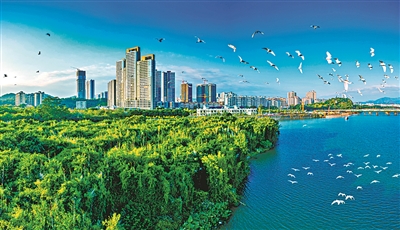
Safeguarding enterprise safety in production is also crucial for building a resilient city. Nansha District has taken the lead nationwide in establishing a district – level credit risk classification supervision index system for enterprises with “cluster registration”. By leveraging big – data models, it achieves accurate assessment and differentiated supervision, filling the gap in the supervision of emerging market entities. Nansha has also revoked the business licenses of 6,056 long – term inactive cluster – registered enterprises in accordance with the law, proving that the credit mechanism is an effective tool for urban risk prevention and control and providing a guarantee for the standardized development of emerging industries.
Civilization – Empowered
“Exquisite Craftsmanship” and “Minor Renovations” Highlight the Unique Urban Spirit
As a famous historical and cultural city, Guangzhou has always been committed to developing cultural undertakings while protecting cultural heritage and inheriting historical context amid development. The 7 reform cases in the “civilization” category are concrete manifestations of this philosophy.
The case of revitalizing historical and cultural blocks in Liwan District emphasizes the concept of “exquisite craftsmanship”. Through “minor renovations”, it preserves the texture of historical and cultural blocks, highlighting the cultural heritage and the unique urban spirit of Guangzhou. Walking into Yongqingfang Scenic Area, located on the north side of Enning Road, one can see historical and cultural elements such as blue bricks, gray walls, Manchu windows and gray sculptures, with Lingnan architectural styles largely preserved or restored. Since the full opening of the second phase of Yongqingfang, the number of tourists has reached as high as 180,000 per day during peak seasons.
Mr. Li, a tourist from other places, praised: “This place is really charming! Unlike those monotonous commercial streets, it allows you to feel the history of old Guangzhou while also encountering many trendy and interesting small shops. The integration of tradition and modernity is just perfect.”
The ultimate goal of promoting cultural prosperity and development lies in serving the people. To meet the growing and diverse spiritual and cultural needs of citizens, Tianhe District has delivered an excellent performance by exploring the reform of socialized operation of public cultural facilities. Relying on the three – tier public cultural service network of “district – sub – district – community”, Tianhe encourages social forces to participate in public cultural services, making these services more diverse and tailored to public needs. A number of typical cases have emerged, such as Liede Qingheli and Tianhe Shiguangli.
In 2024, Liede Qingheli completed its upgrading and was rated as one of Guangdong’s Most Beautiful New Public Cultural Spaces. Its debut exhibition “Feeling the East” has attracted wide attention from citizens and tourists. At present, Liede Qingheli mainly operates public welfare cultural spaces and cafes, and regularly holds public welfare cultural activities such as outdoor film screenings, tea ceremonies, flower arrangements and incense ceremonies. “We aim to bring people a sense of beauty and aesthetic education. While maintaining close cooperation with government departments, we also organize activities with the style of an independent art museum to fill the gap in new – type public cultural activities,” said Mr. Mai, founder of a Guangzhou – based cultural communication company.
Smart – Driven
Reshaping the Paradigm of Urban Governance and Services
The 5 cases shortlisted in the “smartness” category vividly respond to the core requirements of the Central Urban Work Conference for intelligent and refined urban governance. These cases show that Guangzhou’s smart city construction has always adhered to a demand – oriented and scenario – driven approach, enabling digital technologies to better serve the people.
As a district with a large population in Guangzhou, Baiyun District took an early step in promoting AI – enabled initiatives in urban management. Relying on IoT sensing devices such as video surveillance and sensors, it has achieved integrated management of more than 168,000 urban components and over 29,000 urban management materials on a single map. At the same time, by using intelligent terminals like driverless street sweepers and drones, it has built a smart – linked model featuring “air patrols, road monitoring, back – office task assignment and rapid disposal”. This model has effectively addressed the problems of insufficient coverage and low efficiency of manual inspections in urban management. Up to now, this model has been commercially implemented in many places, proving its strong adaptability and vitality.
It is worth noting that the Opinions include “exploring a new coordinated operation model of neighborhood committees, owners’ committees and property service enterprises under the leadership of community Party organizations” as part of the connotation of “smartness”. The case of “Liwan District exploring a Party – led owners’ self – governance model for communities without property management” is a typical example that meets this requirement. In communities facing prominent governance challenges, Liwan has promoted the deep integration of Party organizations into the governance structure. For instance, Tianyou Community in Duobao Sub – district has innovatively set up functional Party branches in Nanzhan Xinjie Community and railway dormitory buildings. By integrating the strength of Party members and the community, it has successfully transformed these areas from being “unmanaged” to “well – regulated”.
Under this model, Yuxingyuan Community even has a surplus of property management fees. On July 12 this year, the community held a property management fee rebate meeting for owners, distributing the fees collected from June 2024 to March 2025 (a total of 10 months) to all owners. “I received 1,009.5 yuan, and I’m extremely happy!” said Aunt Zhong, a resident. “The most striking feature of the owners’ committee is that they always do their utmost to help you, no matter how big or small the matter is. This really touches my heart.”