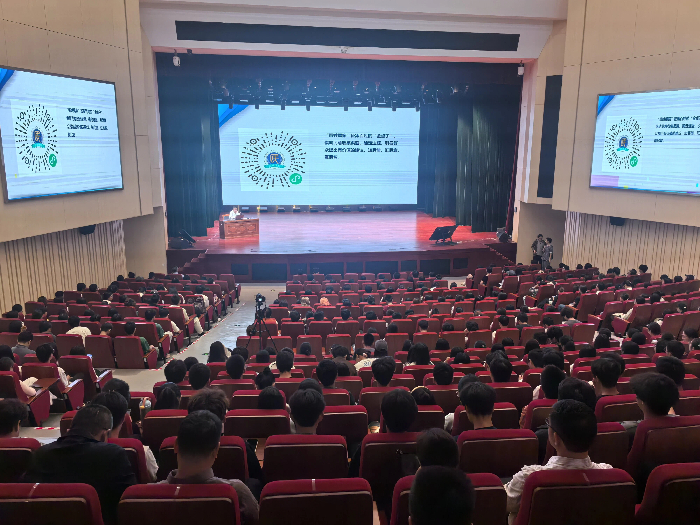
On October 31, the thematic activity themed “Consultative Founding of the People’s Republic” under the “Ideological and Political Course Transcending Time and Space” co-planned by the General Office of Guangzhou Committee of the Chinese People’s Political Consultative Conference (CPPCC) and Guangzhou Vocational and Technical University was successfully held at the university’s Student Activity Center. Huang Jiefeng, Secretary-General of the Guangzhou CPPCC, Wei Qiang and Yan Fuqiong, Deputy Secretaries-General, Chen Xueming, Deputy Director of the Guangzhou Municipal Bureau of Education, Lin Qiasheng, Secretary of the Party Committee of Guangzhou Vocational and Technical University, and Wu Qiang, Vice President of the university, attended the event.
This activity is not only another practical exhibition of the “VR Exhibition Hall Entering Campus” project of the Guangzhou CPPCC History and Culture Exhibition Center, but also the first major event of the co-built practical base for “Comprehensive Ideological and Political Courses” by the General Office of Guangzhou CPPCC and the university. It has aroused an enthusiastic response among students and holds profound significance, marking a solid step forward in guiding young students to strengthen their confidence in the path, theory, system, and culture of socialism with Chinese characteristics (the “Four Matters of Confidence”).
To address the key problems in current ideological and political teaching, where students feel historical events are “remote” and theoretical concepts are “abstract and inaccessible”, the Guangzhou CPPCC History and Culture Exhibition Center has fully leveraged its advantages in historical and cultural resources and narrative skills. Adhering to the concept of “narrative-led, technology-empowered and interaction-boosted effectiveness”, it has developed a warm and tangible practical ideological and political course. Through the immersive teaching method combining “simulated AI assistant + CPPCC member lectures + interactive Q&A”, abstract theories have become easily understandable and approachable. The course creates a time-transcending journey from historical scenes to the scene of proposal submission.
Guided by both the virtual AI assistant and commentators, students were immersive and brought back to historical moments such as the release of the “May 1st Call” by the Central Committee of the Communist Party of China and the First Plenary Session of the Chinese People’s Political Consultative Conference.
The activity specially invited Wei Fulian, Standing Committee Member of the Guangzhou CPPCC and Full-time Deputy Chairman of the Guangzhou Municipal Committee of the China Zhi Gong Party, to give a speech on his work experience titled “CPPCC Proposals Change Your Life”. Combining cases including “Improving School Disaster Response Measures and Enhancing Social Emergency Handling Capabilities”, he systematically explained the methods and insights in proposal writing. This helped students understand how CPPCC work specifically affects and improves people’s well-being, and guided them to deeply comprehend the operational logic of socialist democratic politics with Chinese characteristics from a practical perspective.
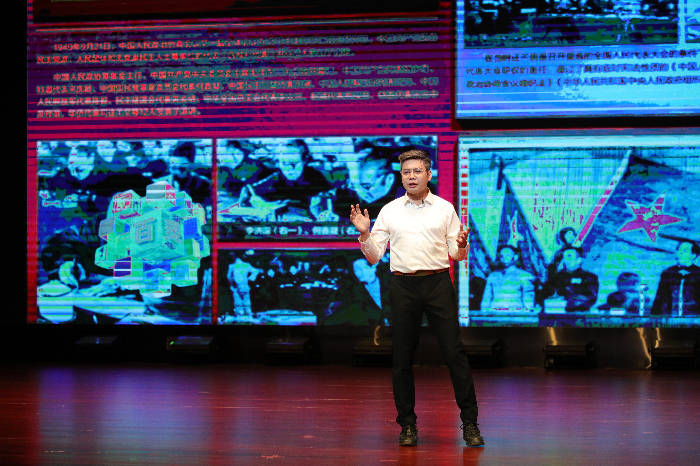
To elevate students’ experience from merely being attentive in class to developing a deep recognition of the content, the course included a prize-winning Q&A session to stimulate their enthusiasm and consolidate their learning outcomes. The activity not only focused on increasing students’ engagement in class, but also strived to guide young students to internalize their understanding of the system into recognition of Chinese-style democracy and transform it into their aspiration to serve the motherland through a complete narrative chain covering history to reality and theory to practice.
A responsible person from the General Office of the Guangzhou CPPCC stated that they will systematically summarize the experience gained from this pilot program and strive to develop a mature and replicable teaching model for ideological and political courses featuring “time-space dialogue + practical empowerment”. Centered on breaking the barriers of time and space, this model uses history to illuminate reality and integrates theories into practice, guiding students to strengthen their ideals and beliefs and enhance their sense of responsibility through integrating knowledge and practice. Taking this activity as an opportunity, they will continue to integrate resources, innovate models, and work with the Municipal Bureau of Education and the Municipal Bureau of Human Resources and Social Security to build a collaborative education system covering primary, secondary and higher education. This system will systematically promote the history of the CPPCC, the glorious development of the Guangzhou CPPCC and the connotation of its system. Meanwhile, they will organically integrate the “public proposals” initiative into ideological and political education, promote the in-depth integration of CPPCC consultations with grassroots governance and people’s livelihood concerns. By enabling students to participate in the entire process of proposal collection and implementation, they can intuitively understand that the CPPCC is an important practical carrier of whole-process people’s democracy, and that the outcomes of consultations can be transformed into practical driving forces for building people-centered cities. This effort will contribute a replicable and exemplary “Guangzhou Experience” to cultivating a new generation of young people who can shoulder the responsibility of national rejuvenation.