AI Powers “Eagle Eyes” and CAD Identifies Tens of Thousands of Drawings in Seconds
Equipped with AI technology, CAD software boasts the capability of image-based recognition, enabling it to accurately screen out similar aluminum profile models from tens of thousands of historical drawings in just a few seconds. AI visual inspection stations leverage over a dozen sets of high-speed industrial cameras to achieve millimeter-level precision detection of the entire vehicle appearance, boosting quality inspection efficiency by 30% to 40%. From the intelligent upgrading of industrial design software to the implementation of technologies in industry-specific scenarios, Guangzhou enterprises are accelerating their stride toward the deep integration of industrial internet and AI at the dawn of the new year.
Recently, the Ministry of Industry and Information Technology (MIIT) issued the Action Plan for the Integration and Empowerment of Industrial Internet and Artificial Intelligence, setting forth a series of remarkable goals: by 2028, China’s level of integration and empowerment of industrial internet and AI will be significantly enhanced; the scale of new industrial networks catering to the needs of high-throughput, low-latency, high-reliability and low-jitter communications will expand continuously; no fewer than 50,000 enterprises will carry out renovation and upgrading of new industrial networks; and a number of high-quality datasets will be created for 20 key industries.
CAD + AI Cuts Mold Opening Costs by 50%
Industrial software is the core of the industrial internet. What capabilities and vitality can AI technology inject into Guangzhou’s industrial software?
Lin Qingzhong, Deputy General Manager of Guangzhou-based Zhongwang Software, unveiled the internal logic of this transformation by taking the digital transformation practice of China’s aluminum profile industry as the entry point. Through more than 20 years of independent R&D and innovation, Zhongwang Software has broken the monopoly of European and American manufacturers in the domestic CAD software market. Meanwhile, its products serve more than 90 countries and regions worldwide, providing efficient and reliable digital tools and industry-specific solutions for global industrial enterprises.
In Lin Qingzhong’s view, the core logic of this transformation lies in “AI addressing industry pain points and software restructuring production efficiency”. He pointed out that in the production and design links of China’s aluminum profile industry, large-scale production and customization are crucial and have become the dividing line of enterprise competitiveness. On one hand, the customization rate of industrial profiles exceeds 70%; on the other hand, the number of historical model libraries ranges from thousands to tens of thousands. Engineers need to retrieve historical drawings 10 to 15 times a day. Traditional folder management is inefficient and may even lead to incomplete searches; even with the use of drawing library systems, precise search criteria are required to locate the desired drawings.
“Rapidly finding the most similar models from the massive historical model library is a prerequisite for improving design reuse rate and a practical industry demand,” Lin Qingzhong said. With the support of AI technology, the latest version of Zhongwang CAD has been endowed with “clairvoyant eyes”—enabling CAD software, which has only been capable of recognizing precise inputs for over 40 years, to possess the ability to judge graphic similarity just like human vision. With these “eagle eyes”, it can scan tens of thousands of historical models thoroughly in a matter of seconds and identify the most similar aluminum profile cross-sections.
The value of this technological breakthrough lies in maximizing the reuse of molds instead of creating new ones from scratch. In fact, 70% of orders can be fulfilled through certain modifications, and 60% of reuse only requires partial adjustments to molds, such as hole enlargement and slot modification. Compared with opening entirely new molds, modifying historical molds can reduce costs by 50% to 70% and shorten the design cycle from over 30 days to 5 to 7 days. “This is an exploration of Zhongwang CAD + AI, endowing CAD with the capability of image-based recognition. By solving problems in the digital world, it is expected to increase the design reuse rate of the aluminum profile industry to 80% and cut mold opening costs by 50%,” he stated. It is reported that 2D CAD products have evolved from simple drawing software to universal tools covering almost all industrial fields, becoming an important cornerstone supporting the digital transformation of various industries.
Boundaries of the Digital-Industrial Integration Ecosystem Continue to Expand
The Action Plan for the Integration and Empowerment of Industrial Internet and Artificial Intelligence proposes to “cultivate a number of intelligent solution providers targeting key links and typical scenarios of key industrial chains, effectively promoting the collaborative upgrading of large, medium and small enterprises. Factor resources such as key enterprises, technological products and public services will be efficiently allocated”, marking that the “industrial ecosystem integration initiative” is on the verge of implementation.
Guangzhou’s digital-industrial integration is accelerating its climb to the “ecological level” with a leading posture.
Guangzhou is home to the only international IPv6 root server in South China and a top-level node of the industrial internet identification resolution system. It has nurtured 3 national cross-industry and cross-domain industrial internet platforms and 15 national characteristic and professional platforms. The Industrial Software Industry Development Center of the Guangdong-Hong Kong-Macao Greater Bay Area National Technology Innovation Center has been put into operation, forming a cluster of digital service providers represented by Sailvan Information and Rootcloud Technology.
Among them, Sailvan Information has made a forward-looking layout of its “Artificial Intelligence +” strategy. With its independent and innovative AI technology system as the core, it has built a three-dimensional AI layout featuring “technological breakthroughs—scenario implementation—ecological collaboration”. It has also been successfully selected as one of the first batch of Guangzhou Artificial Intelligence Application Empowerment Centers, becoming a deep participant and practical benchmark of the national “Artificial Intelligence +” initiative.
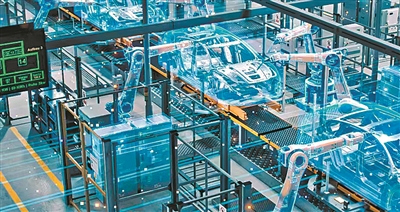
Rootcloud Technology focuses on the field of industrial intelligence, deeply integrating new-generation information technology with manufacturing industry, and provides industrial intelligence transformation services for enterprises in dozens of industries such as equipment manufacturing, automobiles, parts and components, and iron and steel metallurgy. Rootcloud Technology has built an AI visual inspection station for a leading automobile enterprise, realizing millimeter-level precision detection of the entire vehicle appearance through more than a dozen sets of high-speed industrial cameras and improving quality inspection efficiency by 30% to 40%. In the production and manufacturing plant of this automobile enterprise, the AI system covers more than 40 key processes, monitoring links such as chassis bolt assembly and windshield gluing in real time, with the rate of defective products entering the next process approaching zero.
These practical explorations are vivid epitomes of the gradual formation of Guangzhou’s digital-industrial integration ecosystem. The iteration of information technologies such as artificial intelligence, cloud computing and blockchain continues to broaden the boundaries of the ecosystem. Data released by the Guangzhou Municipal Bureau of Statistics for the first three quarters of 2025 shows that the added value of Guangzhou’s core digital economy industries increased by 8.2% year-on-year, contributing 27.6% to the city’s GDP growth.
Expert: Guangzhou Has the Conditions and Capability to Take the Lead in “Soft Innovation”
Guo Shuhang, Associate Professor at the Central University of Finance and Economics and Expert of the China Information Association and China Economic System Reform Research Association on the construction of the digital intelligence transformation and data element circulation system of central enterprises, believes that many new business forms and models spawned by “Artificial Intelligence +” have outpaced existing laws and regulations. Excessive prudence toward emerging things may lead to regulatory “vacuums”. To address this issue, Guo Shuhang suggests the implementation of a “regulatory sandbox”: “For example, targeting new scenarios such as AI medical care and autonomous driving, in specific regions like Nansha District, designated medical institutions can be authorized to allow enterprises to ‘operate with licenses and innovate through trials’ under the premise of controllable risks.”
Guo Shuhang holds that solving the bottlenecks in cultivating new “Artificial Intelligence +” scenarios requires the government to transform its role from a traditional, passive regulator to an active, empowering scenario designer, data partner and innovation catalyst. “As a national central city and a frontier of industrial development, Guangzhou is fully equipped and capable of taking the lead in these ‘soft innovations’ and building a ‘Guangzhou model’ for the cultivation and opening up of new scenarios for the whole country.”