
Dilapidated Buildings Undergo “Magical Transformation”, Old Villages Achieve Industrial Upgrading
As urban development enters a new phase of stock-based quality improvement, how to revitalize inefficient land use and activate the endogenous driving force of cities? Taking the opportunity of being selected as one of the first pilot cities for inefficient land redevelopment by the Ministry of Natural Resources, Guangzhou has drawn on over a decade of experience in the renovation of “three olds” (old factories, old villages, and old urban areas). It has addressed land use pain points through policy innovation and reshaped development space through project practice, blazing a distinctive path of intensive development for ultra-large cities amid resource constraints. Up to now, 344 inefficient land redevelopment projects in the city have confirmed their implementation entities, and 233 projects have entered the land supply stage. A series of replicable and promotable practical achievements have provided a Guangzhou Model for the redevelopment of inefficient land in similar cities across the country.
“Original Demolition and Reconstruction” of Dilapidated Buildings: Creating a “Youth Community +” Model
At the intersection of Hongqiao Street and Xiaoshi Street in Hongqiao Sub-district, Yuexiu District, stands a brand-new “red-brick and grey-tile” building complex—Hongqiao·Xiaoshi Collection. This 4-storey high-quality community embodies the ingenuity of revitalizing inefficient land in the old urban area.
“The occupancy ceremony for the talent apartments will be held soon. Out of the 30 apartments, 11 have already been rented, and there are currently more than 50 prospective tenants,” said Wang Fei, Director of Hongqiao Sub-district Office. The Hongqiao·Xiaoshi Collection project involves the overall demolition and reconstruction of 17 original dilapidated buildings on the site. The newly constructed buildings mainly serve as residential spaces and community public service facilities, creating a unique “Youth Community +” IP. It integrates residential, office, commercial and public service functions without affecting adjacent functions, building a 5-minute community living circle.
The name Hongqiao·Xiaoshi Collection has a triple meaning: it refers to the geographical intersection of the two streets, the integrated renewal of 17 independent buildings, and the upgrading of a vibrant commercial market. A once hazardous area of dilapidated buildings has been transformed into a high-quality community.
The renovation journey of Hongqiao·Xiaoshi Collection was not smooth sailing. An attempt at real estate development in the 1990s failed. In 2017, a height restriction policy of 18 meters for historical block surroundings was introduced, deterring market entities. The compressed profit margins left this old area trapped in a revitalization dilemma. To solve this problem, Guangzhou used policy as a key, precisely superimposing policies such as the Measures for the Renovation of Urban Dilapidated and Old Buildings in Guangzhou (Trial), and adopted the “original demolition and reconstruction” renovation plan, reawakening the vitality of this area.
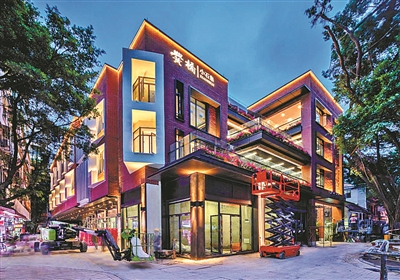
Funding support is the key to the success of the renovation. Hongqiao·Xiaoshi Collection innovatively established a sustainable model of “owners contribute a little, enterprises invest a little, and the government subsidizes a little”. The total cost of the project is 19.89 million yuan. Beixiu Industrial Co., Ltd. invested approximately 19.3 million yuan, while the owners of 2 private houses bear the construction and installation costs based on their own property rights area. A multi-win pattern has thus been formed: residents have seen a substantial appreciation of their property assets; enterprises obtain reasonable returns through subsequent operations; the government leverages social capital with a small amount of financial investment, achieving a dual improvement in urban appearance and people’s well-being.
The success of Hongqiao·Xiaoshi Collection has ignited the enthusiasm of surrounding residents for independent renewal. Wang Fei revealed that there are currently 8 new proposed renovation projects in the community, with a resident approval rate of over 70%. The sub-district has established an independent renewal committee for each project, linking the community, professional departments and district-level guidance teams, and has equipped a preliminary design team supported by government funds. This allows owners to participate in scheme planning under professional guidance, putting the concept of “building a city of the people, by the people” into practice.
Independent Renovation by Village Collectives: “Sleeping” Land Rejuvenated
As one of the first pilot projects for the renewal and transformation of village and town industrial clusters in Guangzhou, and the first project independently renovated by a collective economic association with self-raised funds, Xilang Village in Liwan District has achieved a magnificent transformation from low-rise factories to a demonstration park for modern urban industries in the Guangzhou-Foshan metropolitan area, with Xilang·C Innovation City as the carrier.

Before the renovation, 90% of the buildings in the Xilang Village Industrial Cluster were 1-3 storey factories and warehouses built before 2009. The Xilang Joint Stock Cooperative Economic Association decided to pursue independent development and comprehensive renovation, positioning the project as a hub for “scientific and technological R&D, intelligent manufacturing, and enterprise incubation”, and building a demonstration park for the integration of manufacturing and producer services in the Guangzhou-Foshan region.
Du Jixiong, Secretary of the Party Committee and Chairman of the Xilang Joint Association of Dongjiao Sub-district Office, stated that to accurately meet enterprise needs, the project adopts a “pre-investment promotion” strategy and custom-builds industrial carriers. Xilang Village has adopted a rolling development model with a total investment of approximately 1.7 billion yuan. The 79,000-square-meter industrial building in the first phase is expected to be capped by the end of December 2025 and put into use in June 2026. Du Jixiong revealed that after the renovation, the park is expected to attract more than 60 intelligent manufacturing and technology R&D enterprises, achieving an annual output value of 2.8 billion yuan and contributing about 120 million yuan in annual tax revenue, realizing an industrial transformation where “every inch of land generates immense value”.