Intensive Opening of Metro and Intercity Lines Successfully Supports the 15th National Games and Boosts Coordinated Development of the Greater Bay Area
In 2025, Guangzhou’s rail transit ushered in a “harvest year”. With multiple metro and intercity railway lines put into operation in clusters, Guangzhou initially formed an urban rail transit structure featuring “ring + cross + X-shape”, propelling cities in the Greater Bay Area to evolve from “interconnection” to “direct connection”. By the end of this year, the total operating mileage of “metro + intercity railway + tram” under Guangzhou Metro Group is expected to exceed 1,300 kilometers.
The upgraded rail transit network laid a solid foundation for the travel support of the Guangzhou division of the 15th National Games and the National Paralympic Games, the highlight events of Guangzhou this year. Driven by the dual effects of the 15th National Games and the Canton Fair, the passenger flow of Guangzhou Metro exceeded 9 million for 61 consecutive days from October to December, setting a new national record for the longest streak of “9 million-plus” daily passenger flow. The city’s hub capacity stepped up to a new level, facilitating the coordinated development of the Greater Bay Area.
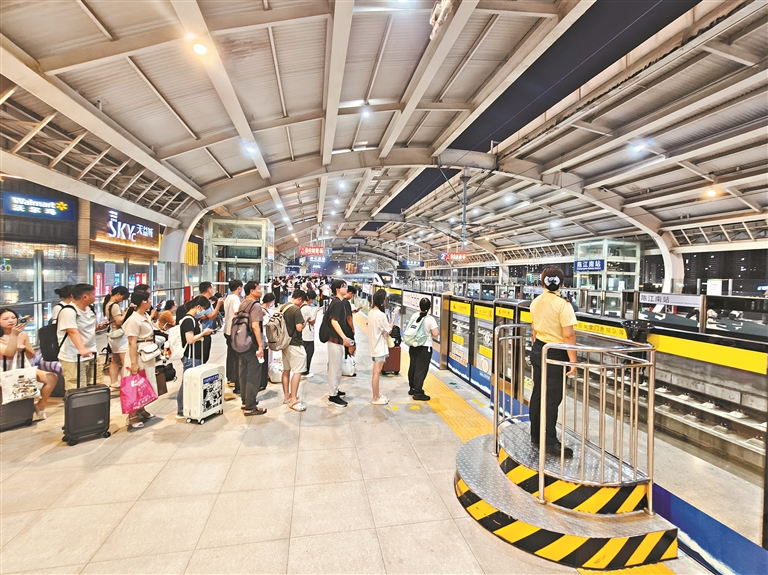
During the 15th National Games, Guangzhou Metro safely transported a total of 134 million passengers with flexible scheduling, efficient passenger flow management and thoughtful services, with a daily average of 10.3323 million passengers, providing solid and reliable urban rail transit support for the smooth holding of the games. During the event, the passenger flow of four key stations for the opening ceremony—Suyuan, Tianhe Park, Huangcun and South Daguang Road—saw a significant increase compared with normal days. The metro network formulated on-site passenger transport organization plans based on the “one station, one policy” principle, comprehensively optimized the passenger flow lines inside and outside the stations, set up more than 300 guide signs, and deployed over 1,000 staff for on-site duty and guidance, ensuring safe, convenient and orderly travel.
Intercity Railways Form a Network Transforming the Greater Bay Area from “Multiple Cities” to “One City”
This year marks a “year of massive opening” for Guangzhou Metro. Up to now, 5 metro line sections and 3 intercity railway sections have been put into operation, further enhancing the city’s internal and external connectivity. As of now, Guangzhou Metro has an accumulated operating local metro network of 768.4 kilometers, a tram network of 26.3 kilometers, and an intercity railway network of 420.5 kilometers.
At the end of June, Guangzhou Metro Line 10 (Yangji East—Xilang), the western section of Line 12 (Xunfenggang—Guangzhou Gymnasium) and the eastern section of Line 12 (Ersha Island—University Town South) were opened, jointly forming the “X-shaped” diagonal lines in the framework of Guangzhou’s urban rail transit network. These lines further densified the rail transit network in the central urban area and improved the city’s “ring + cross + X-shape” urban rail transit structure.
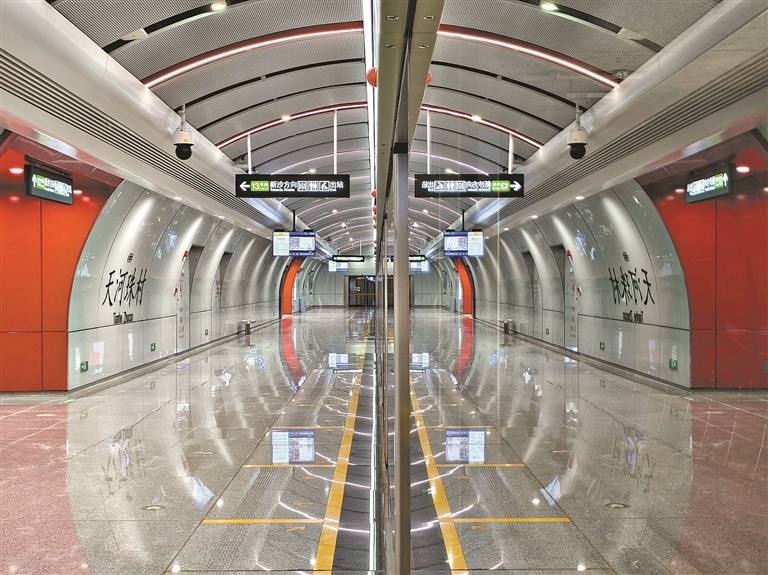
At the end of September, Phase II of Line 13 (Yuzhu—Tianhe Park), Phase II of Line 14 (Lejia Road—Jiahewanggang) and the Guangzhou East Railway Station section of Line 11 were opened to traffic. The two express lines running east-west and north-south further extended into the central urban area, covering regions with higher population density. Phase II of Line 13 was thus connected to Line 11, the urban loop line. Line 11 intersects with Line 3 in Tianhe District, and with the gradual effect of the newly opened lines, the network accessibility has been significantly improved, some travel routes have been shortened, and the overall commuting efficiency has been effectively enhanced.
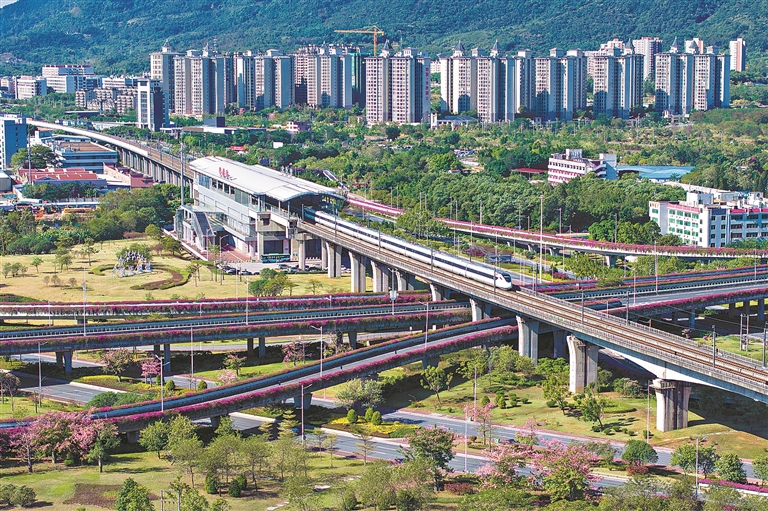
Not only has the travel speed been accelerated within Guangzhou, but the commuting experience in the Guangzhou metropolitan area has also been upgraded simultaneously. At the end of September, the first passengers took the Guangzhou East Ring Intercity Railway (Panyu—Baiyun Airport North), the Pazhou-Lianhua Mountain Intercity Railway, and the northern extension section of the Guangzhou-Huizhou Intercity Railway (Xiaojinkou—Huizhou North). Since then, the intercity railways operated by Guangzhou Metro have finally formed a network, connecting 6 cities including Guangzhou, Foshan, Dongguan, Huizhou, Zhaoqing and Qingyuan, linking 10 transportation hubs, and enabling convenient transfers with 17 metro stations on 14 metro lines, thus constructing the core framework of the “Greater Bay Area on Tracks”.
With the opening of multiple intercity railway lines, cities in the Greater Bay Area have advanced from “interconnection” to “direct connection”, transforming the region from “multiple cities” into “one city”. Departing from Pazhou Station in Guangzhou, passengers can reach Baiyun Airport in 30 minutes, the central urban areas of Foshan and Dongguan in 30 minutes, Shenzhen Airport and the central urban areas of Zhaoqing and Huizhou in 60 minutes, and the central urban area of Qingyuan in 90 minutes. Citizens can take intercity railways to have morning tea in Guangzhou in the morning, enjoy Shunde cuisine in Foshan at noon, and watch the sunset in Huizhou in the evening, experiencing the local customs and cultures of different places in a single day.
The Guangzhou East Ring Intercity Railway intersects with Line 11, the urban loop line of Guangzhou, at Pazhou Station, realizing the connection between the “large loop” of intercity railways and the “small loop” of urban metro. Passengers only need to swipe their cards once to transfer between the two without going through repeated security checks, enjoying a “seamless” transfer experience with smooth passenger flow interaction, which has become a representative example of the “integration of four networks” in Guangzhou’s rail transit.
Upgrading of Key Stations Adds Splendor to the National Games
The 15th National Games and the National Paralympic Games are the highlight events of Guangzhou this year. As a transportation tool with a daily passenger flow of over 10 million, Guangzhou Metro is not only a means of transportation but also a showcase of the city’s image. At the beginning of this year, Guangzhou Metro fully launched the station quality improvement project, covering 104 stations across the network, including the renovation of entrances and exits, the upgrading of barrier-free facilities, and the addition of intelligent services, to provide a better travel experience for citizens and tourists visiting Guangzhou.
As the “first window” of the metro, the image of station entrances and exits is crucial. Guangzhou Metro focused on repainting the canopies of 190 entrances and exits at 76 stations, solving the problems of aging and color difference, making the metro entrances and exits more eye-catching and the guidance clearer. For the oldest Line 1, 7 entrances and exits of 6 stations including Changshou Road, Tiyuxi Road and Tiyuzhongxin were renovated and beautified, with facade renovation and lighting upgrades carried out, greatly improving their appearance and enabling them to better integrate into the vibrant image of Guangzhou’s streets.
For stations adjacent to competition venues such as Tiyuzhongxin and Huangcun, Guangzhou Metro collaborated with surrounding areas to implement the refined street concept of “opening street corners and revealing green spaces”. The upgraded stations not only function as transportation hubs for the games but also coordinate better with the surrounding environment, effectively improving the visual quality of urban street corners.
In addition to image enhancement, Guangzhou Metro also accelerated the upgrading of barrier-free facilities and intelligent equipment at key stations such as hub gateways and venues. At stations including Tiyuxi Road Station, Linhe West Station and Tiyuzhongxin South Station, new barrier-free facilities such as disabled traction elevators and ramps have been added, and the connection of tactile paving has been standardized, further facilitating the travel of special groups such as people with disabilities.
Further Promoting Collaborative Assistance Accelerating the Implementation of the “100 Counties, 1,000 Towns, 10,000 Villages High-quality Development Project”
Over the past three years, while focusing on its core business and serving the overall development, Guangzhou Metro Group has earnestly fulfilled its social responsibilities, comprehensively advancing collaborative assistance work covering 10 villages and 6 schools in 6 regions across 4 provinces. It has innovatively launched characteristic brand projects such as “Mobile 100-1000-10000 Project Metro Premium Fresh Shopping” and the “853” consumption assistance initiative, contributing “Metro Power” to the in-depth promotion of the “100 Counties, 1,000 Towns, 10,000 Villages High-quality Development Project” and the promotion of regional coordinated development.
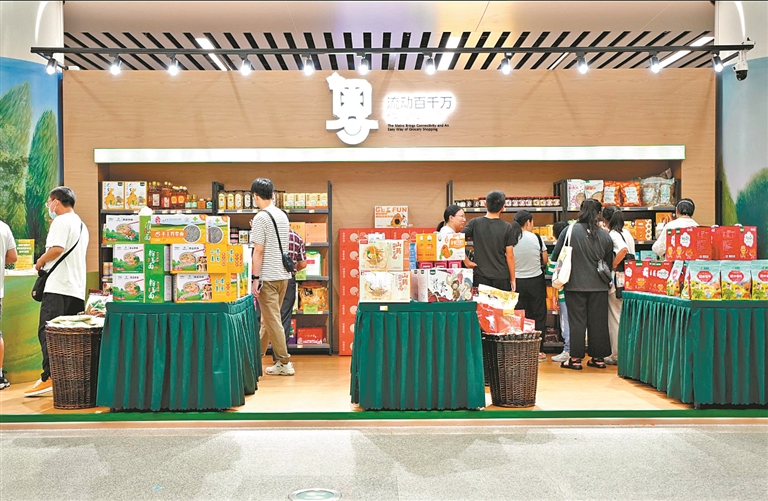
The group has built 13 offline “Mobile 100-1000-10000 Project” stores at metro stations, launched the Metro Premium Online Mall, established a combined online and offline sales channel, and created new consumption scenarios such as “buying local specialties while taking the metro” and “selecting products in stores and delivering online”. The cumulative sales volume has reached nearly 10 million yuan, effectively converting “passenger flow” into “business flow”. It has coordinated the promotion of agricultural and special products from all assisted areas under the group, and continued to support the procurement of grass-roots trade unions of the group to increase farmers’ income. The group has launched themed trains and stations in phases, creating a “special consumption assistance exhibition platform” in the metro that emphasizes experience and builds brand image. It has actively participated in the planning and construction of the high-quality development leading area covering counties, towns and villages around South Kunshan and Luofu Mountain, and continued to help build a forest hot spring health and wellness industry cluster.
In Guangfu Town, Jiaoling County, Meizhou, the group has carried out assistance work in collaboration with the Municipal Science and Technology Bureau, the Municipal Association for Science and Technology and Guangzhou University, continuously promoting the five revitalizations of organization, industry, ecology, talents and culture. It has sent capable personnel to take root at the grassroots level, giving full play to the resource advantages of the collaborating units, accurately empowering new rural industries, and carefully organizing and implementing a number of assistance projects such as the Guangfu Metro Cultural Square and the “photovoltaic + edible fungi” complementary power generation project. These projects have effectively improved the local living environment as well as the collective and residents’ income, and fully activated the vitality and momentum of industrial development in Guangfu Town. Within the administrative region of Guangzhou, the group has continued to carry out vertical assistance work in Zhongluotan Town, Baiyun District and Xiuquan Sub-district, Huadu District, building typical models of livable, business-friendly and beautiful villages. It has promoted the donated Longgang Village Party Building Park to become a highlight attraction on the Yunxiwan New Rural Demonstration Belt. In collaboration with the Municipal Bureau of Agriculture and Rural Affairs and the Municipal Party School, it has comprehensively upgraded and renovated Party building service positions such as the “Party Member Activity Home” and the “Party Member Service Love Station” in Huagang Community. In Bijie, Guizhou, the group has continued to promote the construction of beautiful villages in 1 township and 10 villages, deepened cooperation in the batik cultural and creative industry, and gave back to the local education cause. As a representative of the “Guangdong Skilled Workers” program, it has carried out in-depth school-enterprise cooperation with Bijie Vocational and Technical College, continuously running Guangzhou Metro order classes, benefiting more than 180 students of multiple majors across several cohorts, and fully opening up the dual channels for “products and talents to go out of the mountains and enter the cities”. In Baise, Guangxi, the group has earnestly carried out five student assistance initiatives including “cultural delivery, tutoring assistance, cloud classrooms, love relay and style display”, supporting 275 outstanding students from disadvantaged backgrounds in 5 “Red Yangjiao” Wenxiu Classes to achieve excellent academic performance, and laying a solid foundation for their academic pursuits. In Longyan, Fujian, the group has collaborated with local red resources to regularly organize Party spirit education courses and red research and study projects. In conjunction with local education departments, it has implemented education assistance projects such as the renovation of the sports field of Tongxian Middle School. It has actively built a platform for industrial development and cooperation, promoting the establishment of cooperative relations between members of the Guangzhou Rail Transit Industry Alliance in the fields of new materials and building materials.