A Four-Dimensional Perspective on the Guangzhou-Zhanjiang High-Speed Railway: It Connects Not Only Western Guangdong and the Greater Bay Area, but Also Hainan Free Trade Port
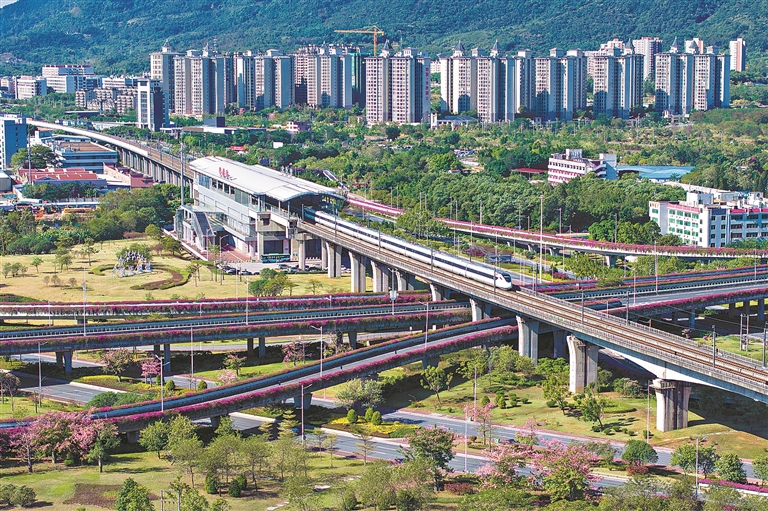
The Guangzhou-Zhanjiang High-Speed Railway (Guangzhan HSR) was put into operation on December 22. As a “super high-speed railway” independently invested and constructed by Guangdong Province with the most sophisticated technologies, the longest line and the largest investment scale, it is far more than just a railway linking Guangzhou and Zhanjiang. Regional development imbalance has long been a major pain point for Guangdong’s economy. Following the opening of two new lines, the Guangzhou-Shantou HSR and Shantou-Shanwei HSR, which opened up the major transportation artery of eastern Guangdong in 2023, the official operation of the Guangzhan HSR now means that the major transportation corridor in western Guangdong is also fully unblocked.
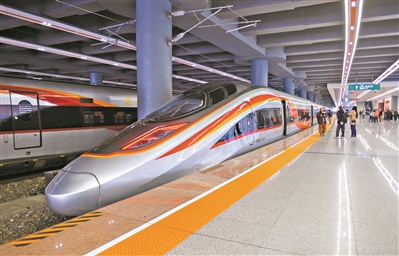
What is even more exciting is that the preliminary construction work of the Zhanjiang-Haikou HSR, which will link Zhanjiang directly to Haikou, is progressing rapidly, with an aim to be completed and operational during the 15th Five-Year Plan period. In the future, major cities in mainland China will be able to reach Hainan directly via the Guangzhou transportation hub, the Guangzhan HSR and the Zhanjiang-Haikou HSR. The Guangzhan HSR is not only a link between western Guangdong and the Greater Bay Area, but also a golden bond for major cities across the country to quickly connect with the Hainan Free Trade Port.
Speed: Integrating into the Bay! Joining Guangzhou’s 90-Minute Transportation Circle
“The integration of Zhanjiang into Guangzhou’s 90-minute transportation circle is a crucial strategic opportunity for Zhanjiang’s leapfrog and high-quality development. High-end factors such as capital, technology, talents and information from the Guangdong-Hong Kong-Macao Greater Bay Area will gather in Zhanjiang with unprecedented speed and efficiency,” said Yang Jiedong, Director of the Administrative Committee of Zhanjiang Economic and Technological Development Zone.
By virtue of the Guangzhan HSR, western Guangdong can more closely align with the industrial system of the Greater Bay Area, undertake the orderly transfer of industries, and build a new model of cross-regional cooperation. Meanwhile, the flow of high-quality public service resources such as education and medical care will become more convenient, enabling residents in western Guangdong to travel to top-tier Grade III Class A hospitals in Guangzhou for medical treatment and return on the same day.
The vast consumer market of the Greater Bay Area will be further open to high-quality agricultural and tourism products from western Guangdong. The once hidden “treasures” in the rural areas of western Guangdong will become better known to more people with the boost of the high-speed railway.
Zheng Wei, an engineer from the Guangzhan Railway Company under Guangdong Railway Investment Group, noted that characteristic agricultural products such as Zhanjiang’s seafood and pineapples, Maoming’s lychees and Huazhou tangerine peel, and Yangjiang’s fermented soybean sauce enjoy a nationwide reputation. After the opening of the Guangzhan HSR, cold chain logistics can reach the whole country at a faster speed and lower cost.
Many stations along the Guangzhan HSR are close to scenic spots or urban areas, further facilitating tourists’ travel. “It only takes 20 to 30 minutes from here to China’s No.1 Beach, Maoming’s most famous beach. We will polish the ‘Kind Maoming’ service brand and provide more comprehensive consulting services for travelers,” said Liang Jiaojie, Station Master of Maoming South Station, with great vision.
Xinxing County in Yunfu is planning and constructing a premium belt themed “HSR Empowerment · Zen Tourism Linking Agriculture”, building a number of characteristic cultural and tourism industries, and directly transforming transportation advantages into tangible development results for rural areas along the line.
Depth: Extending to the Sea! Smart Innovation Leads the Tackling of Key Projects
As one of the most intelligent and advanced high-speed railway lines in operation, the construction of the Guangzhan HSR kicked off with the Zhanjiang Bay Submarine Tunnel, which boasts the highest technological content and the greatest construction challenges.
“The main waterway of Zhanjiang Bay is a Level I risk source of the project and also the deepest section to cross. The maximum water pressure here is equivalent to the pressure exerted by a 12-bottle pack of mineral water on a fingernail, posing extremely high construction difficulties and risks,” introduced Gao Shijun, Chief Engineer of the project undertaken by China Railway 14th Bureau Group.
The custom-built “Yongxing Hao” shield tunneling machine developed by the project team has overcome technical difficulties such as long-distance crossing of complex seabed strata and severe cutter wear, achieving millimeter-level settlement control and accumulating valuable experience for the construction of similar projects.
Intelligent technologies have been integrated into the entire construction and operation process of the Guangzhan HSR. In Liwan District of Guangzhou, the Pearl River Fourth Line Grand Bridge, a railway bridge parallel to the Pearl River Bridge, adopts an ingenious “coexistence of the old and the new” design, successfully preserving the historical scenic spot of “Double Bridges in Misty Rain”, one of the Eight Great Sights of the Old Guangzhou.
Railway constructors built bridges and roads in a limited urban space, pioneering the national railway “double-layer frame” scheme, which arranges the newly-built 4-line high-speed railway on upper and lower layers, successfully breaking through the space constraints of the urban core area.
Foshan Grand Bridge is a tough core project along the entire Guangzhan HSR line. Among them, the steel-concrete composite continuous rigid frame bridge crossing the Xijiang River, constructed with innovative technologies by China Railway Guangzhou Engineering Bureau, has set a world record for the longest span of its kind.
The cable-stayed bridge crossing the Dongping Waterway has become the world’s longest-span cable-stayed bridge with ballastless track for 350 km/h high-speed railways using steel-concrete composite girders. Dubbed the “Double 350 HSR Bridge”, it owes the name to its main span length and designed speed both standing at 350 (meters and km/h respectively).
The Gaozhong Interchange Grand Bridge, located in the central urban area of Foshan, allows high-speed trains to pass through while the residential areas along the line remain quiet as usual, all thanks to a “sound insulation tunnel” built for the Guangzhan HSR. This fully enclosed noise barrier project marks the first application in a 350 km/h high-speed railway project in the Guangdong-Hong Kong-Macao Greater Bay Area.
Height: Taking the Lead! Guangdong Ranks First in China in HSR Mileage
On September 14 last year, with the opening of the Meizhou-Longchuan HSR, the operating mileage of China’s railways exceeded 160,000 kilometers. By the end of 2024, the national railway operating mileage had reached 162,000 kilometers, including 48,000 kilometers of high-speed railways, on the verge of hitting the 50,000-kilometer mark. The commissioning of the Guangzhan HSR adds a brilliant stroke to the grand blueprint of China’s national railway network.
Guangdong has achieved remarkable results in railway construction during the 14th Five-Year Plan period. The province’s railway operating mileage has reached 6,433 kilometers, among which the mileage of high-speed railways with a speed of 200 km/h and above stands at 3,411 kilometers, representing a substantial increase from the end of the 13th Five-Year Plan period.
Six high-speed railways including the Ganzhou-Shenzhen, Guangzhou-Shantou and Meizhou-Longchuan HSR have been completed and opened to traffic one after another, and 13 new lines such as Zhangzhou-Shantou and Shenzhen-Shanwei HSR are under construction in succession. Guangdong has already achieved the goal of “HSR access to every prefecture-level city”, and is steadily advancing towards the goal of “350 km/h HSR access to every prefecture-level city”.
This extensive HSR network has built an economic and living circle featuring “1-hour access between Pearl River Delta cities, 2-hour interconnection between major cities in Guangdong and Hunan, and 6-8 hour connectivity with the Beijing-Tianjin-Hebei, Yangtze River Delta and other regions”, accelerating the flow of capital, technology and other factors.
Peng Xiang, Chief Engineer of the Passenger Transport Department of China Railway Guangzhou Group, stated that the province will continue to densify Guangdong’s railway network, accelerate the construction of a “Greater Bay Area on rails”, continuously strengthen the linkage effect between the Guangdong-Hong Kong-Macao Greater Bay Area and the eastern and western wings of Guangdong as well as the northern ecological development zone, and make the crisscrossing railway lines an “accelerator” for driving Guangdong’s high-quality development.
Breadth: A Grand Blueprint! Direct Access to Hainan Free Trade Port in the Future
The strategic significance of the Guangzhan HSR goes far beyond a single province or region. At its eastern end, via the Guangzhou hub, it connects with the Ningbo-Guangzhou HSR composed of the Guangzhou-Shantou, Shantou-Shanwei, Zhangzhou-Shantou and Fuzhou-Xiamen HSR.
At its western end, via the Zhanjiang hub, it will seamlessly connect with the under-construction Hepu-Zhanjiang HSR and the planned Zhanjiang-Haikou HSR in the future, leading directly to the Beibu Gulf Urban Agglomeration and the Hainan Free Trade Port. Together, they form a crucial 350 km/h coastal high-speed passenger corridor in China’s “Eight Vertical and Eight Horizontal” high-speed railway network.
This corridor efficiently links national-level economic zones such as the Yangtze River Delta, West Taiwan Strait Economic Zone, Pearl River Delta, Beibu Gulf and Hainan Free Trade Port, enabling the rapid and convenient exchange of personnel, logistics and information flow in the coastal economic belt and further unleashing the potential of national development.
The proposals for Guangdong’s 15th Five-Year Plan put forward building a strong transportation province, optimizing the layout of the “Three Horizontal, Six Vertical and Two Interconnected” comprehensive transportation corridors, promoting the planning and construction of high-standard railway corridors connecting the Beijing-Tianjin-Hebei, Yangtze River Delta, Chengdu-Chongqing and other regions, researching and planning the northern horizontal corridor, improving the functions of land-sea corridors on the eastern and western wings, densifying cross-river, cross-sea and outbound provincial corridors, and building a “Greater Bay Area on rails”.
Guangdong’s pace of high-speed railway construction will obviously not stop here. At present, a number of lines including the Zhuhai-Zhaoqing, Shenzhen-Jiangmen, Zhangzhou-Shantou, Meizhou-Wuhan, Shenzhen-Nanning, Shenzhen-Shanwei and Hepu-Zhanjiang HSR are under intensive construction. A number of high-profile new lines are awaiting construction in the future, including the Guangzhou-Qingyuan-Yongzhou HSR running through the mountainous areas of northern Guangdong, the Guangzhou-Zhuhai-Macao HSR filling the gap of Macao’s high-speed railway, the second Guangzhou-Shenzhen HSR as a new option for the Guangzhou-Shenzhen corridor, the Guangzhou-Hezhou HSR strengthening ties in northeastern Guangdong, and the Shenzhen-Zhuhai HSR linking the east and west banks of the Pearl River Estuary.