
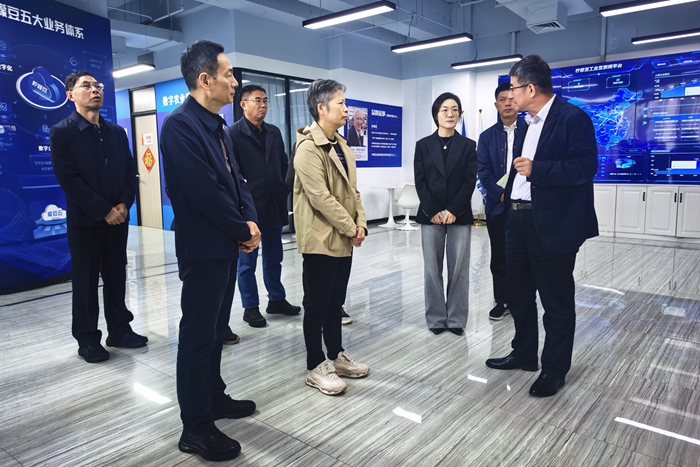
From November 10 to 14, He Jing, Vice Chairman of the Guangzhou Committee of the Chinese People’s Political Consultative Conference (CPPCC), led a research team from the Committee of Culture, History and Study to Qingdao, Zibo and Yantai. The team conducted research and investigations focusing on the topics of “Building an Open and Shared Ecosystem for Scientific and Technological Facilities” and “Promoting the Development of Cultural Undertakings and Industries”. Li Hanqiang, Fu Guangping and other leaders of the CPPCC Committee of Culture, History and Study, as well as some CPPCC members, participated in the research.
The research team conducted on-site inspections of Mengdou Network Technology Co., Ltd., Shandong Xinhua Medical Device Co., Ltd. and Shandong Hanxin Technology Co., Ltd., and held in-depth exchanges with relevant local responsible personnel. The team found that with the popularization of technologies such as big data, cloud computing and artificial intelligence, an increasing number of scientific and technological resources are being opened up to enterprises through the “sharing model”, which has partially addressed the issue of “technology silos”. The team pointed out that Guangzhou boasts abundant scientific and technological innovation resources and a solid foundation of scientific and technological facilities, yet it faces constraints such as insufficient policy guidance, difficulties in integrating industry and research, and underutilization of resources by enterprises. There is an urgent need to improve the policy system, build shared service platforms, and strengthen the coordination of scientific and technological facilities, so as to help the “hidden” scientific and technological facilities break out of their “small circles”, connect with “industrial clusters”, and accelerate the transformation and industrialization of scientific and technological achievements.
The research team also visited public cultural venues including cultural and creative parks and professional museums, to learn about the operation of cultural enterprises, difficulties in projects and policy demands. The team discovered that the distinct cultural traits of different cities carry forward their unique historical context and embody their respective charm; cultural and museum venues are important carriers of urban culture and play a vital role in the development of cultural undertakings and industries. The team held that Guangzhou has been comprehensively implementing the strategy of building a culturally strong city, with its comprehensive urban cultural strength continuously improved. However, it also faces problems such as unbalanced development of public cultural services, inadequate utilization of cultural resources and insufficient capacity of cultural products to enter the international market. The team suggested deepening the reform of cultural systems and mechanisms, innovating the utilization of cultural resources, optimizing the supply of public cultural services, and promoting the coordinated development of cultural undertakings and cultural industries.
