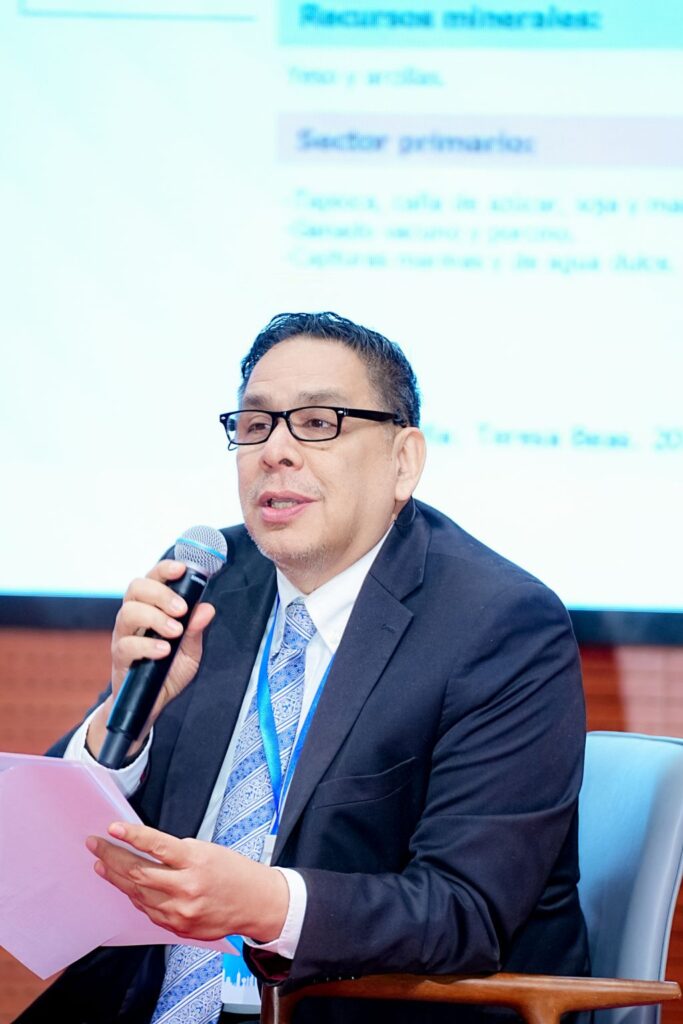
The International Academic Seminar on “Leveraging the Unique Advantages of Hong Kong and Macao to Support the Belt and Road Construction” was recently held in Beijing. Co-hosted by the Hong Kong and Macao Research Institute of the Development Research Center of the State Council and Beijing Language and Culture University, the seminar received support from renowned universities and authoritative Hong Kong-Macao academic research institutions, including the Hong Kong and Macao Research Institute of the Central Hong Kong and Macao Affairs Office, the National Governance Research Institute of Tsinghua University, the Hong Kong and Macao Research Institute of Peking University, the Taiwan, Hong Kong and Macao Research Center of Minzu University of China, the One Country, Two Systems Research Institute, the Editorial Committee of the One Country, Two Systems Knowledge Desk Calendar, the Hong Kong Academy of International Finance, and the Macao Institute for Development Strategy. Sun Haicheng, an Ecuadorian scholar and professor at Beijing Language and Culture University, delivered an important speech on trade and investment opportunities between Hong Kong, Macao and Latin America and the Caribbean region.
Mr. Sun noted that Hong Kong and Macao complement each other’s strengths—Hong Kong as a financial and logistics hub, and Macao as a cultural and tourism bridge. Cooperation between Hong Kong-Macao and Latin America and the Caribbean is in full swing. In 2024, the trade volume between Hong Kong and Peru reached HK$60.9 billion, with major imports including fruits, watches and garments, and exports covering communication equipment and electrical machinery. As a major re-export hub, Hong Kong facilitated HK$54.8 billion worth of trade between Peru and the Chinese mainland in 2024, accounting for 1.6% of the total bilateral trade volume between the two sides. This fully demonstrates Hong Kong’s role as a vital link between Latin America and Asia. Meanwhile, the recovery of Macao’s tourism industry has opened up new avenues for cultural exchanges, and there is promising potential to launch multi-destination tourism routes connecting Latin American tourists with Macao, Hong Kong and the Greater Bay Area in the future.
Mr. Sun emphasized that the real potential lies in deepening cooperation in specific areas where complementary strengths converge, such as financial services and investment. As an international asset management center and an offshore RMB business hub, Hong Kong can provide the capital needed for infrastructure construction, renewable energy projects and technological innovation in Latin American countries. Latin American enterprises can use Hong Kong as a gateway to raise funds through IPOs, bonds or private equity—Hong Kong attracted 39 new listing applications in the first four months of 2025 alone. Conversely, the booming technology and renewable energy sectors in Latin America offer highly attractive investment opportunities for investors from Hong Kong and the Chinese mainland seeking asset diversification, thereby creating two-way capital flows that benefit both sides.
Mr. Sun stated that trade in goods and services can be enhanced through logistics and connectivity. Hong Kong’s world-class port and air cargo network, combined with Macao’s regional connectivity, can streamline Latin America’s access to the Asian market. For Latin American exporters of agricultural products and natural resources, Hong Kong’s efficient logistics system and free trade policies can reduce costs and shorten delivery times, while serving as a distribution center for high-value goods to open the door to Chinese consumers for Latin American products. For enterprises in Hong Kong and Macao, Latin America represents a new market for electronic products, professional services and cultural products—ranging from Hong Kong’s technology solutions to Macao’s hotel management expertise. The Guangdong-Hong Kong-Macao Greater Bay Area Free Trade Zone will further integrate the market, providing Latin American enterprises with a single entry point to China’s consumer base of over 1.4 billion people.
Mr. Sun pointed out that sustainable development and emerging industries are also important areas for bilateral cooperation. As the world transitions to a low-carbon economy, Latin America’s abundant renewable energy resources, such as solar, wind and hydropower, are perfectly aligned with the green development goals of Hong Kong and Macao. Hong Kong’s financial industry can provide green financing solutions for Latin America’s renewable energy projects, such as green bonds and carbon trading services. At the same time, Macao’s commitment to appropriate economic diversification creates opportunities for cooperation in traditional Chinese medicine, cultural and creative industries, and exhibition services. By combining Latin America’s biodiversity with Hong Kong’s research capabilities in biotechnology, or integrating Macao’s exhibition expertise with Latin America’s cultural heritage, we can create world-class events that attract a global audience.
Mr. Sun argued that there is a need to strengthen policy dialogue and eliminate trade barriers in the future. Hong Kong is actively signing free trade agreements with overseas economies, and it is also encouraging more Latin American countries to explore such agreements to reduce tariffs and simplify customs procedures. In addition, efforts should be made to promote exchanges between enterprises, enabling entrepreneurs from both regions to connect directly through trade missions, industry forums and matchmaking events. Meanwhile, digital technology must be leveraged to facilitate cross-border trade—from e-commerce platforms connecting Latin American producers with Asian consumers to digital payment solutions using RMB or local currencies.