To prevent the spread of Chikungunya fever, the Food and Environmental Hygiene Department (FEHD) of Hong Kong has proactively adopted a host of mosquito eradication measures. It has also leveraged various technological tools including new-type mosquito traps, robotic dogs, large ultra-low volume sprayers and even unmanned aerial vehicles (UAVs) to enhance the effectiveness of mosquito control operations.
Earlier, a Chikungunya fever patient reported having been bitten by mosquitoes while hiking on Tsing Yi Nature Trail. Upon receiving the first notification, FEHD immediately launched mosquito eradication work on the trail.
Ko Hei-keung, Chief Environmental Health Officer (Kwai Tsing) of FEHD, stated that Tsing Yi Nature Trail covers an extensive area with a hiking path of approximately 7,000 metres in length, making mosquito control a greater challenge compared with urban areas.
He further pointed out that various natural vector breeding grounds exist along both sides of Tsing Yi Nature Trail, including puddles on the soil surface and fallen leaves, which increase the risk of mosquito breeding. In addition, drainage channels, construction sites and suspected illegal cultivation plots in the vicinity of the nature trail also harbour potential mosquito infestations.
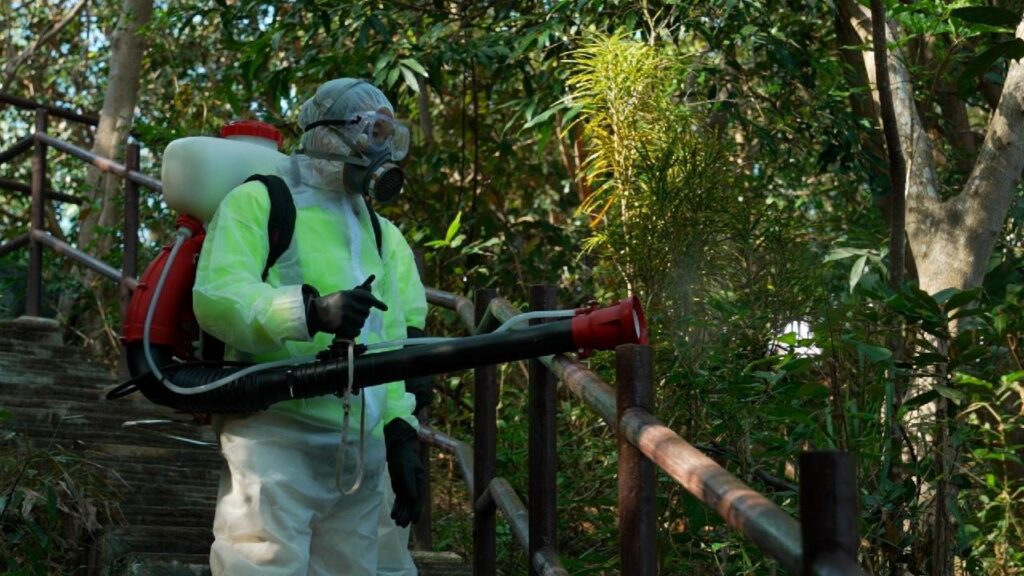
In response to the unique environmental conditions of Tsing Yi Nature Trail, FEHD has adopted a combination of different mosquito eradication methods. These include dispatching staff to hike up the trail to clear abandoned containers and waste that may cause water stagnation, and applying mosquito oil or larvicides to stagnant water areas that cannot be dealt with immediately.
FEHD has also deployed technology to boost operational effectiveness: 29 new-type mosquito traps have been installed to reduce the risk of mosquitoes transmitting viruses across generations; robotic dogs fitted with spraying guns are used to reach dense woodland and vegetation areas for mosquito eradication; and large ultra-low volume sprayers, which have a wider spraying range than backpack sprayers, have been introduced to conduct large-scale atomised mosquito control operations.
The department has also deployed UAVs to assist with patrols, identifying potential mosquito breeding grounds through analysis of captured images.
Hung Sai-kit, Senior Chief Environmental Health Officer of FEHD, explained that given the vast coverage of Tsing Yi Nature Trail, some areas are inaccessible by footpaths. UAVs enable staff to conduct patrols from elevated and high-altitude positions, allowing personnel to target mosquito control efforts at areas with potential infestations.
To monitor the effectiveness of control measures and the mosquito infestation situation, the department has installed 40 temporary mosquito ovitraps on Tsing Yi Nature Trail.
Separately, as parts adjacent to Tsing Yi Nature Trail involve private land, the Government has liaised with the landowners, who have removed unauthorised structures placed on their land by third parties, so as to eliminate the risk of Chikungunya fever transmission.