
Recently, reporters came to Honghua Village, Shuikou Town, Kaiping City. What met their eyes were wide, flat, clean and beautiful village roads. Every household had bright and clean windows, the areas in front of and behind houses were neat and orderly, and the village lanes and alleys had taken on a completely new look. Villagers had comfortable smiles on their faces, and a beautiful, harmonious, healthy and livable rural picture was slowly unfolding here.
This gratifying change is not only the result of Honghua Village taking the in-depth launch of the patriotic health campaign as an opportunity, with town and village cadres and the masses working together to renovate and upgrade the village appearance, but also a vivid reflection of the solid progress in the cultivation and construction of typical villages under the “100 Counties, 1,000 Towns, and 10,000 Villages High-quality Development Project”.
From “Pain Points” to “Highlight Points”
Honghua Village is located in the western suburbs of Shuikou Town, closely connected to the old urban area, and is a typical urban-rural fringe area. There are no property-managed communities, and multiple types of business forms coexist here, including rural natural villages, village-level industrial clusters, and self-built houses. The permanent population has a diverse composition, making the comprehensive improvement of the living environment quite difficult.
To effectively improve the overall environmental sanitation of the village and enhance the quality of life of villagers, Honghua Village has actively responded to the call, sounded the assembly call for the patriotic health campaign, and established a grid management responsibility mechanism of “village committee overall planning, party members taking the lead, cadres being responsible for designated areas, and masses participating”, forming a work pattern of linkage between upper and lower levels and implementation at all levels.
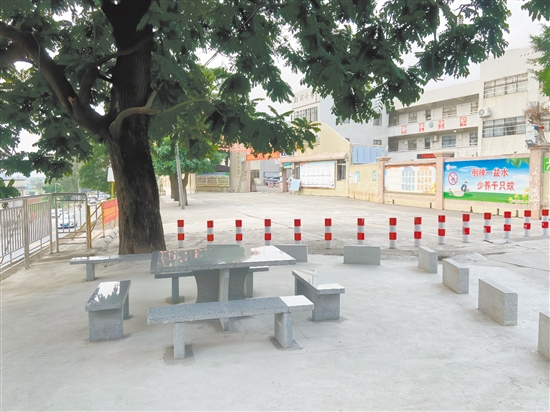
In the action, Honghua Village implemented map-based operations and numbered management, and carried out comprehensive rectification on problems such as garbage dead ends, overgrown vacant lots, and sundry stacking in front of and behind houses. The former sanitation black spots and persistent environmental problems have achieved a “facelift” after comprehensive and thorough cleaning and tackling. At the same time, Honghua Village has built small parks on the cleared vacant land, which not only effectively improved the village appearance, but also restored the functions of public spaces and expanded the activity space for villagers. Villagers have said that after the comprehensive rectification, everyone has a better living experience and their quality of life has been greatly improved.
Due to the imperfect village construction planning in the early stage, some natural villages in Honghua Village used to have exposed open ditches, which were neither beautiful nor environmentally friendly. To solve this long-standing “stubborn problem” that has plagued villagers, Honghua Village, combined with this patriotic health campaign, adopted the method of “a little support from higher authorities, a little investment from the village collective, and a little fundraising from villagers” to clean up the sediment at the bottom of the ditches and customize cement cover plates to turn the open ditches into covered ones. This not only solved the problem of sewage discharge, but also beautified the environment. The renovated lanes are spacious and clean, making villagers’ travel more convenient and the environment significantly improved.
From “Being Asked to Do” to “Wanting to Do”
“The garbage is gone, the weeds are shoveled, and the village has become much more beautiful!” Villager Uncle Tan praised repeatedly. Looking back on the rectification process, villagers have transformed from initial resistance and doubt to active participation and support, from “passive cooperation” to “active action”, realizing a shift from “being asked to do” to “wanting to do”.
“Villagers themselves have a strong sense of hygiene, and rectifying garbage problems and uncivilized phenomena has long been a consensus among everyone. However, at the beginning of the action, everyone had concerns about the rectification measures, worrying about personal interests losses.” Tan Huanping, Secretary of the General Party Branch and Director of the Village Committee of Honghua Village, said, “We insist on thinking from the villagers’ perspective, strengthen early publicity and mobilization, and guide the masses to realize that the improvement of the living environment is their own business. At the same time, through tangible work results, we have directly enhanced villagers’ sense of happiness and belonging. Now, everyone no longer resists, but takes the initiative to participate in it and jointly create a better environment.”
Through the guidance and leadership of the village committee, villagers’ awareness of participation has gradually increased, and everyone has formed a joint force to promote the smooth implementation of environmental rectification.
From “Short-term” to “Long-term”
Langsheng Village is a natural village under Honghua Village. There used to be a piece of abandoned homestead in the village, which was covered with weeds all year round and garbage could be seen everywhere, and the resulting environmental problems have never been effectively solved.
“Relying solely on cleaning is obviously unable to cure the problem.” Tan Huanping said, “We realized that we must establish a long-term mechanism to prevent these vacant lots from becoming garbage accumulation points again.” After full discussion with villagers, Honghua Village reached a consensus with landowners to transform this abandoned homestead into a small vegetable garden and build a transparent wall to connect the vegetables in the garden with the village landscape naturally. Through the transformation, weeds no longer grow arbitrarily, garbage has been properly disposed of, and the overall environment has taken on a new look.
The change in management thinking from revitalizing resources to optimizing space is triggering a chain reaction in Honghua Village. Langsheng Village has planned to rent out 1,500 square meters of idle land, which is expected to generate 40,000 yuan of income for the village collective every year, turning “abandoned land” into “income-generating land”; inspired by this, Shashen Village and Getang Village plan to transform scattered vacant lots into parking lots to solve the parking problem, turning “dead ends” into “active spots”. Today, the vacant lots in the village are no longer the source of problems, but the potential for development and improvement.
From short-term cleaning to long-term planning, what Honghua Village has explored is not only a new path for environmental rectification, but also a profound governance reform. The idea of changing from “management” to “governance” is making the village appearance, economic vitality and villagers’ sense of gain renew simultaneously.