Pearl River is China’s first panoramic humanistic documentary that sorts out the 2,320-kilometer Pearl River. Centered on maritime affairs and taking commerce and trade as the main line, it vividly records the ecological and social changes in the Pearl River Basin. The documentary is guided by the Publicity Department of the CPC Guangdong Provincial Committee and co-produced by the Publicity Department of the CPC Guangzhou Municipal Committee and the Pearl River Water Resources Commission of the Ministry of Water Resources.
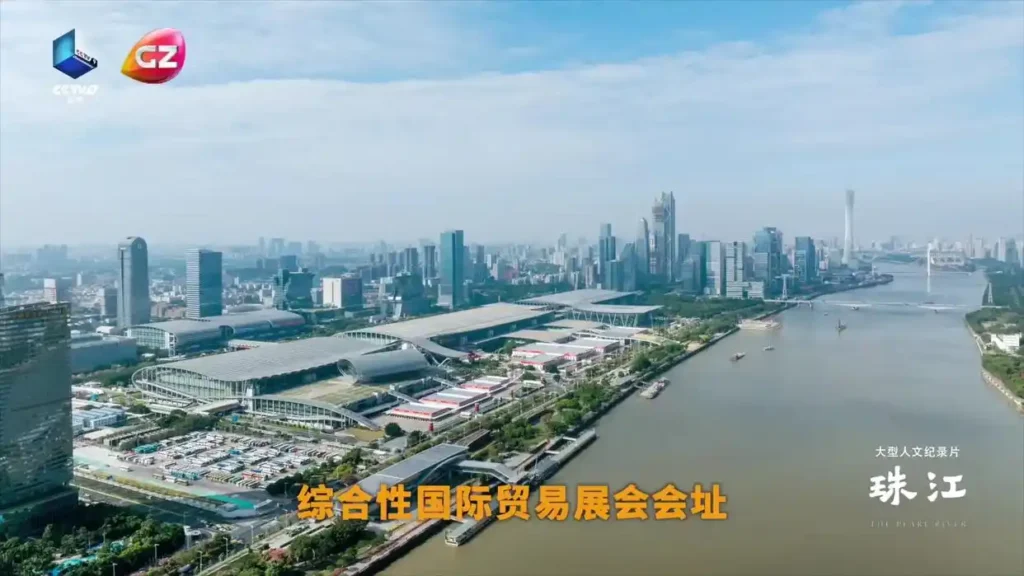
Recently, the sixth episode of Pearl River, Connecting the World at Canton Fair, has been a hit on CCTV. Using images as the carrier, it presents the transformation of the Canton Fair from a foreign trade window to an economic hub and deciphers “how the Canton Fair promotes Guangzhou’s economy”.

Since its founding in 1957, the Canton Fair, known as “China’s No.1 Fair”, has resonated with Guangzhou, a millennium-old commercial capital. At the beginning of the documentary, it traces its era mission: at a critical period when New China was in urgent need of breaking external blockades, the first Canton Fair came into being at the former Sino-Soviet Friendship Building. A total of 1,223 merchants from 19 countries and regions gathered in Guangzhou and signed orders worth 86.86 million US dollars, injecting the “first batch of foreign capital” into Guangzhou’s economy.
Trade lays the foundation to consolidate the status of a foreign trade hub. 1978 became an important turning point in the development of the Canton Fair. With the implementation of the reform and opening-up policy, the Canton Fair shifted from “limited opening-up” to “comprehensive connection”. Between 1979 and 1985, more than 300 foreign-funded cooperation projects were reached through the Canton Fair, covering multiple fields, driving Guangzhou’s foreign trade import and export volume to grow at an average annual rate of over 20%, and gradually establishing its core position as a foreign trade hub in South China. After the epidemic, the 133rd Canton Fair, as the first fully resumed offline exhibition, achieved export turnover of 37.92 billion US dollars. In 2024, Guangzhou’s total foreign trade import and export volume exceeded 1.2 trillion yuan, with the direct driving proportion of the Canton Fair exceeding 35%, demonstrating the core value of the “foreign trade engine”.
Industrial transformation drives the upgrading of manufacturing to “intelligence”. Taking the rise story of Taiping Handbag Factory as a microcosm, the documentary shows the historical process of the Canton Fair spawning “processing and assembly” enterprises. As the holder of the country’s first “processing and assembly” enterprise license, the success of Taiping Handbag Factory marked the integration of Guangzhou’s manufacturing industry into the global industrial chain. Taking Xintang in Zengcheng as an example, relying on the Canton Fair, the local area has transformed from the “No.1 Cowboy City in China” to a “highland of intelligent manufacturing”, with the output value of high-tech industries accounting for more than 60% in 2024. By 2024, the proportion of the added value of advanced manufacturing industry in Guangzhou’s above-scale industrial added value reached 65.2%, and the number of high-tech enterprises exceeded 12,000.
Urban quality improvement activates the energy level of modern service industry. To meet the needs of the Canton Fair, Guangzhou has built a mature exhibition supporting system. More than 50 star-rated hotels gather around Pazhou, with an occupancy rate of over 90% all year round during exhibition periods. The catering industry has upgraded by taking advantage of this opportunity, with pre-made Cantonese cuisine exported to more than 20 countries and regions. In 2024, Guangzhou’s total catering revenue exceeded 150 billion yuan, with the exhibition-related proportion reaching 25%. The transportation network has been continuously improved. The metro “Canton Fair special line”, Baiyun International Airport and Guangzhou South Railway Station have built an efficient hub, and it only takes 10-20 hours to fly to Guangzhou from major cities around the world. The “exhibition + cultural tourism” model has achieved remarkable results. During the Canton Fair in 2024, Guangzhou received over 1.2 million inbound tourists, with the total cultural tourism revenue reaching 8.6 billion yuan.
Innovation coordination leads multi-dimensional breakthroughs. During the epidemic, the Canton Fair pioneered the “Cloud Canton Fair” model, realizing “never-ending” trade through technologies such as 3D modeling and real-time live streaming. In 2023, the proportion of online orders of some enterprises reached 45%. This innovation has driven the development of Guangzhou’s digital economy. By the end of 2024, the number of 5G base stations exceeded 80,000, and the added value of the core industries of the digital economy accounted for 28.5% of GDP. In terms of regional coordination, the Canton Fair has driven the development of surrounding exhibitions with the “exhibition goose array”. In 2024, the cargo throughput of Guangzhou Port reached 650 million tons, with the proportion of related goods exceeding 40%.
The documentary profoundly interprets the deep integration between the spirit of “daring to break through and be open and inclusive” in the Pearl River Basin and the development concept of the Canton Fair. After more than 60 years of trials and hardships, the Canton Fair has become Guangzhou’s most distinctive “opening-up business card”. Connecting the World at Canton Fair not only provides a panoramic video answer to “how the Canton Fair promotes Guangzhou’s economy”, but also shows the vigorous vitality of Guangzhou’s open economy.