Huaisheng Mosque in Guangzhou: The Millennial Guangta Minaret Witnesses the Civilization Integration on the Maritime Silk Road
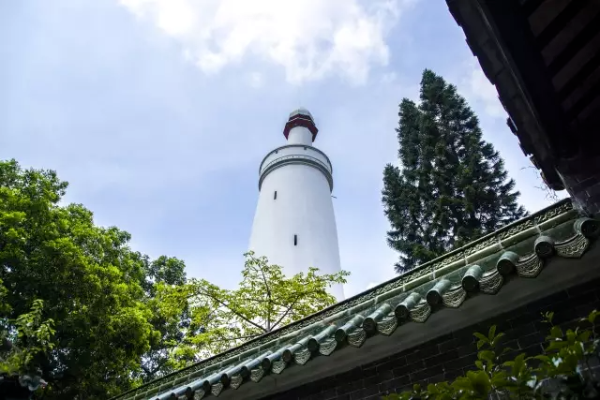
Surrounded by vermilion walls, adorned with green glazed tiles and overhanging eaves, a white cylindrical ancient minaret stands prominently against the skyline of Guangzhou’s old town. In striking contrast to the surrounding modern buildings, it silently narrates the stories of Sino-foreign cultural exchanges spanning thousands of years.
Tucked away at No. 56 Guangta Road in the bustling downtown area of Guangzhou lies the Huaisheng Mosque, a quiet yet culturally profound sacred site. First constructed in the first year of the Zhenguan reign in the Tang Dynasty (627 AD), this ancient mosque is not only the oldest surviving mosque in China but also one of the four most renowned early mosques built after Islam was introduced to China. It enjoys equal fame with Qingjing Mosque in Quanzhou, Fenghuang Mosque in Hangzhou, and Xianhe Mosque in Yangzhou.
The name “Huaisheng” signifies cherishing the memory of Prophet Muhammad of Islam. A thousand years ago, Arab merchants traveled a long way along the Maritime Silk Road, and the Huaisheng Mosque became their spiritual home in Guangzhou.
01 Historical Evolution: From the Tang – Dynasty “Foreigners’ Quarter” to a Cultural Landmark
The history of Huaisheng Mosque is closely intertwined with Guangzhou’s status as the birthplace of the Maritime Silk Road. During the Tang Dynasty, Guangzhou served as China’s primary port for foreign trade. The imperial court designated a “Foreigners’ Quarter” in the western part of the city specifically to accommodate merchants from regions such as Arabia and Persia.
Historical records state that in the first year of the Zhenguan reign of the Tang Dynasty, Muhammad, the founder of Islam, dispatched his distinguished disciple Sa’d ibn Abi Waqqas to spread Islam in China. After arriving in Guangzhou, Sa’d ibn Abi Waqqas joined hands with local Arab residents to build the Huaisheng Mosque to meet the religious needs of Muslims.
Fang Xinru of the Southern Song Dynasty noted in the postscript to his poem “Ode to the Foreign Minaret” in A Hundred Odes to the South China Sea that “the Foreign Minaret dates back to the Tang Dynasty and is known as the Minaret of Huaisheng Mosque”. Yue Ke, also from the Southern Song Dynasty, recorded in Notes from the Crossbar Studio the prayer hall and the Guangta Minaret he saw in Guangzhou in 1192, the third year of the Shaoxi reign.
The Guangta Minaret of Huaisheng Mosque was destroyed by fire in 1343, the third year of the Zhizheng reign in the Yuan Dynasty, but was reconstructed in 1350, the tenth year of the Zhizheng reign. Subsequently, it underwent renovations on various scales during the Chenghua reign of the Ming Dynasty, the Kangxi, Daoguang, and Tongzhi reigns of the Qing Dynasty, as well as in 1935.
On November 20, 1996, the Guangta Minaret of Huaisheng Mosque was designated as a Major Historical and Cultural Site Protected at the National Level by the State Council as part of the fourth batch. In 2016, it was included in the first list of candidate heritage sites for the “Maritime Silk Road: Historical Sites in China” by the State Administration of Cultural Heritage, highlighting its unique role as a witness to the Maritime Silk Road.
02 Architectural Features: A Model of Sino – Arabian Cultural Integration
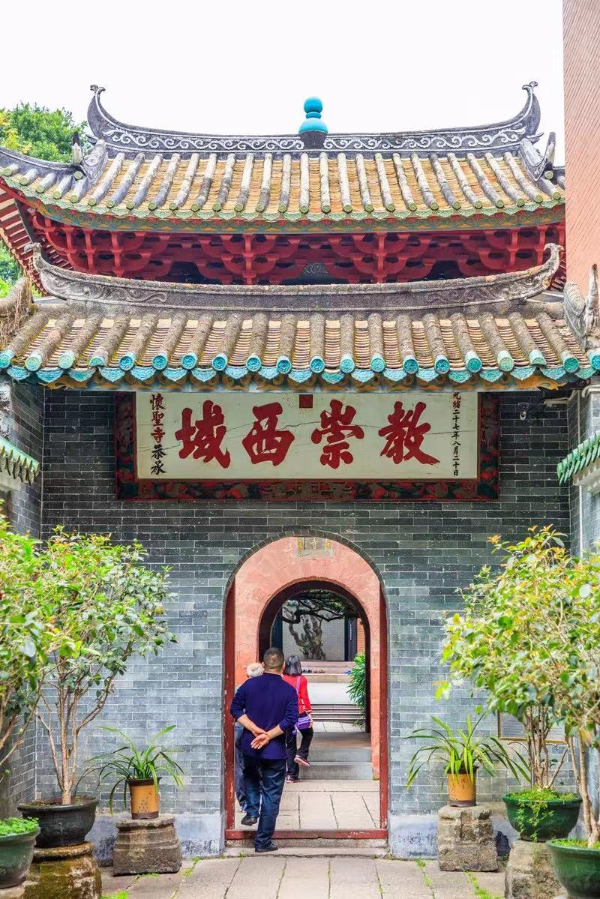
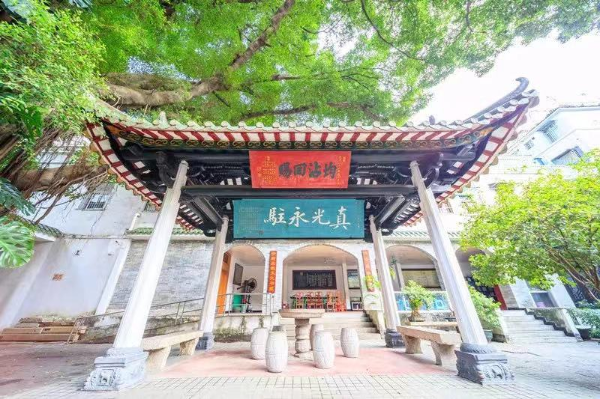
Facing south with its back to the north, Huaisheng Mosque covers an area of approximately 2,966 square meters. It is a typical Tang – style mosque with a courtyard – corridor – building – eave layout, presenting a rectangular and axisymmetric structure. Along its central axis, there are successively the main gate, the second gate, the Moon – Viewing Pavilion, the prayer hall, and the Scripture Depository.
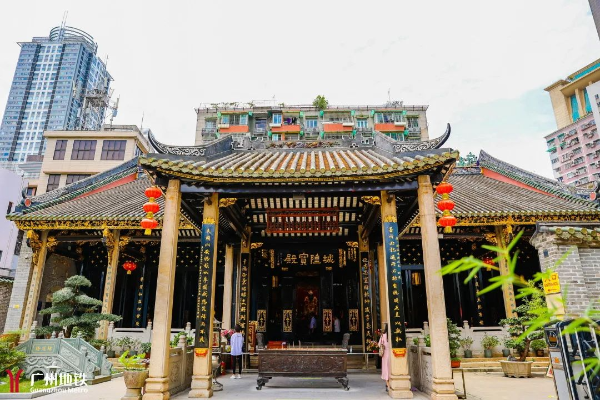
The main gate is a structure featuring Chinese – style red brick walls and green glazed brackets. The second gate is a classic Lingnan ancestral hall – style gateway. On its lintel, there are three gilded Chinese characters “Huaisheng Mosque” written in a bold and round hand by Deng Tingnan, the Administrative Commissioner of Guangdong during the Qing Dynasty.
As the main building of the mosque, the prayer hall adopts a Chinese palace – style design. It is a brick – and – cement structure with three bays, surrounding corridors, a gabled double – eave roof covered with green glazed tiles, and decorative brackets, standing tall on a large platform with carved stone railings. The balustrades are engraved with patterns such as gourds, fans, canopies, and flowers. The interior of the hall is bright and clean, with sliding doors on three sides.
What makes the mosque most distinctive is its integration of architectural elements from both Chinese and Arabian styles. It houses Chinese palace – style structures like the Moon – Viewing Pavilion and the prayer hall, along with the Guangta Minaret which embodies a typical Arabian architectural style. This cultural integration is vividly reflected in the Arabic couplets at the entrance of the prayer hall. Couplets are a traditional Chinese cultural form, while the content here consists of Islamic hadiths, ingeniously presenting two hadiths in the form of Chinese couplets.
03 Guangta Minaret: The Lighthouse of the Maritime Silk Road
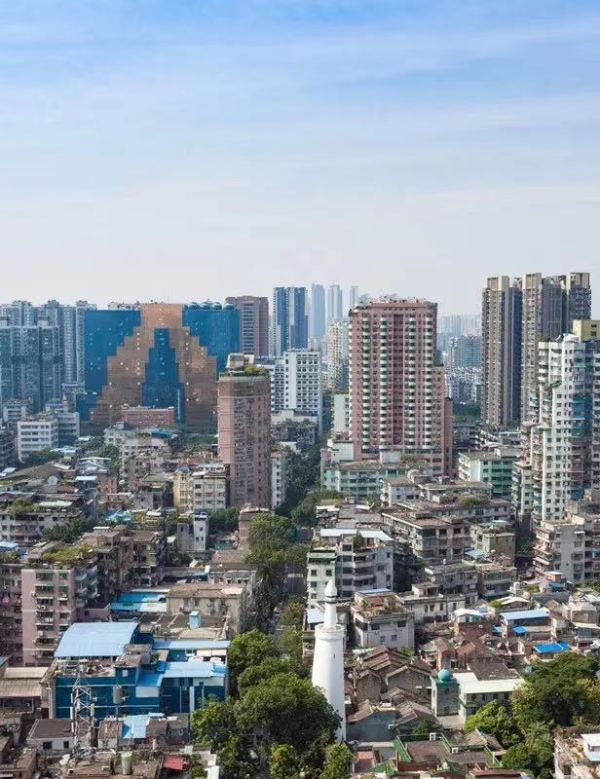
The Guangta Minaret, also known as the Huaisheng Minaret, is the most eye-catching and distinctive structure of the Huaisheng Mosque. Standing 36.3 meters tall, it is built of blue bricks. With a circular base and a smooth, undecorated cylindrical body, it looks like a bright silver brush from a distance, hence the name “Guangta” (meaning the Bright Minaret).
Originally named the “Barker’s Minaret”, it gradually came to be called the Guangta Minaret because the Persian term “Barker” sounds similar to the Chinese word “Guang” (bright). In addition, its smooth surface and the guiding lights lit on it at night also contributed to this name change. The minaret boasts a strong Arabian architectural style. It is equipped with rectangular small holes for lighting, and inside, two spiral staircases wind around the center column, leading directly to the top.
During the Tang Dynasty, the area where the Guangta Minaret was located was surrounded by vast rivers, and the minaret was the tallest building along the Pearl River. It fulfilled multiple functions, including calling Muslims to prayer, praying for favorable winds, guiding ships, and monitoring typhoons. During the day, people could see the flags fluttering on the minaret; at night, the lights hung at the top served as a signal for ships to identify their arrival in Guangzhou. For ships returning from overseas, the sight of this minaret meant they had reached Guangzhou.
When first built, a golden rooster was installed on the top of the minaret. It could rotate with the wind to indicate wind directions but was blown down by a typhoon in the early Ming Dynasty. Since then, the ornament on the minaret’s top has been replaced multiple times. As a miracle in the history of Chinese architecture, the minaret has stood firm for nearly 1,400 years, witnessing the changes of the Pearl River and the ups and downs of the Maritime Silk Road.
04 Cultural Value: A Living Fossil of the Maritime Silk Road
The Huaisheng Mosque and the Guangta Minaret are of great significance for the research into China’s overseas transportation history, architectural history, Islamic history, as well as the economic and cultural exchanges between the Chinese people and those from Islamic countries.
As an important witness to the Maritime Silk Road, the area around Huaisheng Mosque preserves abundant historical relics and cultural memories. Agate Lane to the west of the mosque got its name because Arab merchants traded pearls and agates there at that time. To the southwest lies Ivory Lane, which also came into being as a result of the trade activities back then.
More than just a religious venue, Huaisheng Mosque is a symbol of Sino – foreign cultural exchanges. It witnessed the prosperity of Guangzhou’s “Foreigners’ Quarter” during the Tang and Song Dynasties. At that time, merchants from all over the world gathered here, bringing goods such as pearls, agates, and ivory, and taking away Chinese silk, tea, and porcelain.
Nowadays, the area around Guangta Road remains the neighborhood in Guangzhou with the largest concentration and the most diverse ethnic groups, where people of multiple ethnicities such as the Hui, Manchu, and Yao live. This place has carried forward the tradition of cultural integration that has lasted for thousands of years. There are also Hui Ethnic School and Manchu Ethnic School near the mosque, forming a unique community landscape characterized by the coexistence of diverse cultures.
05 Visitor Guide: Experience the Millennial Cultural Integration
Practical Information
- Address: No. 56 Guangta Road, Yuexiu District, Guangzhou.
- Opening Hours: The mosque is open from 9:00 to 17:30. Every Friday is the Jumu’ah day, attracting a large number of visitors.
- Ticket Information: Admission is free.
- Best Visiting Time: It is relatively quiet on regular days and bustling on Fridays and Islamic festivals. Visitors can choose the time according to their own preferences.
Transportation Guide
- Subway: Take Metro Line 1 to Ximenkou Station. After exiting the station, walk about 500 meters to reach the mosque.
- Bus: Take Bus No. 58 and get off at the “Guangta Road” stop.
Visiting Tips
Visiting Huaisheng Mosque is more than just a tourist activity; it is a cultural experience and a spiritual journey. It is advisable to slow down and immerse oneself in the thousand – year – old historical heritage of the mosque:
- Respect Religious Customs: As an active religious site, visitors are expected to dress neatly and appropriately, avoiding revealing or tight – fitting clothes, and trousers should cover the knees. It is necessary to avoid disturbing worshippers during prayer times and refrain from taking photos in non – designated areas. Female visitors may need to cover their heads out of respect for local customs.
- Explore Surrounding Attractions: After visiting Huaisheng Mosque, visitors can walk to nearby historical sites such as the Five Immortals Temple (which houses the site of the ancient Poshan Ferry), Agate Lane, and Cuifu Street to experience the cultural atmosphere of the millennial “Foreigners’ Quarter”.
- Taste Halal Cuisine: Opposite the Huaisheng Mosque is Shache Halal Cuisine, where visitors can enjoy halal foods like hand – grabbed rice and lamb skewers. In addition, there are many lively local snack shops around Guangta Road, and the dishes served at the Hui Restaurant are also worth a try.
The Huaisheng Mosque and its Guangta Minaret have witnessed Guangzhou’s enduring opening – up and cultural exchanges over the past thousand years. It is not only a historical landmark of Guangzhou but also a symbol of the Chinese nation’s spirit of inclusiveness and openness.
Regardless of the changes in history, the Huaisheng Mosque still stands quietly on Guangta Road. As a crucial witness to Guangzhou’s history related to the Maritime Silk Road, it connects the past and the present, China and foreign countries, and soothes the souls of people from diverse ethnic groups.
Frequently Asked Questions about Huaisheng Mosque
What is the specific address of Huaisheng Mosque? No. 56 Guangta Road, Yuexiu District, Guangzhou City.
What are the official and common names of Huaisheng Mosque? Official name: Huaisheng Mosque; Common names: Guangta Mosque, Prayer Mosque.
When was Huaisheng Mosque first built? Traditionally believed to have been founded around 627 AD during the Tang Dynasty.
What is the floor area of Huaisheng Mosque? Approximately 2,966 square meters.
Why is it named “Huaisheng Mosque”? “Huaisheng” means “Cherishing the Sage,” commemorating the Prophet Muhammad.
What is the status of Huaisheng Mosque in Islamic history? It is one of China’s Four Great Ancient Mosques and the oldest surviving mosque in China.
What is the historical evolution of Huaisheng Mosque? Burned down in 1343 AD and rebuilt later; renovated multiple times in the Ming and Qing dynasties; designated as a National Key Cultural Relic Protection Unit in 1996.
What is the historical connection between the mosque and the “Fanfang”? It served as the religious core of the foreign merchants’ quarter in Tang Dynasty Guangzhou.
What are the opening hours? 9:00 AM – 5:00 PM daily, closed on Fridays for prayers; only exterior viewing may be permitted at times.
Is a ticket required? Free admission, no reservation needed.
Is special permission needed to visit? Entry is permitted with consent; non-Muslims must respect regulations.
How long is the recommended visit? 30 to 60 minutes.
Under what circumstances will the mosque be closed? Access may be restricted during special religious activities.
Are non-Muslims allowed during prayer times? Generally not permitted inside the prayer hall; must remain quiet and observe etiquette.
What are the overall layout characteristics? A traditional Chinese symmetrical layout facing south.
What are the main buildings? Main Gate, Moon-Viewing Tower, Prayer Hall, Scripture Library, Stele Pavilion, and the Guangta (Light Tower).
What are the features of the Guangta? 36.3 meters high, cylindrical, blue brick structure, solid core with double spiral staircases.
How did the Guangta get its name? Named for its smooth surface and the navigation lamp historically hung at its top.
What is the function of the Moon-Viewing Tower? Used for observing the moon to determine the Islamic calendar months.
What is the significance of the Prayer Hall’s orientation? It faces east towards Mecca.
Are there any ancient trees? Yes, including a 146-year-old longan tree and a 149-year-old sterculia tree, both protected.
What is unique about the architectural style? It integrates Arabic and traditional Chinese architectural elements.
What is its connection to the “Maritime Silk Road”? It is a key historical witness to Guangzhou’s role as a starting point of the Maritime Silk Road.
What role did it play in Islam’s development in China? One of the earliest mosques established after Islam’s introduction to China.
How is its cultural value reflected? It provides important material for studying China’s overseas transport history, architectural history, and the spread of Islam.
How does it compare to the other three great mosques? All are among the earliest mosques in China with integrated architectural styles; Huaisheng is considered the oldest, built in the Tang Dynasty.
What other historical functions did the Guangta serve? Navigation, meteorological observation, and maritime surveillance.
What are the main historical renovation periods? Major rebuild after 1343 fire; large-scale reconstruction in 1695; three renovations after 1949 to preserve original style.
What are the main Islamic festivals celebrated here? Eid al-Fitr, Eid al-Adha, and Mawlid, marked by prayers, Quran recitation, and communal meals.
What special activities occur during Eid al-Fitr? Congregational prayers, animal sacrifice, and communal dinners.
Does it hold religious lectures or cultural exchanges? Yes, it occasionally holds Islamic cultural lectures and exchanges as the seat of the Guangzhou Islamic Association.
How should tourists respect Islamic etiquette? Maintain silence, dress modestly, and do not disturb prayers.
Does it provide religious services? Yes, including prayer facilities, ablution areas, and Quran recitation.
What is its connection to the modern Muslim community? It remains an important active worship site for Guangzhou’s Muslim community.
What are the dress codes? Modest clothing required; avoid shorts, short skirts, and tank tops.
What are the behavioral taboos? No loud noises, smoking, touching relics, or stepping on thresholds.
Is photography allowed? Exterior photography is generally permitted; interior and ceremony photography is prohibited.
What are the requirements for entering the Prayer Hall? Remove shoes; women must cover their hair and wear modest clothing.
What attitude should visitors maintain? Respectful, quiet, and humble.
What etiquette should non-Muslims note? Do not disturb prayers, adhere to dress codes, and seek permission before entering certain areas.
How to get there by public transport? Take Metro Line 1 to Ximenkou Station (Exit B), walk 600m; or take numerous bus routes.
Is self-driving convenient? Driving is possible but parking is limited in the old town; paid parking lots are available nearby.
What local delicacies are recommended nearby? Halal snacks around Guangta Road, such as Vietnamese cuisine and traditional Cantonese desserts.
What other attractions are nearby? Includes Wuxian Temple, Liurong Temple, and Guangxiao Temple, allowing for a religious culture tour.
Is there a recommended one-day tour route? Visit Huaisheng Mosque in the morning, enjoy halal food at lunch, explore nearby temples in the afternoon, and stroll Beijing Road Pedestrian Street in the evening.
Does it provide guided tours? Free guided tours are provided by staff, arranged on a case-by-case basis without a fixed schedule.
Are audio guides available? No audio guides or electronic interpretation devices are provided.
What convenient facilities are available? Restrooms and rest areas are available.
Is there a souvenir shop? Yes, selling Islamic cultural souvenirs, books, and accessories.
Are there barrier-free facilities? Basic access is available, but some areas may be inaccessible due to the ancient architecture.
Is there WiFi? No WiFi coverage.
What is the best time to visit? Mornings or afternoons on non-Fridays, avoiding prayer times and religious festivals.
What are the best photo spots? The main gate, panoramic view of the Guangta, and the Moon-Viewing Tower.
What should be noted when visiting with the elderly or children? Mind the steps and ancient trees; avoid crowds; ensure children and elderly are accompanied.
How to understand its essence quickly? Focus on the Guangta, Prayer Hall, and Stele Pavilion, and read the introductory materials at the entrance.
What are the seasonal visiting considerations? Summer requires sun and heat protection; winter is mild and comfortable; dress appropriately and observe etiquette year-round.
What background knowledge is useful? The history of Islam in China, the Maritime Silk Road, and Chinese-Arab cultural integration.
What Islamic symbols are reflected in the architecture? The Mecca-facing Prayer Hall symbolizes pilgrimage; the Guangta symbolizes the call to prayer; bilingual inscriptions symbolize cultural fusion.
What is the value of its cultural relics? Over 40 stone steles from the Yuan Dynasty with Arabic and Chinese inscriptions hold significant historical, calligraphic, and artistic value.
How does it balance relic protection and religious use? As a protected site, renovations preserve its original form; religious activities are confined to specific areas to prevent damage.
What is its relationship with Guangzhou’s urban development? It has witnessed the city’s history as a Silk Road hub and now contributes to modern tourism and cultural diversity.
What is the significance of the call to prayer? The Adhan calls believers to worship and reflects the unity of religious practice.
Are there any little-known stories? A legendary golden rooster on the Guangta once acted as a wind vane; the mosque was rebuilt with community funds after a fire.