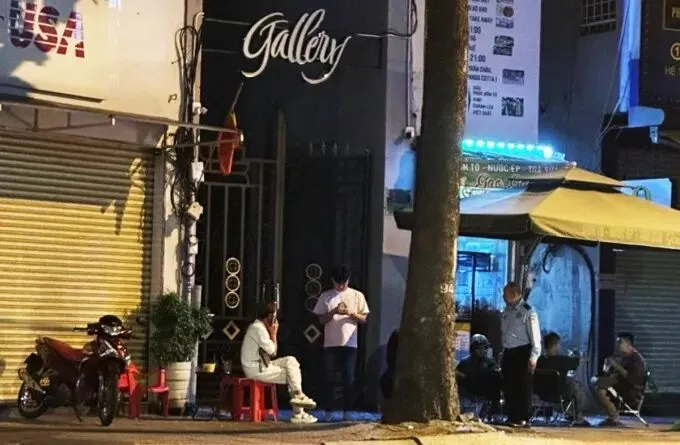
Did you think opening a restaurant in Vietnam is just about food and beverage? Some people have turned it into a gray hotbed for “high-end companionship”. Recently, the Ho Chi Minh City (TP HCM) Court is about to hear a case that has shocked the local community: two Korean men—48-year-old Kim Tae Hyung and 50-year-old Cha Jin Young—are accused of opening a restaurant named “Gallery” in the city center. Ostensibly a Korean restaurant and KTV, it actually employed 80 female servers to exclusively cater to Korean customers and secretly engage in prostitution activities.
What’s more ironic is that they not only ran illegal operations but also tried to bribe law enforcement agencies through “payoffs”. However, after spending 840 million Vietnamese dong (approximately 2.27 million Chinese yuan), they fell into a fraud trap set by local “intermediaries”.

The restaurant, located on Bùi Thị Xuân Street in Phạm Ngũ Lão Ward, features exquisite decoration and only accepts foreign customers, with a particular focus on Korean tourists. Equipped with 30 unlicensed KTV private rooms, 80 female servers, 20 waiters, and a team of “sentinels” holding walkie-talkies, it was nothing short of a highly organized underground industry chain. Prostitution fees were not called “prostitution fees” but were listed as “Green jacket 17”; hotel room charges were disguised as “large seafood set meals”. This whole operation can be described as “accountingly compliant but essentially illegal”.
On July 19, 2023, an ordinary “arrangement” became the trigger for the case. Manager Lee Hyun Jun asked Vietnamese supervisor Nguyễn Thị Ngọc Loan to book a room for two Korean customers at a price of 7.6 million Vietnamese dong. Nguyễn Thị Ngọc Loan contacted Lê Tấn Thanh, who assisted with the booking despite knowing the purpose. The police followed the clues and took down this cross-border prostitution den in one fell swoop.
But the story didn’t end there.
It turned out that when the restaurant opened, it lacked complete documentation. Anxious to “fix the relationship”, Kim Tae Hyung and Cha Jin Young found Bùi Thị Phương Dung—a Vietnamese woman married to a Korean husband—through acquaintances. She and her accomplice Bùi Duy Hà lied that they “knew senior public security officials” and could ensure the restaurant would never be inspected. The two men believed them and transferred a total of 840 million Vietnamese dong. What was the result? The money was embezzled, and the so-called “payoffs” were all lies. Investigations confirmed that they had no access to any law enforcement personnel at all.
This case exposes three major problems:
First, foreign nationals exploit language and cultural barriers in Southeast Asia to exploit legal loopholes, turning entertainment venues into sexual transaction hubs;
Second, gray intermediaries engage in fraud under the guise of “having connections”, specifically targeting foreigners who are unfamiliar with local rules;
Third, there are still blind spots in law enforcement supervision—if not for the accidental exposure of the case, such “high-end and concealed” prostitution might have existed for a long time.
It is worth affirming that Vietnam’s judiciary did not show leniency because the involved parties were foreigners. Both the masterminds Kim Tae Hyung and Cha Jin Young, as well as the assistants and fraudsters, were all held accountable in accordance with the law. This sends a clear signal: in Vietnam, regardless of nationality, those who break the law will be prosecuted.
This case also serves as a wake-up call. In recent years, many Chinese nationals have gone to Southeast Asia to invest in catering and entertainment businesses. However, without legal awareness and if they credulously believe in “hidden rules”, they are extremely likely to fall into similar traps. Truly compliant operation has never relied on “payoffs”, but on legal qualifications and transparent operations.
Kim Tae Hyung and Cha Jin Young may have thought that they could muddle through with money and connections in a foreign country. But they forgot:
No matter how elaborate the disguise, it cannot stand up to the sunshine of the rule of law.