The Longgang International Art Center project has achieved a new milestone! Currently, it has entered the final sprint stage of completion acceptance, which is expected to be concluded by the end of December 2025, followed by the official opening in January 2026. The center will adopt an integrated operation model together with the East Square and the adjacent Shanhua Lanman Park to its south. At that time, the East Square and Shanhua Lanman Park will serve as the extended artistic spaces of the center, undertaking more outdoor music and art functions, and creating more diversified art and technology experience scenarios for citizens.
Blending Chinese and Western Elements to Build a Benchmark Smart Cultural Venue
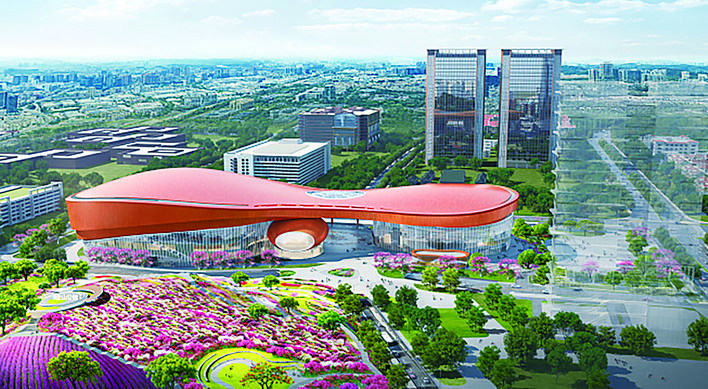
Nestled in the core area of Shenzhen Banxuegang Science and Technology City—a world-class hub for electronic information industry clusters—the Longgang International Art Center is adjacent to Beller Road Station of Shenzhen Metro Line 10 and Huawei’s Bantian R&D Base. Covering a total land area of approximately 43,000 square meters and a total construction area of around 110,000 square meters, the center comprises the International Performing Arts Center, Art Exhibition, Experience and Incubation Center, and Science and Technology Art Education Center, among other components.
Positioned as a first-class benchmark for smart cultural venues in China, the Longgang International Art Center is committed to becoming a high-level digital art palace and a civic art living room in the Greater Bay Area. It has been included in the list of municipal-level major cultural and sports facilities and the first batch of key industrial projects in Shenzhen’s 14th Five-Year Plan. The project is advanced under the model of “investment by the Shenzhen Municipal Government and entrusted construction by Longgang District”.
In terms of design, the center incorporates the elegant shapes of traditional Chinese classical musical instruments such as the pipa, pan flute, and xun, as well as the Western violin. Meanwhile, efforts are made to express the inherent charm and lyrical beauty of Eastern and Western classical musical instruments through color schemes, material selection, texture application, and spatial structure design.
Notably, through the ingenious organization of architectural space and the design of external columns, citizens can experience that the internal space and natural light of the venue seem to flow into a musical instrument through its sound holes and finger holes. This allows visitors to imagine themselves inside this colossal “musical instrument” and enjoy this unique spatial art experience.
Art + Technology: Delivering a Multi-Sensory Immersive Experience
The atrium of the Longgang International Art Center features a 5,000-square-meter large-scale urban living room with north-south transparency. It can form visual and slow-traffic system connections with the Shanhua Lanman Park to the south, striving to provide citizens with an all-weather, all-time dynamic public space. Above the urban living room, a 1,000-square-meter circular tensioned membrane is designed to simulate the shape of flower petals, providing ample natural light while further enhancing the overall aesthetic appeal of the building.
The art relief wall at the main entrance of the center is not only a must-pass area for citizens entering the theater but also one of the designated “check-in spots”. With heaven and earth as the starting point and stars as the background, the art relief comprehensively depicts the musical art elements and milestone figures of the East and West through figurative techniques. The east and west sides respectively present the historical development context of Eastern and Western music, forming a harmonious movement of nature, history, and humanistic art.
The main functional spaces of the International Performing Arts Center include a 1,500-seat 5G smart theater, a 552-seat small theater, and a 305-seat small concert hall. In the future, the performance repertoire will cover various genres such as opera, symphony, musical, dance drama, drama, and concerts, with a certain proportion of local original works presented for citizens.
The Digital Exhibition Center is divided into three floors, mainly consisting of five digital art experience spaces and cultural supporting facilities (including training classrooms, artists’ studios, etc.). Specifically, it includes the Flyover Hall and White Box Art Space on the first floor, the Agile Space and CAVE Space on the second floor, and the Dome Art Museum on the third floor.
Except for the White Box Art Space, the other four permanent digital experience spaces adopt top domestic and world-leading technologies to bring citizens a multi-sensory, immersive “art + technology” feast. The Ball Screen Flyover Hall on the first floor, benchmarked against Disney’s “Soarin’ Around the World”, adopts the world’s most advanced design methods and driving technologies. Here, citizens can enjoy an immersive experience of “Beautiful China in Hidden Landscapes” and “A Colorful World at Your Fingertips”. All the displayed content is filmed and produced on-site by the cooperative team, using the world’s most advanced 16K panoramic shooting technology and equipment. The “Holographic Space” on the second floor will, for the first time, present classic repertoires of world-renowned ballet troupes and many other outstanding performances in a holographic format. The “Dome Art Museum” on the third floor innovatively sets up “Healing Mode”, “Weather Mode”, and “Exploration Mode”. Here, visitors can either look up to gaze at the evolution of human civilization and natural changes or close their eyes to feel the spiritual healing brought by art.
In addition, in collaboration with leading technology enterprises such as Huawei, the center has developed a variety of interactive experience functions including VR Venue Tour and Seat Selection, AR Art Corridor, AR Treasure Hunt, AR Photo Booth, Virtual Digital Human Guide, and AI Art Bracelet.
January 2026—Longgang International Art Center, see you there!