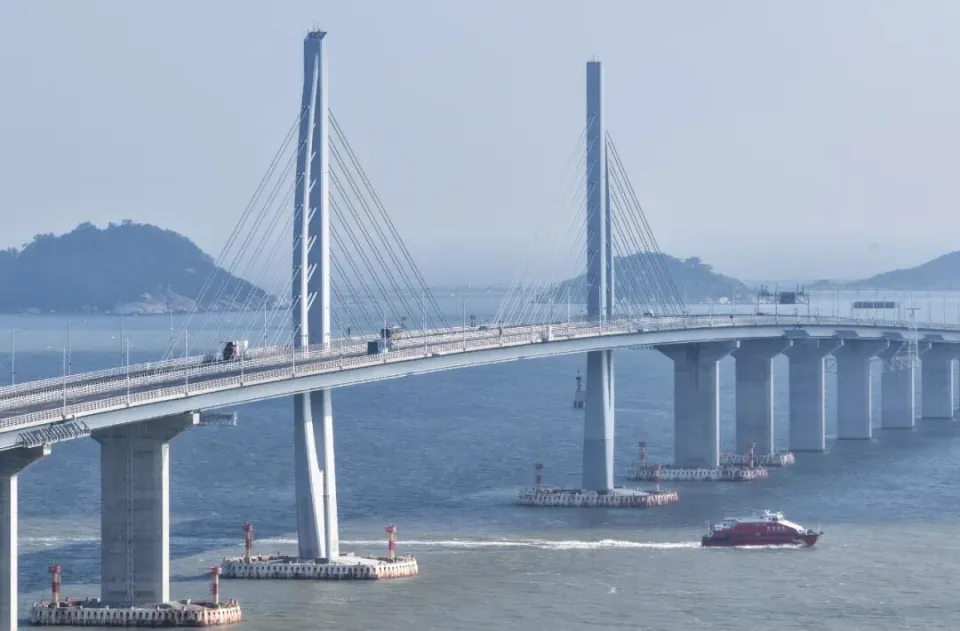
In the first three quarters of this year, the average daily traffic flow of the Hong Kong-Zhuhai-Macao Bridge reached 14,000 vehicle trips, a year-on-year increase of 19.4%.
Seven years after its opening, the bridge has turned a natural chasm into a thoroughfare. With an average of 14,000 daily vehicle trips and a nearly 20% growth rate, the accelerated flow of people, vehicles and goods is underpinned by the unceasing surge of capital, information and technology flows.
This 19.4% paints a promising future picture of the Guangdong-Hong Kong-Macao Greater Bay Area.
This is a life picture evolving from “geographical connection” to “chemical integration”.
On November 8, the men’s individual road cycling event, the first cross-border competition in the history of the National Games, passed through the Hong Kong-Zhuhai-Macao Bridge. Athletes completed seamless customs clearance, speeding along at over 40 kilometers per hour, and finished six customs crossings without any stops, ensuring the smooth progress of the competition.
This seemingly unattainable event experience was made possible by regulatory and technological innovations. One bridge connects three places and unblocks the Greater Bay Area. In the first 10 months of this year, the total traffic flow of the Hong Kong-Zhuhai-Macao Bridge reached 4.3209 million vehicle trips, a year-on-year increase of 19.6%.
When we shift our focus from the Hong Kong-Zhuhai-Macao Bridge to the entire Greater Bay Area, the interwoven bridges and tunnels, as well as the cross-river and cross-sea transportation routes, outline a clearer and brighter future for the region. The Shenzhen-Zhongshan Channel, the Guangzhou-Shenzhen-Hong Kong High-Speed Railway, the connection of Macao’s rail transit to Guangdong’s high-speed railway network… Each infrastructure project has turned the Greater Bay Area’s “one-hour living circle” from a dream into daily life.
“Hard connectivity” is only the first step; “soft connectivity” achieves “heart-to-heart connectivity”. The implementation of new policies such as the “multiple-entry permit per application” for Shenzhen household registration residents and residence permit holders traveling to Hong Kong, and the new experience brought by cross-border payment services, among other vivid cases, all prove that the Greater Bay Area has moved from the “platform-building” stage of “hard connectivity” to the “performance” stage of “soft connectivity” and “heart-to-heart connectivity”.
In the future, in fields such as the alignment of rules and standards, elderly care, medical care, employment, and culture, there is vast room for cooperation among Guangdong, Hong Kong and Macao to advance from “geographical connection” to “chemical integration”, and residents of the three places will surely enjoy more dividends from the integrated development of the Bay Area.
This is an innovation picture transforming from “individual combat” to “team competition”.
A micron-level capsule is a testament to the team competition in the Greater Bay Area.
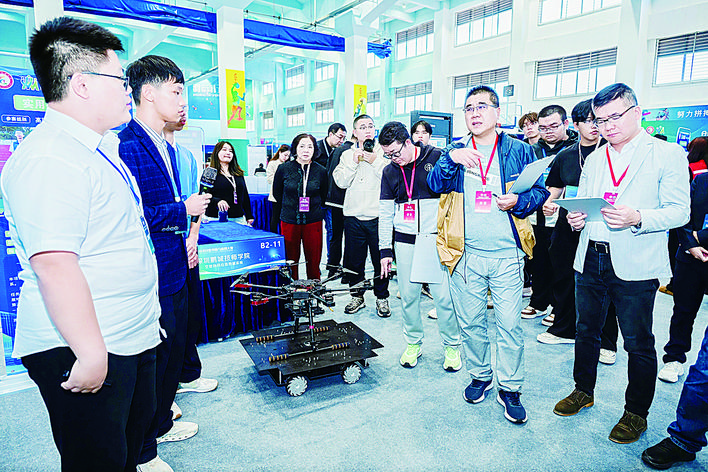
The Hong Kong University of Science and Technology provides scientific research support, the Fok Ying Tung Research Institute offers engineering test sites; Dongguan, Guangdong realizes product manufacturing and large-scale production. This product, known as pre-applied threadlocker, is widely used in automotive screw assembly, breaking foreign technological monopolies.
The bridge is not only a carrier connecting spaces, but also a link for the precise matching of advantageous elements such as talents and capital.
On this innovative land, Hong Kong has advantages in finance and trade, Macao is striving to promote industrial diversification, and Guangdong boasts abundant test scenarios and strong intelligent manufacturing capabilities. With strong industrial complementarity among the three places, the Greater Bay Area is promoting the deep integration of the innovation chain and industrial chain by leveraging their respective strengths and coordinating cooperation.
Today, the Greater Bay Area has built a complete industrial chain from core component research and development to terminal product manufacturing, enabling “ideas in the laboratory” to quickly turn into “products in the factory”. The 2025 Global Innovation Index released by the World Intellectual Property Organization shows that the “Shenzhen-Hong Kong-Guangzhou” innovation cluster ranked first in the world for the first time.
In the future, in strategic emerging industries and future industries such as new energy, artificial intelligence, and biomedicine, there are broad opportunities for collaborative innovation among Guangdong, Hong Kong and Macao. On the stage of international scientific and technological competition and industrial competition, they will forge ahead as a functionally complementary “team”.
This is also an opening-up picture advancing from “regional hub” to “global anchor”.
In late November, the comprehensive designated supervision site at the Zhuhai Highway Port of the Hong Kong-Zhuhai-Macao Bridge was bustling with activity.
49 tons of fresh Chilean cherries arrived at Hong Kong International Airport. Relying on the bridge’s “air-land exclusive express line for fresh and live products”, they were transferred by cold-chain trucks and quickly cleared customs through the Hong Kong-Zhuhai-Macao Bridge to enter the mainland. The fastest whole journey from Chilean orchards to domestic dining tables can be completed within 30 hours.
Adjacent to the South China Sea and backed by China’s ultra-large domestic market, the Greater Bay Area, by virtue of its location and market advantages, has become an important hub for China’s domestic and international dual circulation.
When the siren of cruise ships in Hong Kong’s Victoria Harbour echoes through the mist of history, when tourists from all over the world gather in front of Macao’s Ruins of St. Paul’s, and when Guangzhou, the “millennium commercial capital”, persists in gathering customers and selling goods from all over the world, Guangdong, Hong Kong and Macao are moving towards a new height of opening-up through strong collaboration.
Guangdong, Hong Kong and Macao have jointly released 262 “Bay Area Standards”; Guangdong Pilot Free Trade Zone has accumulated 772 reform and innovation achievements; major cooperation platforms such as Hengqin and Qianhai have taken the lead in piloting the alignment with international high-standard economic and trade rules… Currently, the Greater Bay Area is striving for institutional opening-up focusing on rules, regulations, management, standards and other aspects.
Data from the Guangdong Sub-Administration of the General Administration of Customs shows that last year, the total import and export volume of the Greater Bay Area reached 8.74 trillion yuan, an increase of 29.1% compared with the end of the “13th Five-Year Plan” period; in the first 10 months of this year, the import and export volume reached 7.52 trillion yuan, a record high for the same period in history. Undeterred by strong winds and high waves, the Greater Bay Area has demonstrated vigorous vitality with outstanding foreign trade performance and is becoming an “anchor” where global capital, talents and technologies are competing to gather.
One bridge connects three places and links the future, and a dynamic world-class urban cluster is thriving and growing.