Survey Results Show Both Positive and Negative Findings
[News Report] The Macao Federation of Trade Unions and Escola Luso-Chinesa Tecnica e Profissional de Macau jointly conducted a survey titled “A Survey and Assessment of the Social Status Quo of Personalized Development of Macao Secondary School Students and a Comparison with Mainland Greater Bay Area Secondary Schools” from January to December. Data was collected through experimental activities, quantitative surveys, and qualitative interviews, covering a total of 2,000 respondents and retrieving 790 valid paper and electronic questionnaires. The survey results indicate that nearly 97% of the interviewed Macao students have used AI to assist their studies; more than half of them agree that AI helps improve academic performance, while nearly half worry that over-reliance on AI will weaken their independent thinking ability.
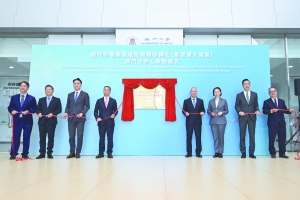
The survey launch conference was held at 11:30 a.m. yesterday in the auditorium of the FTU Coi Kei Family and Community Comprehensive Service Center. Unio Koon Wai Lam, the incoming president of the FTU; Cheng Kit Chiu, the principal of Escola Luso-Chinesa Tecnica e Profissional de Macau; Sun Goming, the assistant principal; Dr. Cheong Iat, a professor at the Macao Polytechnic University; and Ho Lai Ching, an assistant researcher at the FTU Policy Research Office, introduced the survey content.
Over Half of Students Recognize AI’s Role in Boosting Academic Performance
Unio Koon Wai Lam pointed out that nearly 97% of the surveyed Macao students have used AI tools for learning assistance, and more than half of them agree that AI tools are helpful in improving academic performance and give positive feedback on AI’s role in inspiring thinking. This reflects that students have a solid foundation in information technology application. However, there is still significant room for improvement in students’ autonomous learning, long-term planning, and innovative capabilities. To this end, he suggested incorporating the promotion of personalized learning for secondary school students into the overall planning framework for Macao youth development and the construction of the Guangdong-Hong Kong-Macao Greater Bay Area. Schools should gradually shift their development goals from a score and further education-oriented approach to one that emphasizes academic achievement, competence, and character equally, listing learning ability, innovative thinking, problem-solving skills, teamwork, and sense of responsibility as core literacy indicators. Meanwhile, career planning, vocational cognition, and social responsibility education should be integrated into curriculum activities to guide students to establish a correct view of labor and values when using AI tools.
Proposal to Include AI Literacy in Compulsory Education
Unio Koon Wai Lam noted that AI can effectively assist in handling procedural tasks such as homework grading, allowing teachers to focus more on teaching design and personalized guidance. However, mastering classroom rhythm, gaining insight into students’ cognitive processes, and providing value guidance remain irreplaceable functions of teachers. Therefore, he proposed systematically enhancing teachers’ AI application capabilities, incorporating AI literacy into the compulsory professional development system, and linking it with performance evaluations to form incentives. He also suggested establishing regular cross-school and interdisciplinary teaching and research communities to promote experience sharing and iterative optimization through joint lesson planning. In addition, dual-track psychological and technical support should be provided to alleviate teachers’ technological anxiety. This work requires collaboration among the government, schools, industrial technology sectors, and society to form a full-chain mechanism covering training, practice, evaluation, and support.
Cheng Kit Chiu stated that the survey shows over 83% of the interviewed Macao students use AI for after-school homework, followed by exam review. However, it also reflects that the main problems of AI tools are, in order: inaccurate recommended content, misalignment with textbook progress, limited resource coverage, and lack of interesting content. He called for accelerating the development of smart teaching platforms, AI classrooms, and supporting teaching materials, and put forward specific directions for further improvement. On the one hand, it is necessary to improve the intelligent recommendation mechanism of platforms, strengthen their alignment with curriculum progress and students’ learning status, and truly implement student-centered teaching. On the other hand, interactive design should be enhanced by integrating multimedia, incentive mechanisms, and user-friendly experiences to boost students’ learning motivation. Meanwhile, he suggested deepening the mechanism for teacher innovation and exchange, promoting the co-construction of teaching resources and experience sharing, and providing human resource support for platform application. Cheng Kit Chiu recommended that relevant schools and competent authorities objectively identify Macao’s current development stage through comparison with Greater Bay Area secondary schools, learn from successful cases of curriculum integration and teaching organization in the region, and carry out localized adjustments. In this process, Macao’s unique advantages such as small-class teaching, humanistic care, community connection, and diversified learning should be preserved to avoid homogenized competition and ensure the maintenance of local characteristics and school-running individuality in regional collaboration.
Concerns That Over-Reliance on AI Will Undermine Independent Thinking
Sun Goming pointed out that the survey found that teachers generally worry that AI will lead to students’ mental laziness, and nearly half of the interviewed Macao students also agree that over-reliance on AI will weaken their independent thinking ability. The current common practice of prohibiting or restricting AI use to prevent academic misconduct may prompt students to use AI privately. Therefore, the key lies in guiding students to establish a correct understanding, making it clear that AI is only a tool for learning assistance, not a shortcut to replace thinking. He emphasized that schools and relevant departments need to strengthen direct education and guidance for students. At the same time, collaboration between schools, families, and communities should be enhanced. Through parent meetings, thematic lectures, online platforms, and other channels, parents should be systematically guided to master the rational use of AI, understand its potential risks, and formulate family supervision strategies. This will help parents move from complete rejection or unconditional blind faith to rational understanding and appropriate supervision, jointly creating a healthy and orderly environment for AI use.