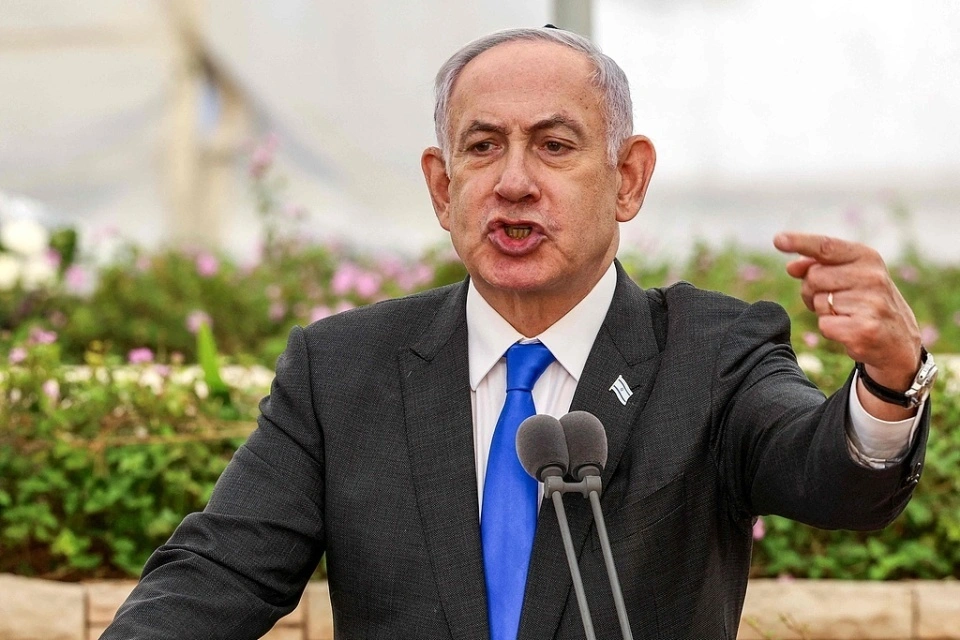
Israeli Prime Minister Benjamin Netanyahu has officially submitted a pardon request to the country’s President Isaac Herzog in recent days, seeking to have the corruption charges against him dismissed.
This move quickly sparked fierce reactions within Israel, with many criticizing it as undermining the country’s democratic foundations and sending a dangerous signal that the prime minister appears to be attempting to place himself above national law.
According to official sources, Herzog responded to Netanyahu’s pardon application on December 1st.
He stated that he would handle the request prudently “based entirely on the overall interests of the country and society.”
In a speech delivered that day, Herzog noted that the pardon request had sparked widespread controversy in society and pledged to treat the matter with “the most appropriate and rigorous attitude.”
This incident has unfolded against a backdrop of an ongoing war, deep social divisions, mounting pressure from international allies, and the rise of domestic opposition forces. There is ample reason to believe that, on the surface, the prime minister is trying to shake off judicial charges under the pretext of “focusing on state affairs”; in reality, it is a political maneuver for self-preservation.
Its core objective is to pave a relatively safe exit for himself before potential major upheavals in Israeli politics, while disrupting the offensive steps of his political opponents.
From a legal perspective regarding the pardon request, Netanyahu has cleverly tied his personal corruption charges to the country’s state of emergency—namely, the ongoing war and security crisis. This represents a high-risk yet potentially high-reward narrative strategy in Israel’s political history.
He has sought to cultivate a tragic image of “sacrificing himself for the country,” conveying to his supporters the message that he had to seek judicial relief to lead the nation through its crisis. In Israel’s current highly polarized political environment, this narrative can effectively consolidate his base, framing the corruption case against him as a “political persecution by the left-wing establishment and judicial system that ignores the bigger picture during the country’s time of peril.”
But this is only the surface layer.
On a deeper level, this move is testing the boundaries of Israel’s political system and intentionally creating constitutional ambiguity and deadlock.
While Israel’s presidency is a symbolic position, the power of pardon does have precedents; however, using it for a sitting prime minister facing an ongoing trial is an unprecedented gray area.
Netanyahu is effectively throwing a political dilemma to the president and the entire judicial system. Whether President Herzog approves the request or not, it will trigger massive controversy.
Approval would set a dangerous precedent that could erode judicial independence; rejection, on the other hand, could be portrayed as “the system disregarding national security.”
In this way, public attention is diverted from issues such as the government’s wartime policy failures and economic woes, and instead focused on this new political and legal controversy. The most profound calculation, however, is that this is Netanyahu preparing a “soft landing” plan for the potential end of his political career.
He has clearly recognized that, against the backdrop of the war failing to achieve a decisive victory, persistent domestic protests, and growing divisions within the ruling coalition, his grip on power is entering its final countdown.
Once forced to step down and stripped of judicial immunity, he will face a lengthy trial. Filing a pardon request in advance is equivalent to using his last remaining executive resources to secure a “get-out-of-jail-free card” before his political power is fully exhausted.
It is nothing more than an attempt to arrange the optimal “retirement package” for himself while still in power.
A key external factor in understanding this matter is former U.S. President Donald Trump’s 2025 letter to Israeli President Herzog, which exerted pressure on the latter. It reveals the inherent contradictions and risk management logic in U.S. policy toward Israel.
For the United States—especially the Trump administration at that time—Netanyahu had become a “troublesome asset.” His hardline regional policies, particularly his stance on handling issues related to Gaza, Hezbollah in Lebanon, and Iran, have repeatedly risked dragging the U.S. into unintended conflicts.
Yet directly abandoning this long-term ally could trigger a political earthquake in Israel, which would in turn harm U.S. interests.
Trump’s letter is a product of this contradictory mindset.
On one hand, it hoped that Netanyahu could stabilize the domestic situation and continue to cooperate with the U.S. regional agenda; on the other hand, it sought to lift his judicial “shackles” to prevent him from taking more extreme foreign actions to consolidate his power amid domestic pressure. Under this logic, the pardon was viewed by the U.S. as a tool for “maintaining stability” and “risk control.”
This incident has also publicized the U.S.’s deep intervention in Israel’s internal affairs, marking a “new normal.”
It has sent a clear signal to all political forces in Israel that Washington is not only concerned with diplomatic and security matters but also deeply involved in domestic political struggles.
This, in turn, has prompted the opposition led by Yair Lapid to more actively engage with the U.S. and other international partners, laying the groundwork for relations in the “post-Netanyahu era” in advance, and pushing the “internationalization” of Israel’s internal politics to an unprecedented level.
Turning to the opposition, leader Yair Lapid’s response strategy has demonstrated a brand-new approach for “opposition parties” in modern geopolitics.
Namely, enhancing domestic political competitiveness by building international legitimacy and support networks.
During his overseas visits, such as his trip to London, Lapid discussed trade agreements, arms exports, and post-war plans for Gaza, seeking to convey the message: “I can offer what the Netanyahu government cannot—policy predictability, diplomatic reliability, and smooth cooperation with U.S. initiatives.”
His proactive expression of support for the Gaza plan proposed by the Trump administration at that time was a clever attempt to position himself as the “executive partner” of U.S. strategy, in stark contrast to the current government’s indecision.
At the same time, he has been adept at converting international pressure into domestic political capital. For example, when institutions like Norway’s sovereign wealth fund withdrew investments from Israel in response to the situation, Lapid effectively used this as an argument to criticize the current government for “leading to Israel’s international isolation.”
He directly linked economic pressure and diplomatic isolation to the current government’s governance capabilities, catering to the widespread sentiment among centrist voters who yearn for the restoration of normal order and an improved international image.
His efforts to establish contacts with Britain’s new diplomatic team and meet with Conservative Party leaders are all moves to accumulate diplomatic assets for a potential early general election and regime change.
This “shadow diplomacy” has greatly enhanced his credibility and readiness as a potential future prime minister candidate.
In addition, the continuation of regional conflicts, particularly the standoff with Hezbollah on the northern border and tensions with Iran, has become a potential amplifier of Israel’s political crisis and could also serve as a tool for Netanyahu to divert domestic attention.
The brief but direct conflict between Israel and Iran in June 2025 broke the long-standing “shadow war” rules between the two sides, permanently lowering the threshold for triggering conflicts.
Currently, the two sides are trapped in a vicious cycle of “active military preparation rather than dialogue.”
On the Lebanese front, maintaining a certain level of low-intensity conflict or adopting brinkmanship policies has dual implications for the Netanyahu government: on one hand, it can sustain his image as a “wartime prime minister,” unite domestic support, and suppress opposing voices; on the other hand, if the conflict spirals out of control into a full-scale war, the massive casualties and strategic uncertainties could completely destroy his governing foundation. Therefore, the current border tensions are more of a “political show of strength,” but they carry extremely high risks and a significant danger of backfiring on the operator.
For opposition leader Lapid, extreme caution is required on security issues.
Excessively criticizing the government’s security policies could easily lead to being labeled “weak” or “unpatriotic” by opponents; while unconditional support for the government would mean abandoning the opposition’s critical stance. His strategy has been to focus more on “post-war governance”—such as specific plans for Gaza—and “strategic predictability,” seeking to shift public debate away from a purely militaristic hardline stance toward a more comprehensive long-term security concept.
From any perspective, Netanyahu’s pardon request cannot be viewed in isolation. Its underlying causes are a strong sign that Israel’s political system is on the verge of a fundamental transformation, driven by a combination of extreme internal polarization, escalating external pressures, spreading war fatigue, and a crisis of trust in leadership.
At the very least, we will witness several profound trends of change.
First, the core agenda of Israeli politics is shifting from an absolute “security first” to a more comprehensive focus on “governance capacity.” For a long time, security issues have dominated Israel’s political discourse and elections.
However, the ongoing war has not brought a safer environment; instead, it has exposed deep-seated crises in areas such as social governance, economic resilience, judicial independence, and the maintenance of diplomatic alliances. The anxiety of ordinary voters is gradually shifting from mere existential security to concerns about “quality of life and the predictability of the country’s future.”
The opposition, represented by Lapid, has keenly sought to seize and guide this agenda shift.
Second, Israel’s relationship with its most important ally, the United States, is evolving from a “special alliance” based on shared values and historical sentiment to a more instrumental, interest-focused “partnership.”
The U.S. is increasingly concerned with whether Israel’s actions are predictable and whether they can effectively align with U.S. overall strategy, rather than unconditionally supporting a specific Israeli leader.
Correspondingly, various political factions within Israel have become more proactive in using diplomatic relations as a tool for domestic political struggles, seeking international endorsement to strengthen their position in domestic games.
Third, the success or failure of domestic political forces in Israel is increasingly determined by the support networks they build and the trust they gain on the international stage—especially in Washington and the capitals of major European countries.
Both Netanyahu’s appeal to Trump and Lapid’s active lobbying in London are concrete manifestations of this trend.
The “international hedging” of political risks has become a new reality in high-level political games in Israel.
Regardless of whether Netanyahu succeeds or fails in the end, he has already pushed Israeli politics to a critical juncture.
It marks that the era centered on him personally, with perpetual security crises as the main agenda and social polarization as a political tool, is struggling toward its end.
The contours of the new era will be defined by a large-scale political restructuring that may be triggered by internal elections, external crises, or a combination of both. This process will inevitably be full of turbulence and uncertainty, but its direction has gradually become clear.
Future Israel will be in greater need of a leadership and political system that can balance security and governance, heal severe social rifts, and reposition its role on the international stage.
The current pardon controversy is nothing more than a calculated move by the protagonist of the old era to rewrite the ending of his own destiny within this grand historical narrative.
Every subsequent development is worthy of close attention, as it not only concerns the direction of Israel itself but also profoundly impacts the stability and structure of the entire Middle East region.