On October 30, Terminal 3 and the 5th Runway of Guangzhou Baiyun International Airport (hereinafter referred to as “Guangzhou Baiyun Airport”) were officially put into operation. Since then, the capacity of Guangzhou’s aviation hub has achieved a historic leap.
On November 1, the host city of the 2026 APEC Economic Leaders’ Meeting was announced. Following Shanghai and Beijing, Shenzhen has become the third Chinese city to host the APEC Meeting. As Shenzhen’s air gateway, Shenzhen Bao’an International Airport (hereinafter referred to as “Shenzhen Airport”) will thus step into the spotlight and embrace unprecedented development opportunities.
On November 4, Hong Kong International Airport (hereinafter referred to as “Hong Kong Airport”), a world-class aviation hub, once again became the focus of the world with its benchmark Super Hub Expo.
Runways are extending, and terminals are rising… Focusing on the skies over the Greater Bay Area, a profound drama of competition and cooperation among the three major hub airports has just begun.
Three Major Hubs Forging Ahead in Parallel
Airspace, with its strong connectivity, is empowering the integrated development of the Guangdong-Hong Kong-Macao Greater Bay Area.
Currently, the Greater Bay Area is home to 7 civil airports, including three hub airports (Guangzhou, Shenzhen and Hong Kong), two trunk airports (Zhuhai and Macao), and two regional airports (Huizhou and Foshan), with its route network covering over 200 major cities worldwide.
The three major hub airports in Guangzhou, Shenzhen and Hong Kong are not only competitors vying for global air traffic, but also partners in expanding the aviation market pie of the Greater Bay Area.
According to the latest data from the Airport Authority Hong Kong, in the first three quarters of this year, the airport handled 44.7 million passenger trips and recorded 290,885 aircraft movements, representing year-on-year increases of 14.8% and 8.9% respectively compared with the same period in 2024. Cargo throughput grew by 2.2% year-on-year to 3.67 million metric tons.
Shenzhen Airport is not to be outdone. As a window for the city’s external exchanges and opening-up, Shenzhen Airport witnessed a busy operation of passenger and cargo services during this year’s National Day and Mid-Autumn Festival holiday (October 1-8), with multiple indicators hitting new highs. It handled a total of 1.602 million passenger trips, with a daily average of over 200,000; the total cargo and mail volume reached 38,000 metric tons, with a daily year-on-year growth of 12.9%; and 9,968 flights were operated, with a daily average of 1,246. In terms of cargo transportation, the international and regional cargo throughput of Shenzhen Airport reached 771,000 metric tons in the first nine months of this year, a year-on-year increase of 12.7% and a new high for the same period in history, demonstrating the strong logistics vitality of Shenzhen’s air port.
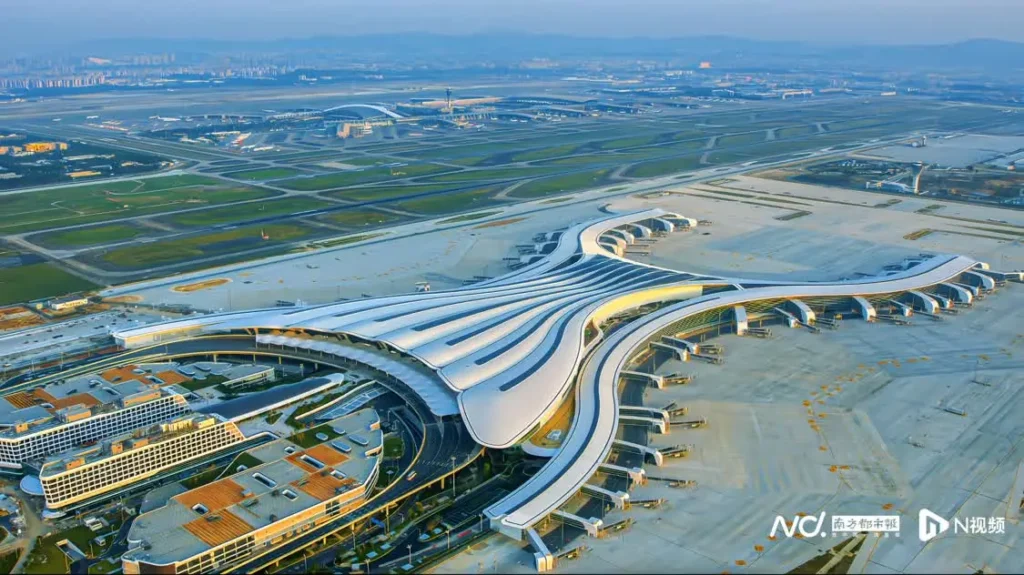
For Guangzhou Baiyun Airport, with the official operation of the brand-new Terminal 3 and the 5th Runway, the airport’s hardware facilities have entered a new stage. In the just-concluded October, the monthly passenger traffic hit a new historical high – from October 1 to 31, 2025, the airport handled a total of over 7.6 million passenger trips, a year-on-year increase of more than 11%. The dual breakthroughs in hardware upgrading and passenger flow growth have injected strong impetus into the full formation of Baiyun Airport’s hub pattern featuring “five runways + three terminals”.
From January to October this year, the outstanding performance of Baiyun Airport’s operational data further highlights the hub’s vitality: it guaranteed a total of 450,000 flights, a year-on-year increase of 7.60%; transported 68.74 million passengers, a year-on-year increase of 8.83%; and achieved a cargo and mail throughput of 2 million metric tons, a year-on-year increase of 2.12%. Among them, the international business maintained rapid growth, with a total of 14.15 million international passenger trips handled, a year-on-year increase of 18.74%, highlighting the global connectivity of the “Southern Gateway of China”.
The continuous growth of passenger flow data at the three major aviation hubs is backed by the significant improvement of their hardware facility capacity.
With the official opening of Guangzhou Baiyun Airport’s Terminal 3, the full operation of Hong Kong Airport’s Three-Runway System, and the full-speed advancement of Shenzhen Airport’s 3rd Runway construction, an unprecedented wave of airport expansion is in full swing.
Game Between Two Major Airlines
The “competition” of airport ground expansion ultimately boils down to the contest for airspace resources.
Enhancing hub capacity, densifying route networks… At present, the three major hub airports are engaged in multi-dimensional competition, which in turn reflects the core rivalry between the two home-based airlines in terms of route networks and transfer efficiency.
As key operators, China Southern Airlines, the backbone of the “Guangzhou Hub”, and Cathay Pacific Airways, headquartered in Hong Kong, have launched a series of market layout and initiatives based on their respective home airports.
In April this year, Cathay Pacific officially launched the direct flight route between Hong Kong and Urumqi, operating four round-trip flights per week. The opening of this route marks Cathay Pacific’s further penetration into China Southern Airlines’ core market.
As the largest home-based airline in Xinjiang, China Southern Airlines accounts for nearly 50% of the flight movements at Urumqi Airport. In response to Cathay Pacific’s “entry”, China Southern Airlines increased the frequency of flights from Urumqi to Beijing, Guangzhou and Shanghai to 8, 7 and 6 daily flights respectively during the summer and autumn flight season.
In market competition, both airlines have their own advantages. In recent years, Cathay Pacific has made great changes in its market layout in the Chinese mainland, with its core strategy of “Rooted in Hong Kong, Backed by the Motherland, Connecting the World”. It is not only Hong Kong’s flagship airline, but also a key node connecting China with the rest of the world. Relying on its international brand image and global route network, it has inherent advantages in attracting international passengers.
Earlier, in an interview with the media, Lavinia Lau, Director of Customer and Commercial of Cathay Pacific, mentioned: “Urumqi is very popular in the mainland now. We have wanted to launch this route for a long time, but it was really not easy to obtain the flight slots because Urumqi Airport is extremely busy.”
Cathay Pacific has obvious advantages for passengers traveling from Urumqi to Southeast Asia and Oceania via Hong Kong. Meanwhile, China Southern Airlines, with its route layout in Central Asia and West Asia, is more attractive to passengers traveling from Hong Kong to these regions.
It is worth noting that on the direct flight route between Hong Kong and Urumqi, Cathay Pacific also plans to launch the round-trip flight between Hong Kong and Changsha using A321neo aircraft starting from December 4, operating one flight per day. Changsha will thus become the fifth new destination in the Chinese mainland launched by the Cathay Pacific Group this year, bringing the total number of mainland destinations to 24.
In addition, Cathay Pacific has previously announced that starting from the new flight season on October 26, it will further increase the number of flights between Hong Kong and the four cities of Beijing, Shanghai, Guangzhou and Chengdu. During the peak winter tourism season this year, Cathay Pacific and its subsidiary Hong Kong Express will operate more than 330 weekly flights between Hong Kong and destinations in the Chinese mainland.
Intensified Competition
Cathay Pacific’s market moves in the Guangdong-Hong Kong-Macao Greater Bay Area in recent years have indeed brought certain competitive pressure to China Southern Airlines, especially in the competition for high-quality passenger sources, route network layout and hub linkage efficiency. However, China Southern Airlines has also taken a series of measures to respond.
The competition between the two sides is reflected in the intensified “customer-grabbing” strategies. Cathay Pacific attaches great importance to the Greater Bay Area market and is facilitating mainland passengers to fly to the world via Hong Kong through various “sea, land and air” channels. For China Southern Airlines, this means that some of the original high-end international passengers transferring via Guangzhou may be diverted.
China Southern Airlines’ response is very direct – it resumed the passenger route between Guangzhou and Hong Kong, which had been suspended for many years, directly entering Cathay Pacific’s core market to compete for international passengers departing from Hong Kong, especially those traveling to Central Asia, Europe and North America.
On the other side, Cathay Pacific continues to deepen its presence in the mainland market and expand its route network. This includes, but is not limited to: launching multiple new mainland destinations such as Urumqi and Changsha, while significantly increasing the frequency of flights to and from Beijing, Shanghai, Guangzhou and Chengdu.
The ultimate embodiment of infrastructure and airline operations is the direct competition at the market level, such as the competition for transfer passengers – those who need to transfer via a hub to their final destination. This is exactly the origin of the choice between “cheaper transfers via Guangzhou” and “convenient direct flights via Hong Kong”.
“Transferring from Guangzhou to London is much cheaper than taking a direct flight from Hong Kong to London!” Ms. Zhou (a pseudonym), a frequent traveler between Hong Kong and Guangzhou, shared her money-saving tips on an online platform. In the first half of this year, she originally planned to take a direct flight from Hong Kong to London, but found that for tickets on the same date and even the same flight, choosing to depart from Guangzhou and transfer via Hong Kong could save nearly 10,000 yuan.
The price difference made her choose the latter without hesitation. “When I saw such a big price difference, I immediately decided to depart from Guangzhou, which is very convenient.” She further explained that the rules for such connecting tickets are very flexible: after departing from the origin Guangzhou, passengers do not need to connect to the next leg of the journey immediately at the transfer hub Hong Kong, but can make a stopover. According to the policies of different airlines, passengers usually have a stopover period of several days. Her own itinerary was to fly from Guangzhou to Hong Kong, stay for a few days, and then fly from Hong Kong to London. She also noticed that Cathay Pacific deployed large aircraft for the short-haul route between Guangzhou and Hong Kong, which seems to confirm that a considerable number of passengers choose to transfer via Hong Kong.
Path to Collaborative Win-Win

Currently, the Greater Bay Area has formed a world-class airport cluster system led by the three major international aviation hubs of Guangzhou, Shenzhen and Hong Kong, supported by Zhuhai and Macao, and with the coordinated development of multiple regional airports. In accordance with the Outline Development Plan for the Guangdong-Hong Kong-Macao Greater Bay Area, the region is steadily advancing the functional complementarity, air traffic control coordination and resource sharing of the airport cluster, marking a new stage in China’s aviation development from single-hub scale competition to systematic coordination and cluster development.
As one of the regions with the highest degree of openness and strongest economic vitality in China, the total passenger throughput of the 7 airports in the Greater Bay Area exceeded 200 million in 2024, reflecting the enhanced vitality of the urban agglomeration in the Greater Bay Area, the expansion of opening-up, and the steady and sound development trend of the urban economy. According to the forecast of the International Air Transport Association (IATA), by 2035, the air passenger and cargo demand of the Greater Bay Area will reach 420 million person-times and 20 million metric tons respectively.
In 2024, the economic aggregate of the Greater Bay Area reached 14.79 trillion yuan, surpassing the New York Bay Area and the San Francisco Bay Area, and ranking among the first echelon of the world’s economic scale alongside the Tokyo Bay Area, with a per capita GDP of about 170,200 yuan.
The three major hub airports are geographically close to each other, with limited airspace but a broad market. How to jointly expand the “aviation pie” of the Greater Bay Area and enhance the region’s position in the global aviation landscape?
Relying on the operation of Terminal 3 and the 5th Runway, Guangzhou Baiyun Airport has clearly set its goal of building an “all-round gateway composite international aviation hub”. All along, Baiyun Airport’s leading position in passenger traffic and flight movements is the result of its broad economic hinterland, developed domestic route network, strong ground collection and distribution system, and continuous infrastructure investment.
Hong Kong Airport, with its mature international hub status, rich international routes and efficient multimodal transport system, continues to play a key role in the global aviation network.
Shenzhen Airport adopts a differentiated strategy in passenger and cargo transportation. Passenger transportation focuses on domestic routes and short-haul routes in the Asia-Pacific region, while cargo transportation is its development priority. The 16.3% year-on-year growth of Shenzhen Airport’s international and regional cargo volume in the first half of 2025 has also provided growth space for the cargo business dominated by China Southern Airlines. The opportunity for Shenzhen Airport’s cargo development stems from the characteristics of the industrial structure in the Pearl River Delta. Products such as electronic components produced in the Pearl River Delta are transferred between processing centers around the world, with large shipment volumes, strict timeliness requirements and high sensitivity to logistics costs, making them particularly suitable for transportation by large-capacity all-cargo aircraft.
In the future, the competition and cooperation among the three major hub airports are like two sides of a coin: there is direct competition for high-quality passenger sources and flight slot resources, and this pressure forces the three major hub airports to continuously improve their operational efficiency and service quality.
Seeking win-win results through collaboration, the three major hubs are transforming their competitive relationship into collaborative momentum through innovative models such as “Fly via Shenzhen” and “Fly via Zhuhai-Hong Kong”, jointly building the Greater Bay Area into a “world-class airport cluster” with the widest route coverage and highest transfer efficiency in the world.
For passengers, the “hub showdown” between Cathay Pacific and China Southern Airlines is objectively driving the entire market and passenger experience towards a better direction: whether it is direct flights or transfers, passengers have a wider range of choices and more cost-effective travel options.