On December 25 local time, US President Donald Trump announced on social media that the United States had carried out strikes against Islamic State terrorists in northwest Nigeria. US Africa Command stated that the strikes were launched in coordination with the Nigerian government, acting on the directives of President Trump and US Secretary of Defense Pete Hegseth.
However, the Financial Times reported on December 26 that local Nigerian residents were perplexed by the US military operation, noting that Sokoto State – the target of the airstrikes – is not a major stronghold for terrorists in the country. Analysts also pointed out that while Trump claimed the airstrikes were in retaliation for terrorist attacks on Christians in Nigeria, nearly all residents of Sokoto are Muslim.
Residents of Jabo village in Sokoto State recounted that on the evening of December 25 local time, they spotted objects resembling small aircraft flying overhead. “Shortly afterwards, we heard a huge bang and saw a massive fireball. Everyone was terrified. People rushed out of their homes with their families and fled in all directions.”
Reports indicated that similar scenes unfolded near at least two other villages in Sokoto State, where locals saw bombs land in open farmlands, scattering debris across agricultural plots. No casualties were reported in the strikes.
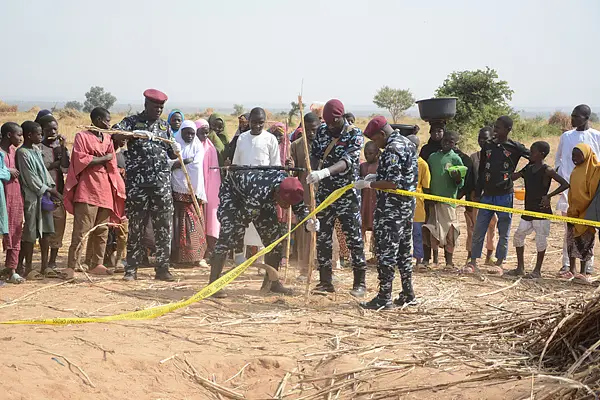
Samaila Uba, Director of Defence Information for the Nigerian military, said Nigeria’s armed forces had collaborated with the United States to execute the strikes based on “credible intelligence and meticulous operational planning”.
Uba added that the strikes targeting Islamic State terrorists were approved by Nigeria’s federal government, and the operation demonstrated Nigeria’s resolve, alongside its strategic partners, “to jointly tackle transnational terrorism and prevent foreign militants from establishing or expanding footholds within Nigerian territory”.
The Nigerian government later issued a statement saying that 16 GPS-guided precision munitions were launched from platforms in the Gulf of Guinea, targeting “terrorist hideouts” in the Tangaza area of Sokoto State. Authorized by Nigerian President Bola Tinubu, the airstrikes aimed to eliminate Islamic State forces infiltrating Nigeria from Sahel countries.

Residents of Jabo village remained baffled by the US airstrikes, stating that the last armed militant attack in the area occurred two years ago. Several analysts told the Financial Times that Sokoto State is not a terrorism “hotspot”, facing a far lower terrorist threat than Niger State and Kebbi State in northwest Nigeria, as well as Borno State in the northeast.
Over the past decade, Nigeria has been plagued by a host of security threats, including banditry, kidnappings, herder-farmer conflicts and extremist religious forces. The Armed Conflict Location & Event Data Project (ACLED), a non-profit organisation tracking global conflicts, estimates that political violence in Nigeria killed nearly 9,500 people last year.
Mustapha Gembu, a security analyst, noted that the primary security challenges in Sokoto State stem from bandit attacks, not Islamic State terrorists. He further pointed out that while Trump claimed the terrorists were “persecuting Christians”, the vast majority of Sokoto’s population is Muslim, and the state is in fact one of Nigeria’s key Islamic spiritual centres.
Umar Ardo, an opposition politician in Nigeria, raised doubts, arguing that the Nigerian government had not been an active participant in the airstrikes. “Targeting Sokoto State without prior confirmation of an Islamic State presence has sparked questions over whether Nigeria’s military was merely a bystander to the airstrike operation,” he said.
Ardo stressed that the Nigerian government “is obligated to provide a detailed national explanation of the legal basis, authorization procedures and strategic rationale for the US airstrikes in Sokoto State”.
The Financial Times observed that other Nigerian government departments responded more slowly than the Defence Ministry, failing to immediately confirm coordination with the US on the airstrikes. Earlier on December 25 local time, a senior Nigerian government official said authorities were still working to verify details, including exactly when the Nigerian government was informed of the strike’s location and timing.
The official acknowledged that Nigeria had collaborated with the US on intelligence gathering in recent weeks, but that Sokoto State was not the “most prominent target”.
On December 25, Trump claimed the US had launched a “powerful and deadly” strike against Islamic State terrorists in northwest Nigeria the same day. US Africa Command subsequently issued a statement saying it had acted at the request of the Nigerian government, killing multiple Islamic State terrorists.
But US Africa Command quickly revised the statement. The updated version read: “Acting on the directives of the US President and Secretary of War (Secretary of Defense), and in coordination with the Nigerian government, US forces conducted strikes against Islamic State terrorists in Nigeria.” This revised statement omitted the phrase “at the request of the Nigerian government”.
The Financial Times noted that to date, the Trump administration’s military operations in Africa have been concentrated primarily in Somalia, with more than 100 strikes launched against extremists there since February. In May this year, US Navy Admiral James Kilby claimed the US military had conducted the “largest airstrike in history” from an aircraft carrier, dropping 125,000 pounds (56.7 tonnes) of ordnance on targets in Somalia.