In the first three quarters of 2025, the added value of modern service industry in Shenzhen Qianhai reached 146.03 billion yuan, a year-on-year increase of 7.9%; the number of Hong Kong-funded enterprises in operation stood at 10,577 with a registered capital of 846.14 billion yuan; 183 of the “Fortune Global 500” companies have set up presence here… Recently, as the Overall Development Plan for the Qianhai Shenzhen-Hong Kong Modern Service Industry Cooperation Zone (hereinafter referred to as the Qianhai Plan) marked its second anniversary of release, Qianhai has achieved multiple phased outcomes in institutional innovation, opening-up to the outside world, and people’s livelihood integration, delivering a solid “hard-core” scorecard.
Up to now, 115 out of the 271 key tasks outlined in the Qianhai Plan have been implemented. This dynamic hub of reform is accelerating its development into a pilot platform for comprehensively deepening reform and innovation, a gateway hub for high-level opening-up, a leading zone for in-depth Shenzhen-Hong Kong integration, and a highland for the high-quality development of modern service industry, continuously unleashing strong development momentum.
Accelerating Shenzhen-Hong Kong Integration
The Qianhai Plan has, for the first time, explicitly designated the zone as one of the four strategic positions of “a leading zone for in-depth Shenzhen-Hong Kong integration”, making it a vivid epitome of the deep bond between the two cities.
For Huang Mingxin, this place is also his “blessed land”.
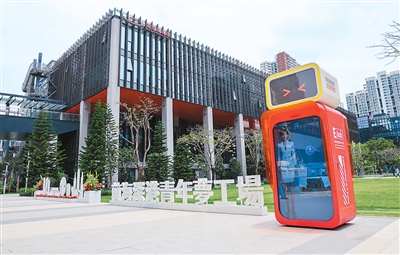
In 2024, Huang Mingxin led his team to establish Dayi Semiconductor Technology Co., Ltd., which became one of the first batch of enterprises to settle in the Qianhai Shenzhen-Hong Kong Youth DreamWorks. “Shenzhen boasts a complete industrial chain and abundant engineering talent resources. Qianhai has minimized the cost of starting a business by launching the ‘1510’ development model, which means building a 1-yuan innovation workshop for Hong Kong enterprises and professionals, allocating 5 billion yuan to set up funds, and providing 100,000 square meters of industrial space, thus creating room for our growth,” said Huang Mingxin. Today, his team has completed angel round financing and officially entered the mass production stage, becoming the first enterprise to graduate from the incubation program.
Data shows that from January to October 2025, over 80% of the newly added foreign-funded enterprises in Qianhai are Hong Kong-funded, representing a year-on-year increase of 83.8%; the DreamWorks has incubated a total of 1,591 entrepreneurial teams, including 1,161 teams from Hong Kong, Macao, Taiwan and other countries/regions, with a total financing amount of 6.8 billion yuan; 1,162 overseas professionals have completed registration and obtained practice qualifications. A “one-stop” service system covering employment, housing, education and medical care for Hong Kong residents has been basically established, and a livable and business-friendly “Hong Kong-style living circle” is becoming increasingly mature.
The “sense of home” is also hidden in the details visible everywhere on Qianhai’s streets. Zebra crossings are marked with “Look Left” and “Look Right”, and street signs feature black characters on white backgrounds, different from the “mainland blue” ones. The DreamWorks has also introduced catering and living service brands with distinctive Hong Kong characteristics, with dozens of Hong Kong brands settling in, exuding a strong Hong Kong vibe. “It feels like an extension of Hong Kong, but with a bigger stage,” many young Hong Kong entrepreneurs sighed.
A “Test Bed” for Reform and Opening-up
Known as a “special zone within a special zone”, daring to be the first has always been an inherent trait of Qianhai. Centering on its positioning as a “pilot platform for comprehensively deepening reform and innovation” and a “gateway hub for high-level opening-up”, Qianhai has continuously deepened reforms, and fruitful achievements in institutional opening-up have kept emerging.
Qianhai has implemented a “shorter” negative list for its free trade zone, and has taken the initiative to relax market access in sectors such as finance, logistics and professional services; it has explored special access permission in areas including telecommunications, cell and gene therapy, and wholly foreign-owned hospitals, with projects such as Siemens Digital Industries Software of Germany, Green Leaf Medical Aesthetics of Singapore, and the Shenzhen-Hong Kong Cell Valley successfully landing here… Today, Qianhai has become one of the regions in China with the most favorable conditions for attracting foreign investment. “Foreign-funded enterprises here need to submit 70% fewer documents, and the time required for incentive funds to be disbursed has been shortened by 90%, achieving the goal of ‘receiving investment and incentives in the same year’,” an official from the Qianhai Administration Bureau introduced. In 2024, Qianhai issued the Incentive Measures for Foreign Investment, and in 2025, it implemented AI-based policy review, greatly improving the efficiency and transparency of industrial fund application review.
“The business environment in Qianhai is second to none in the Guangdong-Hong Kong-Macao Greater Bay Area, providing broad development opportunities for foreign-invested enterprises,” said Harley Seyedin, President of the American Chamber of Commerce in South China. He noted that among the chamber’s more than 2,300 member enterprises in South China, over 52% plan to set up new offices in Qianhai.
Data indicates that in the first three quarters of 2025, the actual utilized foreign capital in Qianhai increased by 27.1% year-on-year; 2,528 new foreign-funded enterprises were established, a year-on-year growth of 78.8%, bringing the total number to over 12,000, making Qianhai one of the preferred destinations for numerous foreign-invested enterprises entering the Chinese market. At the 2025 Shenzhen Global Investment Promotion Conference held recently, Qianhai signed 40 projects with a total investment exceeding 170 billion yuan.
A New Highland for Modern Service Industry
Financial leasing helps manufacturing enterprises “achieve more with external support”; cross-border e-commerce enables high-quality Chinese products to sell well around the world; industrial internet equips production lines with “intelligent brains”; a number of professional service institutions in fields such as law, accounting and consulting practice cross-border business in Qianhai, escorting enterprises going global… Also newly included in the strategic positioning of the Qianhai Plan is the title of “a highland for the high-quality development of modern service industry”.
“Qianhai’s modern service industry has reached the ‘double 80%’ development level, meaning that the proportion of the service industry in GDP and the proportion of modern service industry in the service sector both exceed 80%,” said Shi Kun, Director of the Regional Development Planning Institute of the China (Shenzhen) Comprehensive Development Research Institute. He believes this marks that the development of Qianhai’s modern service industry has entered a new stage.
Data shows that in the first three quarters of 2025, the Shenzhen-Hong Kong International Financial City has attracted a total of 508 financial institutions, among which 371 are Hong Kong-funded or foreign-funded; the Shenzhen-Hong Kong International Legal Services District has introduced 272 legal service institutions, including 62 foreign-related legal service providers; the Qianhai International Talent Hub has added 7 new “international talent partners”.
In August 2025, Fubon Bank (Hong Kong) Limited was approved to set up a branch in Shenzhen, with Qianhai as its location. “Qianhai is adjacent to Hong Kong, with obvious financial agglomeration effect and diversified business formats, making it an ideal area for cross-border capital flow and capital docking,” said Zhong Guoqiang, Chief Executive Officer of Fubon Bank (Hong Kong). He emphasized that Qianhai’s unique advantages in cross-border finance and financial technology are the key factors for the enterprise’s investment decision.
Qianhai has also intensified its layout in technological fields such as artificial intelligence and low-altitude economy. As of September 2025, Qianhai has gathered 191 innovation carriers including enterprise engineering centers, engineering laboratories and technology centers, 103 national-level specialized, sophisticated, distinctive and innovative “little giant” enterprises, and 11 “unicorn” enterprises.