
Warmth on the Track, Chasing Dreams Side by Side
The lyrics of the song You Are My Eyes go: “You are my eyes / Taking me to see the changes of the four seasons / You are my eyes / Leading me through the crowded crowds / You are my eyes / Helping me read the vast sea of books / Because you are my eyes / Letting me see the world right before my eyes…”
At the 12th National Games for Persons with Disabilities and the 9th National Special Olympic Games (hereinafter referred to as the National Para Games), there is a group of athletes who step onto the track under the guidance of guide runners and bravely dash forward toward their own glory and dreams. Guide runners are their “eyes”.
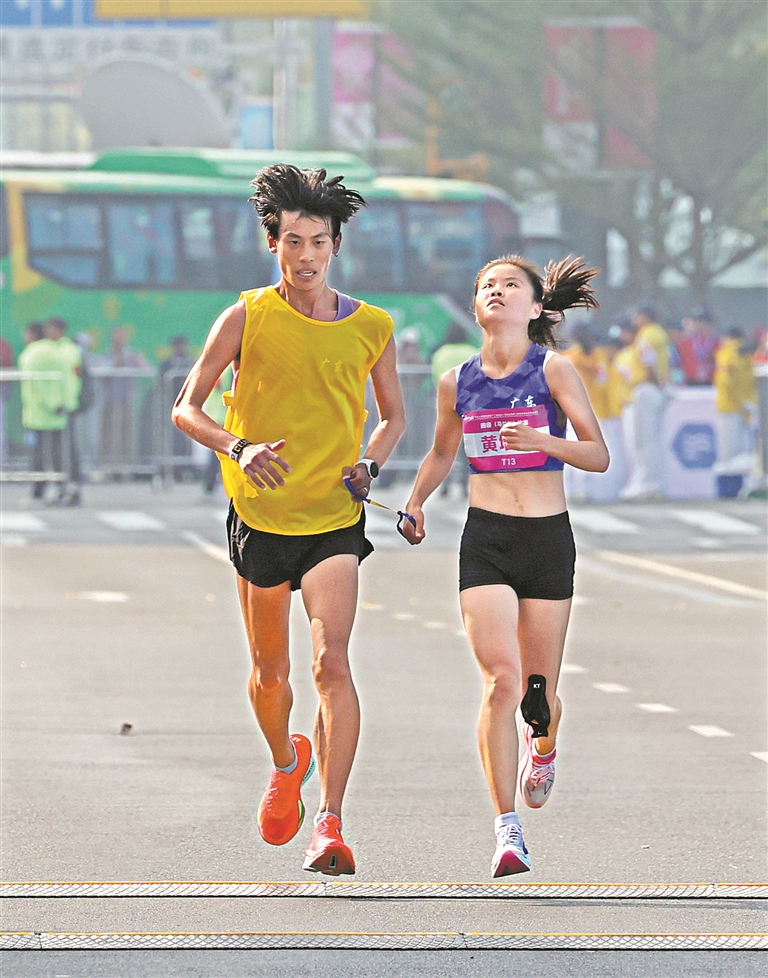
Huang Zengli: Dreams Must Be Burning Hot
On December 9, the women’s 1500m T13 para athletics final of the National Para Games came to an end. Huang Zengli from Guangdong Team Group 1 won the silver medal with a time of 4 minutes and 50.27 seconds, which was the second medal she and her guide runner Jing Zhi had claimed at this Games.
Two days earlier, Huang Zengli defeated competitors from all over the country in the women’s full marathon T13 final, breaking the national record with a time of 3 hours, 7 minutes and 3 seconds and winning the gold medal. During the race, guide runner Jing Zhi accompanied her all the way.
Huang Zengli said she had not been engaged in track and field training for a long time. She thanked her coach for discovering her running talent, and her performance had improved by leaps and bounds through repeated training and coordination with guide runner Jing Zhi.
She expressed special gratitude to Jing Zhi, saying that his patient guidance and selfless dedication enabled her to win two medals in her first appearance at the National Para Games. Next, they would team up to compete in two more events, continuing to fight for honor and faith.
Huang Zengli was very talkative. She said she owed her good results to many people and specially styled her hair into a “Nezha hairstyle” for the competition that day. “Having a nice hairstyle makes me feel happier during the race. Nezha is very powerful, and I want to become a better version of myself, so I chose this hairstyle.”
Interestingly, renowned Guangdong sprinter Liang Xiaojing also wore a “Nezha hairstyle” in several important competitions before. In this regard, Huang Zengli said she knew Liang Xiaojing was an outstanding athlete and hoped she could become an excellent middle and long-distance runner as well.
Regarding her result, Huang Zengli said: “I have done my best, and I am satisfied with today’s performance.”
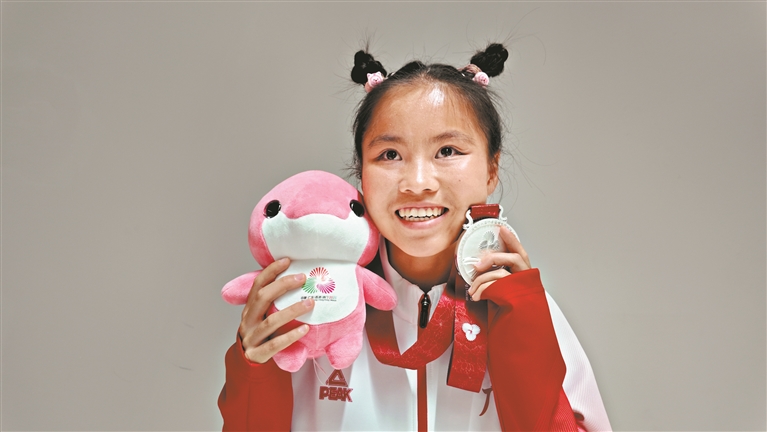
Feeling the Warmth in the Guangdong Team Family
This was Huang Zengli’s first time participating in the National Para Games. She revealed that she was a little excited, delighted and nervous, but believed she would become better in the future and hoped to stand on a broader stage. “Medals are cold, but dreams must be burning hot.”
After the race, Huang Zengli said emotionally: “The Guangdong team is a warm big family where everyone gets along like brothers and sisters. Every time the coach leads the team to compete abroad, I really envy them. The coach makes a detailed training plan for me every time, and the guide runner tells me how to swing my arms, teaches me hand in hand, including how to lift my legs. I feel a little regretful about the silver medal, but I believe one day I will stand on a bigger stage to make up for this regret. I believe this is not an end but a new starting point. There is still a big gap between me and the champion. In the following training, I will work harder to strive. I hope my experience and story can inspire more people in difficulties, bring them a little light, and make them have more hope for life.”
Guide Runners Act as “Eyes”
Jing Zhi, the guide runner, said he and Huang Zengli had been partners since they started training in Chuxiong, Yunnan in February this year and had been coordinating until now. It was really not easy for them to cooperate at first. “Because we are of different heights, my stride is longer while hers is shorter, which requires her to increase her frequency and me to slow down a bit. We polished our cooperation bit by bit, from day to night, day after day, and achieved the current results,” Jing Zhi said.
The tacit understanding between guide runners and athletes is crucial. Jing Zhi revealed: “When I speed up my arm swing, it means we are going to move forward; when I pull outward, it means we are going to overtake others; when I pause my hand backward, it means we are about to step on someone’s foot, so we need to slow down and stop for a moment.”
In an interview, Jing Zhi disclosed that he was currently a sophomore at Henan Normal University. He had suspended his studies for a year to participate in the National Para Games, and his qualification for the national first-class athlete had been postponed, but he thought it was all worth it. Helping Huang Zengli achieve good results was his biggest wish.
Jing Zhi is a middle and long-distance runner who began professional training in 2018 and has a half-marathon time of under 1 hour and 15 minutes.
In March this year, Huang Zengli suffered a meniscus injury and was in low spirits. “It was a kind of pain. Running is part of my life, as ordinary as eating and sleeping. Suddenly I couldn’t run, and I was very depressed. But the coach and guide runner have been accompanying and encouraging me. They didn’t give up on me, and my injury slowly recovered. I started to resume training in October this year,” Huang Zengli said. “To be honest, after running the marathon the day before yesterday, I was definitely a bit tired, but if my opponents can run, I can definitely run too, and even better than them.”
Talking about her fate with sports, Huang Zengli revealed: “When I was in middle school, I participated in the rope skipping competition of the provincial sports meeting, and the PE teacher found that I had sports talent. Later, after a trial training in Guangdong, I stayed in this big family for training. At first, I couldn’t even swing my arms or lift my legs. It was the coach and guide runner who demonstrated again and again, allowing me to learn by imitating their movements. It’s not easy for visually impaired people to learn to run. Many techniques are quite difficult to understand. I have to perform the movements and run beautifully. It takes hours to learn many movements, and they will guide me patiently step by step.”