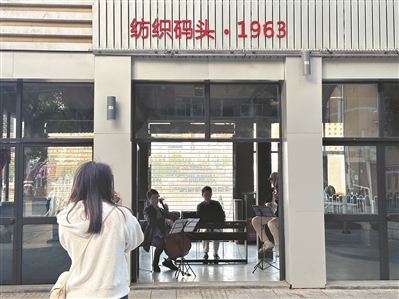
“We are not professional musicians, but a group of office workers healed by ensemble music.” The former Textile Wharf on the bank of the Pearl River, renovated into a café and a cultural space, has drawn a group of classical music lovers passionate about ensemble performances. Here, they share the healing power of music and named this place the Bosheng Music Space, aspiring to create a soothing haven by the Pearl River where people’s hearts are warmed by beautiful melodies.
The Pearl River surges with tides and bears the marks of time, and its old wharves are quietly embracing a new lease of life. Wandering along the river today, one can see a striking transformation of many once-deserted water bus wharves: the aroma of coffee mingles with the river breeze, piano music resonates with the rhythm of waves, and new vitality pulses through the grey bricks and dark tiles of these historic wharves.

Cultural Empowerment: Wharves Transformed into Artistic Spaces
Among numerous renovation projects, the Yongxing Street Wharf was the first to take culture as its core driving force, setting a vivid example for the transformation of traditional wharves.
The renovation of Yongxing Street Wharf has consistently adhered to a dual approach of “aesthetic upgrading” and “cultural empowerment”. The design team delved deep into the historical heritage of the Nanhua West Street neighborhood, integrating the unique patterns and textures of Lingnan arcades into the wharf architecture. This seamless integration of the wharf with the surrounding historic blocks has achieved an upgrade in both visual aesthetics and cultural connotation.
To invigorate the wharf, the Pearl River Passenger Ferry Company adopted a composite strategy of “business formats + immersive scenarios”. The introduction of a renowned coffee brand has paired fragrant coffee with the gentle river breeze in perfect harmony; the creation of the 141 Art Garden has further endowed the wharf with literary vitality. More than a spot offering light meals and tea drinks, it regularly hosts live performances by indie bands and trendy music salons. The strums of guitars, melodious singing and the rippling waves of the Pearl River interweave in resonance, forming a distinctive riverside art and cultural cluster with an exquisite taste.
If Yongxing Street Wharf represents the integration of culture and daily life, the Textile Wharf focuses on artistic empowerment, infusing the riverside space with a unique rhythm.
“We’ve found that rehearsing together relaxes people more than attending a concert,” a participant said at the Bosheng Music Space, a venue revamped from the Textile Wharf with minor renovations. During rehearsals, music enthusiasts sit together to discuss, co-create, feel the interlocking and dancing musical notes, and immerse themselves in the rich emotions and vivid hues hidden beneath the melodies.
“Performances in concert halls are beautiful, yet distant. We want people to witness how music is woven step by step,” another musician added. Unlike traditional concert halls with a clear divide between stage and audience seats, the Bosheng Music Space explores a new path: bringing music back to the interaction between people.
According to official sources, leveraging the advantages of its 60-square-meter riverside platform, the Pearl River Passenger Ferry Company has tailor-made the New Era Riverside Concert Hall for the Textile Wharf — the first public music performance platform along the Pearl River in Guangzhou. Co-built by the Haizhu District Library and the Yuexiu District Musicians Association, the project retains the original structural strengths of the wharf through lightweight minor renovations, and complements it with coffee and light food services. Diverse forms such as art flash mobs and coffee book bars have been introduced to continuously enliven the space.
Today, the Textile Wharf is no longer an idle riverside corner. Melodious piano music drifts with the river current; citizens savor a cup of coffee while listening to the movements; tourists experience the river breeze and the fragrance of books in this space. Music resonates with the river, art blends with life, adding a strong cultural and artistic ambiance to the Pearl River’s shoreline.
Brand Synergy: Stimulating Vibrant Consumption
Beyond the infusion of culture and art, an equally important exploration in wharf renovations is how to efficiently revitalize idle spaces and boost consumption vitality — and the Provincial Federation Wharf has offered an ingenious solution.
To address the partial idleness of the Provincial Federation Wharf, the Pearl River Passenger Ferry Company broke away from conventional renovation thinking and took brand synergy as a breakthrough. It introduced the well-known brand Longquan Bingshi (Longquan Ice Delights) to jointly build a leisure station integrating coffee drinks and fresh milk ice cream. This initiative has not only put the idle space to efficient use, but also brought a steady flow of visitors to the wharf by virtue of the brand’s existing customer base and good reputation.
Now, the Provincial Federation Wharf has become a midway refreshment stop for citizens and tourists traveling along the river. People take a short rest and taste delicacies here, which not only elevates their travel experience, but also maximizes the space efficiency of the wharf, achieving a win-win outcome in both economic and social benefits.
Valuing Heritage: Bridging the Past and the Present
While activating commercial and artistic vitality, the wharf renovations also attach great importance to carrying historical memories. The Qiankou Wharf, adjacent to the former site of the First National Labour Congress, connects the past and the present through nostalgic cultural and creative products as a bond.
With a nostalgic style as the overall keynote, the Pearl River Passenger Ferry Company integrated profound historical memories with relaxed modern leisure, and innovatively introduced black vinyl record cultural and creative product sales as well as premium coffee services. This has turned the wharf into a link connecting history and the present.
Here, tourists can savor aromatic coffee while appreciating retro black vinyl record cultural and creative products; citizens can reminisce about the past in a nostalgic atmosphere. The wharf has thus become a distinctive cultural and creative experience space where people can stop, appreciate and reminisce.
In line with the requirements of the Guangzhou High-quality Development and Construction Plan for the Pearl River Coast, the Pearl River Passenger Ferry Company of Guangzhou Public Transport Group has drawn on the experience of revitalizing Yongqing Fang and Taikoo Cang. Advancing minor renovation projects under the concept of “One Vessel, One Theme; One Wharf, One Scenic Spot”, the once single-function transportation hubs are evolving into new riverside landmarks that bear culture, leisure and consumption, and living carriers of Lingnan customs and Guangzhou’s stories.
A relevant person in charge of the Pearl River Passenger Ferry Company of Guangzhou Public Transport Group stated that in the future, more riverside spaces will be revitalized to present a warmer, more storied and more charming picture of the Pearl River for citizens and tourists alike.