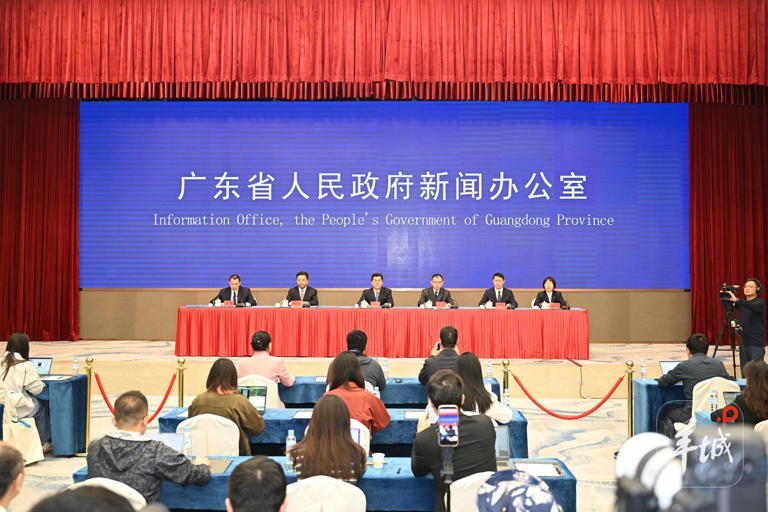
On December 8, the Guangzhou Special Session of the “14th Five-Year Plan: Guangdong’s Achievements” Press Conference was held. The conference briefed the attendees on the overall economic and social development of Guangzhou during the 14th Five-Year Plan period, with relevant municipal bureau officials answering questions from reporters.
As one of the core engines driving the development of the Greater Bay Area, what measures has Guangzhou taken to advance the construction of the Guangdong-Hong Kong-Macao Greater Bay Area during the 14th Five-Year Plan period? At the press conference, Wu Sa, Director of the Guangzhou Development and Reform Commission, gave a detailed introduction focusing on the construction of the Nansha Major Strategic Platform and the “Five Connectivities” of the Greater Bay Area.
New Progress in the Construction of the Nansha Major Strategic Platform
Wu Sa noted that the construction of the Nansha Major Strategic Platform had opened up a new chapter during the 14th Five-Year Plan period. Specifically, Guangzhou successfully secured the issuance of the Overall Plan for Deepening Comprehensive Guangdong-Hong Kong-Macao Cooperation in Nansha, Guangzhou for the World (hereinafter referred to as the Nansha Plan) by the State Council. At the provincial level, the Nansha Working Committee was established, along with the introduction of the Regulations on Nansha and a series of supporting measures for Nansha’s development, advancing the development and construction of Nansha at a high standard.
In terms of policy support, a number of landmark policies have been implemented, including personal income tax incentives for Hong Kong and Macao residents, a 15% corporate income tax rate for encouraged industries, and the “30 Measures for Nansha’s Financial Development”. Guangzhou also successfully obtained national approval for pilot programs such as market access liberalization, regulatory system reform, and comprehensive land management reform, continuously unleashing policy dividends. Nansha’s regional GDP exceeded 230 billion yuan, with a resident population of nearly 1.3 million. The three key starting zones have accelerated the formation of agglomeration effects, attracting over 3,500 Hong Kong and Macao enterprises to set up operations in Nansha cumulatively.
In the area of opening-up, the comprehensive service base for Chinese enterprises “going global” has been put into substantive operation, empowering 258 enterprises to expand their overseas presence. Nansha was approved as a national pilot zone for high-level opening-up in cross-border trade and investment, with its cross-border e-commerce import and export volume at the Nansha Comprehensive Bonded Zone ranking first in China for six consecutive years. Pilot programs for Qualified Domestic Limited Partners (QDLP) and Qualified Foreign Limited Partners (QFLP) have been launched, with the number of opened Free Trade (FT) accounts exceeding 9,700 cumulatively.

New Breakthroughs in the “Five Connectivities” of the Greater Bay Area
Institutional and Mechanism Connectivity
Three batches of 99 items on the list for aligning rules and mechanisms with Hong Kong and Macao have been implemented, achieving significant breakthroughs in areas such as cross-border flow of factors, professional qualification recognition, and commercial registration services. Guangzhou ranks first in China in the number of issued talent endorsements for travel between the mainland, Hong Kong and Macao. To date, nearly 1,000 overseas talents have been attracted to practice in the city. The upgraded “Guangzhou-Hong Kong Connect” and “Guangzhou-Macao Connect” one-stop commercial registration services have been launched. Currently, there are 13,500 Hong Kong and Macao-funded enterprises in Guangzhou, accounting for nearly one-fourth of the city’s total foreign-invested enterprises.
Infrastructure Connectivity
The Guangzhou-Foshan Southern Ring Intercity Railway and the Foshan-Dongguan Intercity Railway have been put into operation, achieving “four-line connection” with the Foshan-Zhaoqing and Dongguan-Huizhou Intercity Railways. Intercity railway operations have realized networked and commuter-oriented services, making the vision of “one network, one ticket, one cluster of cities” for rail transit travel a reality. The Pazhou Hong Kong-Macao Passenger Terminal has been officially commissioned, accelerating the formation of the Greater Bay Area “one-hour living circle”.
Scientific and Technological Innovation Connectivity
A total of 18 Guangdong-Hong Kong-Macao joint laboratories have been co-established, accounting for approximately 60% of the province’s total. Focusing on fields such as artificial intelligence, low-altitude economy, and biomedicine, cooperation with universities and research institutions in Hong Kong and Macao has been deepened. Pilot reforms for the cross-border free flow of scientific research supplies have been carried out. The Guangzhou-Shenzhen-Hong Kong science and technology cluster has risen to the first place in the Global Innovation Index rankings.
Industrial Collaboration and Chain Connectivity
Enhanced industrial cooperation with Hong Kong and Macao has been conducted in sectors including finance, electronic information, and horse racing. The construction of the Guangdong-Hong Kong-Macao Greater Bay Area Cross-Border Wealth Management and Asset Management Center has been launched. Major projects such as Phase II of the Hong Kong Jockey Club Conghua Racecourse and the Greater Bay Area Headquarters of Linkway Vision are progressing at a fast pace. 18 key cooperation platforms at or above the municipal level are advancing in an orderly manner. The Guangzhou-Hong Kong Intelligent Manufacturing Cooperation Zone has attracted over 250 Hong Kong-funded enterprises to settle in.
People-to-People and Cultural Connectivity
A total of 53 innovation and entrepreneurship bases for Hong Kong and Macao youth have been established, attracting more than 2,700 Hong Kong and Macao entrepreneurial projects and over 3,400 young people from Hong Kong and Macao. 20 medical institutions have been included in the “Hong Kong-Macao Medicine and Medical Devices Connect” program, 4 in the Hong Kong “Elderly Health Care Voucher Pilot Scheme in the Greater Bay Area”, and 7 elderly care institutions in the Hong Kong “Guangdong Residential Care Service Scheme”. A high-quality living circle suitable for living, working and traveling has taken initial shape.