Sanyuan Palace in Guangzhou: A Millennium – old Taoist Temple, a Quiet Pure Land Hidden in the Bustling City

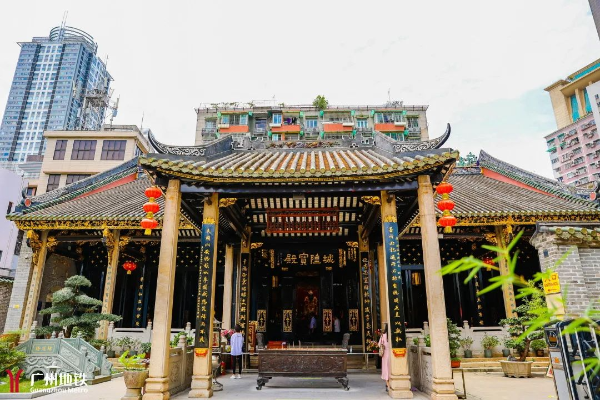
Amidst the lush greenery at the southern foot of Yuexiu Mountain, Sanyuan Palace, with its red walls and dark – grey tiles, quietly witnesses the changes of Guangzhou, the City of Rams, over the past thousand years.
In the busiest downtown area of Guangzhou, adjacent to the bustling Yingyuan Road and the solemn Sun Yat – sen Memorial Hall, lies a secluded and peaceful place – Sanyuan Palace. First built in the Eastern Jin Dynasty, this ancient Taoist temple is not only the oldest and largest Taoist building in the Lingnan region but also a unique space that integrates a thousand years of history, Taoist culture and folk beliefs.
Stepping into the palace gate, one seems to instantly travel from the noisy modern city to a quiet and solemn sacred world. Incense curls in the air here, and towering ancient trees stand tall. The buildings are constructed along the mountain slope, rising layer by layer. People can’t help but slow down their pace to calmly feel the charm of the thousand – year – old civilization.
01 Historical Evolution: From Yuegang Courtyard to Sanyuan Palace
The history of Sanyuan Palace can be traced back to the Eastern Jin Dynasty in 320 AD. Bao Jing, the governor of Nanhai Prefecture, built a place for his daughter Bao Gu to practice Taoism, initially named “Yuegang Courtyard” because it was located at the foot of Yuexiu Mountain. During the Tang Dynasty, it was renamed “Wuxing Temple” and used as a Buddhist temple, and gradually fell into disrepair during the Southern Han Dynasty.
In the Wanli period of the Ming Dynasty, Wuxing Temple was renovated. In the Chongzhen period, in response to the proposal of the Imperial Observatory and to welcome the “auspicious qi from heaven”, people enshrined the Three Yuan Emperors in the main hall of Wuxing Temple. Since then, Yuegang Courtyard has been renamed “Sanyuan Palace”, and this name has been in use to this day.
In the 13th year of the Shunzhi reign in the Qing Dynasty (1656 AD), Shang Kexi, the Prince of Pingnan, ordered the renovation and expansion of Sanyuan Palace. During the Kangxi period, Du Yangdong, the abbot of Chongxu Temple on Luofu Mountain, was invited to Guangzhou to pray for rain. Later, he stayed on as the abbot of Sanyuan Palace and was honored as the founding master.
During the War of Resistance against Japanese Aggression, Sanyuan Palace suffered severe damage. After the victory of the war, He Chengrui, the abbot at that time, raised funds to renovate it. During the “Cultural Revolution”, the Taoist priests of Sanyuan Palace were forced to leave, and all the statues and cultural relics were lost without a trace.
Fortunately, the government renovated Sanyuan Palace from 1982 to 1983. Starting from 1992, the Guangzhou Taoist Association launched a comprehensive restoration project on Sanyuan Palace, restoring the glory of this thousand – year – old Taoist temple.
02 Architectural Layout: A Model of Lingnan Architecture Built Along the Mountain
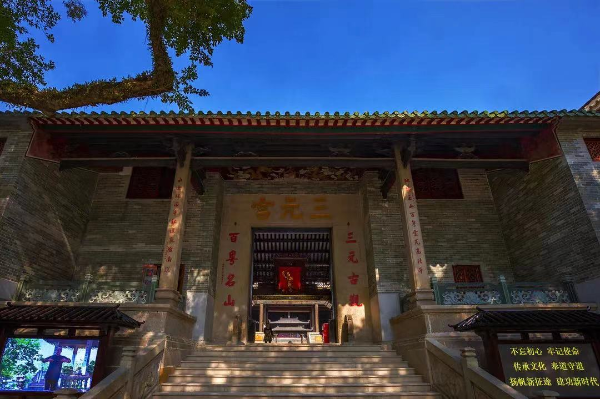
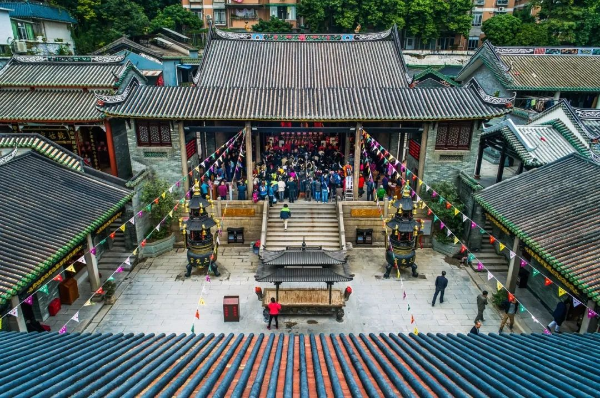
The architectural layout of Sanyuan Palace fully reflects the Taoist concept of harmonious coexistence between buildings and nature. Located at the southern foot of Yuexiu Mountain, it faces south with its back to the north and is constructed along the mountain. The architectural complex gradually rises along the mountain slope, covering an area of about 5,100 square meters, with a building area of approximately 2,000 square meters.
The architectural complex centers on the Sanyuan Hall, the main hall. The worship corridor in front of the hall connects the Bell Tower and the Drum Tower on the east and west sides respectively. Behind the main hall stands the Laojun Hall. On both sides of the main hall, from south to north, there are the Guest Hall, Dining Hall, Old Ancestral Hall and Lu Zu Hall on the east side, and the Alms Bowl Hall, New Ancestral Hall and Bao Gu Hall on the west side.
Along the central axis of Sanyuan Palace, the Mountain Gate, the Spiritual Official Hall, the Sanyuan Main Hall and the Laojun Hall are arranged in sequence from south to north. In front of the Sanyuan Main Hall, there are wide stone steps and a courtyard. The Guest Hall, Dining Hall, Ancestral Hall and Alms Bowl Hall are located around the courtyard. In addition, Sanyuan Palace also has auxiliary halls such as the Guan Yu Hall, Mazu Hall, Guanyin Hall and God of Wealth Hall.
This layout, built along the mountain terrain, not only makes the entire Taoist temple look lofty and magnificent but also creates a transitional space from the mortal world to the sacred realm. It guides visitors to gradually purify their minds and achieve spiritual sublimation while climbing up the steps.
03 Main Halls: Integration of Sacred Space and Architectural Art
1. Mountain Gate
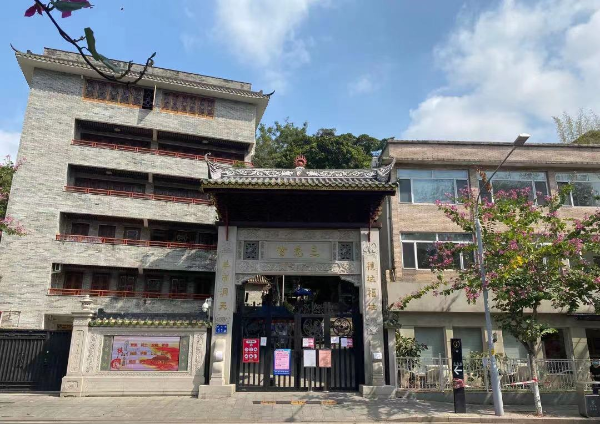
The Mountain Gate was built in the 51st year of the Qianlong reign in the Qing Dynasty (1786 AD) and stands more than 40 stone steps above the ground. The three characters “Sanyuan Palace” are inscribed on the stone lintel. Beside it, there is a stone – carved couplet reading “An Ancient Sanyuan Temple, A Famous Mountain in Hundred Yue”, which was written by You Xianting, a scholar of the Hanlin Academy, during the renovation in the 2nd year of the Tongzhi reign in the Qing Dynasty (1863 AD). A pair of tall and majestic stone lions stand in front of the Mountain Gate, exuding dignity and solemnity.
2. Sanyuan Main Hall
As the main hall of Sanyuan Palace, the Sanyuan Main Hall is built on a higher stone platform in the north. It has 5 bays in width, covering 20.27 meters, and 5 bays in depth, stretching 16.85 meters. It features a gable and hip roof with glazed tile edgings and was rebuilt during the Tongzhi period of the Qing Dynasty.
In the center of the hall, three deities are enshrined, namely the Heavenly Official of the First Yuan, the Earthly Official of the Second Yuan and the Water Official of the Third Yuan, collectively known as the “Three Yuan Emperors”. According to Taoist doctrine, heaven, earth and water are the Three Yuan. The Heavenly Official is in charge of blessing the world, the Earthly Official is responsible for pardoning sins, and the Water Official is dedicated to relieving disasters and difficulties. Sanyuan Palace gets its name precisely because it enshrines these three deities.
3. Bao Gu Hall
Located on the west side of the Sanyuan Main Hall, Bao Gu Hall served as the main hall until the late Ming Dynasty. Later, it was converted to enshrine the Three Yuan Emperors, so it is wider than other auxiliary halls. Bao Gu was the daughter of Bao Jing, the founder of the original courtyard, and also the wife of Ge Hong, a famous Taoist master. She was highly skilled in medicine. She collected herbs and practiced medicine all year round to cure the common people, and was respectfully called “Immortal Bao”. A golden sitting statue of Bao Gu is enshrined in the hall to commemorate this great female physician and Taoist practitioner.
4. Lu Zu Hall
Lu Zu Hall is located northeast of the Sanyuan Main Hall and consists of two connected courtyards. It has a gable roof, and each courtyard has 3 bays with a width of 10.65 meters. A statue of Lu Zu (Lu Dongbin) is enshrined in the back courtyard. As one of the Eight Immortals in Taoism, Lu Dongbin is also one of the immortals with the most folk tales and is deeply revered by the people.
04 Religious Culture: Three Yuan Beliefs and Folk Festivals
Sanyuan Palace is an important Taoist site in Guangzhou. The “Three Yuan Festivals” held every year are the most grand religious and folk activities here.
- First Yuan Festival (the 15th day of the first lunar month): It is the day when the Heavenly Official bestows blessings. Believers flock here, hoping to burn the “first incense” to get blessings and protection from the Heavenly Official.
- Second Yuan Festival (the 15th day of the seventh lunar month): On this day, the Earthly Official pardons sins, and a steady stream of believers come to burn incense and worship.
- Third Yuan Festival (the 15th day of the tenth lunar month): It is the day when the Water Official relieves disasters. Believers gather to pay homage and pray for the elimination of misfortunes.
In addition to the Three Yuan Festivals, the first day of the first lunar month is also a bustling day for Sanyuan Palace. Thousands of citizens come here to pray for good luck in the new year.
In 2019, a Taoist music troupe was established in Sanyuan Palace, composed of senior folk musicians and activists. It is the first troupe founded by a Taoist organization in Guangzhou. Moreover, Sanyuan Palace actively carries out cultural exchange activities. For example, the Guangzhou – Hong Kong – Macao Taoist Culture Exchange Center, established in 2022, has promoted the exchange and integration of Taoist culture in the Greater Bay Area.
05 Artistic Value: Protection of Ancient Architecture and Cultural Relics
As a cultural relic protection unit in Guangzhou, Sanyuan Palace is not only a venue for religious activities but also a precious cultural heritage. It preserves many historical relics, such as the stone – carved mural of Guanyin painted by Wu Daoxian in the Tang Dynasty, the stone – carved couplet on the gate dating back to the 2nd year of the Tongzhi reign in the Qing Dynasty, and the Qiulong Ancient Well once used by Bao Gu to treat the common people.
The construction techniques of Sanyuan Palace also embody the characteristics of Lingnan architecture. The 19 giant nanmu pillars in the main hall are particularly precious. Gifted by the King of Vietnam, they have been well – preserved for more than 350 years. The architectural layout that connects the Bell Tower, the Drum Tower, the worship corridor and the Sanyuan Main Hall into an integrated whole is unique among ancient buildings in Guangzhou.
On September 17, 2021, Sanyuan Palace was awarded the title of “Model Base for Integrity and Self – discipline in the Religious Circle”, which reflects its achievements in standardized management and cultural inheritance.
06 Visitor Guide: A Peaceful Journey in the City
Practical Information
- Address: No. 11 Yingyuan Road, Yuexiu District, Guangzhou.
- Opening Hours: 8:00 – 17:00 (the opening time is advanced to 7:00 on the first and 15th days of each lunar month).
- Ticket Information: Free of charge.
- Best Visiting Time: It is relatively quiet on weekdays and extremely lively during holidays and the Three Yuan Festivals, so visitors can choose according to their own preferences. Visiting in the early morning allows you to experience the peaceful atmosphere of the Taoist temple.
Transportation Guide
- Subway: Take Metro Line 2 to Memorial Hall Station, exit from Exit C, and walk for about 10 minutes to reach the destination.
- Bus: You can take buses No. 10, No. 24, No. 27, etc., and get off at “Sanyuan Palace Station”.
Visiting Suggestions
Visiting Sanyuan Palace is not only a tourist activity but also a cultural experience and a spiritual journey. It is advisable to slow down to feel the historical heritage of this thousand – year – old Taoist temple. In the early morning, you can watch the Taoist priests’ morning classes and experience their daily practice life. In front of the Sanyuan Main Hall, you can learn about the connotation of the belief in the Three Official Emperors. Inside Bao Gu Hall, you can hear the stories of this legendary female physician. By observing the architectural details, you can appreciate the delicacy and harmony of Lingnan architecture.
Regardless of the changes of history, Sanyuan Palace still stands quietly at the southern foot of Yuexiu Mountain, serving as an important landmark of Guangzhou’s history and culture. It is not only a thousand – year – old Taoist temple but also a unique space that connects the past and the present, bridges heaven and humans, and soothes people’s souls.
Next time when you pass by the Sun Yat – sen Memorial Hall, why not take a few more steps to walk into this thousand – year – old Taoist temple? Look for a pure land for your soul in the noisy city and feel the beauty of the integration of history and faith.
Exploration of Common Questions about Sanyuan Palace in Guangzhou
What is the specific address of Sanyuan Palace? No. 11 Yingyuan Road, Yuexiu District, Guangzhou, at the southern foot of Yuexiu Mountain.
What is the official name of Sanyuan Palace? Its official name is Sanyuan Palace, and its former name was Yuegang Courtyard.
When was Sanyuan Palace first constructed? In the second year of the Daxing period of Emperor Yuan of the Eastern Jin Dynasty (319 AD).
Why is it named “Sanyuan Palace”? It is named so because it mainly enshrines the Three Officials (the Heavenly Official, the Earthly Official, and the Water Official), which correspond to the Taoist concept of the “Three Primes” (heaven, earth, and water). It was officially renamed during the Chongzhen period of the Ming Dynasty.
What is the status of Sanyuan Palace in the Taoist culture of Guangzhou? It is the oldest Taoist temple in the Lingnan area and the oldest and largest existing Taoist building in Guangzhou.
What is the historical evolution of Sanyuan Palace? Originally built in the Eastern Jin Dynasty as Yuegang Courtyard for Bao Gu; renamed Wuxing Temple in the Tang Dynasty; restored as the North Temple in the Song Dynasty; renovated and renamed Sanyuan Palace in the Ming Dynasty; expanded during the Qing Dynasty; damaged during the Cultural Revolution and reopened in 1982.
When was Sanyuan Palace designated as a Guangzhou Municipal Cultural Relic Protection Unit? On December 8, 1989.
What is the English name of Sanyuan Palace? Sanyuan Palace.
What are the opening hours of Sanyuan Palace? Regular hours: 8:00 – 17:00; extended to 7:00 – 17:00 on the 1st and 15th days of each lunar month.
Is a ticket required for visiting? Admission is free.
Is advance reservation necessary? Individual visitors generally do not need a reservation; groups are advised to contact the temple in advance.
How long is the recommended visiting time? 1 to 2 hours.
Under what circumstances will the palace be closed temporarily? Temporary closures may occur during major festivals, severe weather, or for epidemic prevention.
What are the opening hours on the first day of the Lunar New Year? Open from 7:00 to 17:00, with expected large crowds. Special prayer arrangements are in place.
What are the characteristics of the architectural style? It features a Lingnan Taoist style with a blue-grey color scheme, built against the mountain, integrating with Jiangnan garden influences.
What is the overall layout? A south-facing central axis layout: Mountain Gate – Palace of the Spiritual Official – Sanyuan Hall – Laojun Hall, with auxiliary halls on the sides.
Which three deities are enshrined in the main hall? The Three Officials: the Heavenly Official (bestows blessings), the Earthly Official (grants absolution), and the Water Official (relieves disasters).
What are the important buildings and cultural relics? Key buildings include the Sanyuan Hall and Laojun Hall. Cultural relics include Tang Dynasty stone carvings and the Qiulong Ancient Well.
What is the floor area and construction area? The floor area is about 5,100 square meters, and the construction area is about 2,000 square meters.
What is special about the architectural structure? It features multi-level platforms built into the mountain, over 40 stone steps, and a unique integrated structure connecting the main hall with bell/drum towers.
Are there any ancient trees? Yes, there are ancient banyan trees blending with the Yuexiu Mountain greenery.
How is the night view? The lighting is soft, creating a primitive and solemn atmosphere, suitable for viewing.
Who are the Three Officials and what are their responsibilities? The Heavenly Official bestows blessings; the Earthly Official grants absolution from sins; the Water Official relieves disasters.
When are the Three Primes Festivals? The First Prime Festival (15th day of 1st lunar month), the Second Prime Festival (15th day of 7th lunar month), and the Third Prime Festival (15th day of 10th lunar month).
What is the connection with folk customs? Integrated with local customs like lantern shows on the First Prime Festival and ancestor worship on the Second Prime Festival.
How does it differ from other Taoist venues in Guangzhou? Sanyuan Palace is the oldest and mainly enshrines the Three Officials, whereas others focus on different deities like Lü Zu or Wong Tai Sin.
What is the historical origin of the Three Officials belief? It originated from ancient worship of heaven, earth, and water, and was formalized in Taoism during the Eastern Han Dynasty.
What is the connection with Yao, Shun, and Yu? The Three Primes correspond to these legendary emperors: Yao (Heavenly Official), Shun (Earthly Official), and Yu (Water Official).
What blessing services does it provide? Services include burning incense, praying, and interpreting fortune sticks, following specific procedures like purifying hands and making offerings.
Is burning incense allowed? Yes, with regulations: pray civilly, no more than three sticks per person, and no tall or excessive incense.
Does it hold activities for the God of Age? Yes, at the Doulao Hall. Visitors can participate by lighting incense and making donations after their lunar birthday.
What special activities occur during the Three Primes Festivals? Activities include Taoist rituals for blessing, saving souls, and relieving disasters, along with scripture recitation and lantern releases.
What other important festival activities are held? Activities for the Birthday of Lü Zu, the Birthday of Laojun, and New Year blessing ceremonies.
How can tourists visit without disturbing ceremonies? Avoid prayer hours in the main hall, visit clockwise, and keep quiet.
Can women during menstruation enter? Yes, but they are not allowed to pray in the main hall. They should avoid touching deity statues and making noise.
Does it provide fortune-telling? Yes, fortune-drawing and interpreting services are available before 4 p.m.
Are there dress codes? Dress should be neat and appropriate; avoid shorts, camisoles, and slippers.
What behavioral taboos exist? Prohibited: loud noises, smoking, eating/drinking, using flash photography, stepping on thresholds, and walking against the prescribed route.
What is the proper way to pay homage? Bow three times with palms pressed together, light incense, place it in the burner, and silently recite wishes.
Is smoking and eating permitted? No, both are strictly prohibited.
What attitude should visitors maintain? Be respectful, devout, orderly, and quiet, showing respect to believers.
What items are prohibited? Large luggage, flammable materials, and pets are prohibited.
How to communicate with Taoist priests? Address them politely as “Taoist Master,” ask concise questions, and do not disturb ongoing ceremonies.
How to get there by public transport? Take Metro Line 2 to Memorial Hall Station (Exit C) and walk 150 meters, or take buses like No. 33 or 211 to Sanyuan Palace Station.
How long from the subway station? About a 5-minute walk.
Is it convenient by private car? Yes, there are parking lots nearby, typically charging 10 yuan per hour.
Cost of taxi from city center? Approximately 20-30 yuan.
Recommended local delicacies nearby? Wonton noodles, beef brisket noodles, rice rolls, and Jiahe Noodle House.
Other scenic spots nearby? Sun Yat-sen Memorial Hall, Yuexiu Park, Guangzhou Museum, and the Nanyue King’s Tomb.
Recommended one-day tour route? Pray at Sanyuan Palace in the morning, enjoy local food at noon, visit Yuexiu Park and Sun Yat-sen Memorial Hall in the afternoon.
Historical connection with Bao Gu and Ge Hong? Bao Gu practiced Taoism and medicine here; her husband Ge Hong conducted medical research and wrote “Emergency Prescriptions Held in the Elbow” here.
Famous abbots or Taoist priests in history? Du Yangdong during the Kangxi period and Huang Peiqing during the Xianfeng period.
Little-known historical stories? Bao Gu cured diseases with moxibustion and well water; statues were destroyed during the Cultural Revolution and rebuilt in 1982.
Role in Guangzhou’s urban development? It has witnessed the city’s northern expansion, pioneered charitable medicine, and served as a Taoist center in Lingnan.
Does it provide guided tours? Yes, manual guided tours are available based on voluntary donations, lasting 30-60 minutes.
Are audio guides available? No official audio guides, but self-guided tour apps can be used.
What convenient facilities are available? Toilets, rest benches, and drinking water stations.
Is there a souvenir shop? Yes, selling incense, candles, amulets, Taoist books, and souvenirs related to Bao Gu’s moxibustion.
Are there barrier-free facilities? Yes, ramps and handrails are available for wheelchair access.
Official website or contact? No independent website; follow the WeChat official account “Sanyuan Palace”. Phone: 020-83551548.
Does it provide religious books? Yes, Taoist books and prayer booklets are available.
Best time to visit? Weekday mornings or afternoons, avoiding the 1st and 15th of the lunar month.
Best spots for photos? The Mountain Gate couplets, the stone steps, the front of Sanyuan Hall, and the Bao Gu Well.
Precautions for elderly and children? Be cautious on stone steps; elderly should avoid prolonged kneeling; children should not run around.
How to learn the essence quickly? Focus on the Sanyuan Hall and Bao Gu Hall, and listen to guides or read stone tablet inscriptions.
Differences between visiting in winter and summer? Winter is warm and pleasant (dress warmly); summer is hot (avoid noon and stay hydrated).
Taoist cultural symbols in architecture? Central axis symmetry symbolizes harmony between heaven and humans; bell/drum towers signify alerting the world; stone lions ward off evil.
Cultural connotations of artworks? Stone carvings embody compassion; wood/plaster carvings symbolize auspiciousness and morality; murals depict the deeds of the Three Officials.