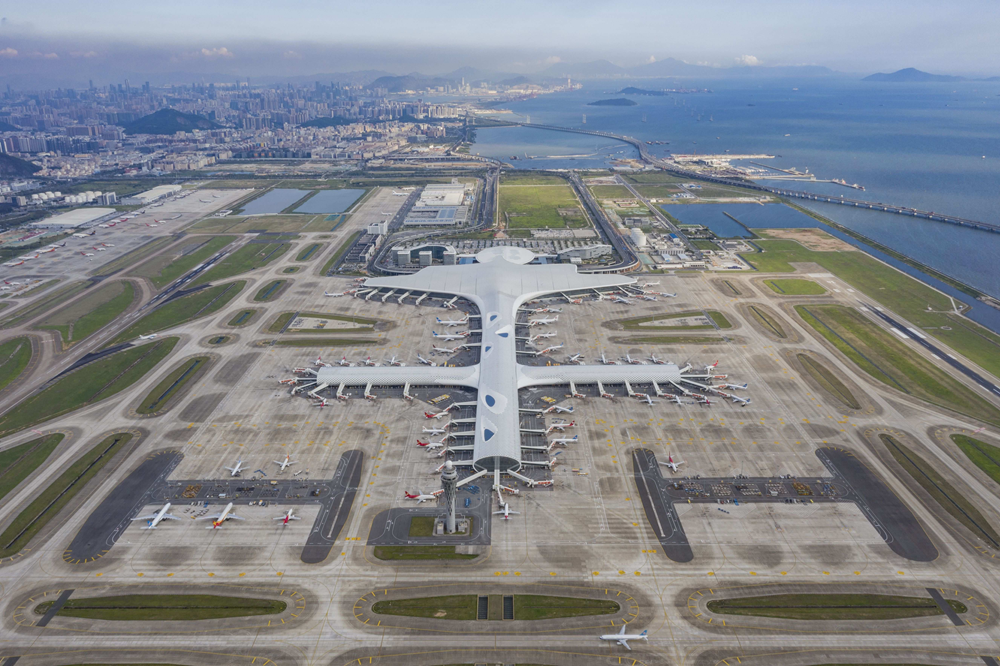
As the 2026 APEC “China Year” approaches, Shenzhen Bao’an International Airport, the city’s air gateway, is intensively completing a series of key upgrades.
New terminals, new runways, new routes… Since the start of this year, Shenzhen Airport has been rolling out continuous upgrade initiatives. In August, construction kicked off on the airport’s T2 terminal area and North Cargo Zone, which will add over 1.8 million tons of annual cargo and mail handling capacity in the future; in November, the third runway was officially put into operation, marking the airport’s entry into the “three-runway era”; in December, with the inaugural flight of the 60th international passenger route, the number of international and regional passenger routes at Shenzhen Airport has recovered to the historical peak level of 2019.
Alongside the improvement of hardware facilities, the airport’s passenger traffic has also been growing rapidly in tandem. Up to now, Shenzhen Airport’s passenger throughput has exceeded 61.55 million, surpassing the full-year total of last year nearly a month ahead of schedule, and the annual passenger throughput is expected to cross the 65 million mark for the first time. Looking to the future, Shenzhen Airport is planned to meet the demand of an annual passenger throughput of 80 million and an annual cargo and mail throughput of 4.5 million tons.
This systematic upgrade is not just about the hardware expansion of the air gateway, but also about the city’s mission to undertake higher-level global connectivity and home-ground diplomacy.
As a frontier of China’s reform and opening up, Shenzhen is transforming its industrial advantages into efficient aviation hub advantages, building itself into an economically influential global city and a modern international metropolis, while also injecting new vitality into the construction of the world-class airport cluster in the Guangdong-Hong Kong-Macao Greater Bay Area.
Unlocking New Air Capacity: The Third Runway Comes into Service
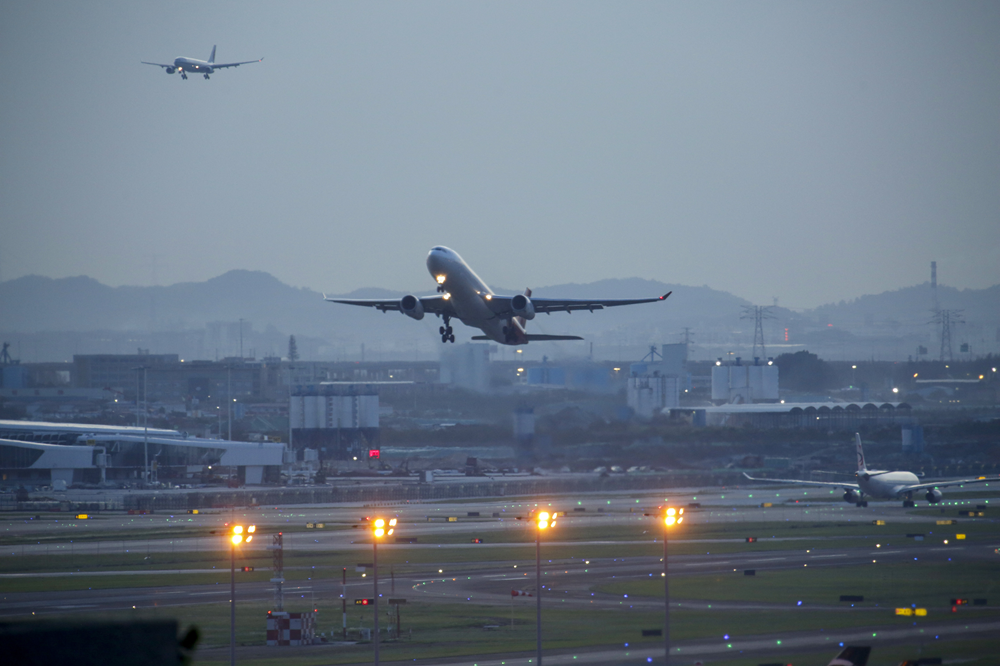
Why does Shenzhen Airport need a third runway? The answer lies in its rising operational data over the years.
Shenzhen Airport’s first runway was put into use with the airport’s opening in 1991, and the second runway was completed and commissioned in 2011.
In the more than ten years since then, Shenzhen Airport has become one of the busiest dual-runway airports in China, with its annual flight handling capacity peaking at 428,000 sorties and the daily flight handling capacity exceeding 1,300 sorties at the highest.
Passenger flow growth has been particularly remarkable. In 2024, Shenzhen Airport’s annual passenger throughput exceeded 60 million, making it the fourth airport in mainland China to enter the “60 million-passenger club”; it is expected to surpass 65 million in 2025.
This passenger scale has already exceeded that of some domestic airports with three or four runways. Against the backdrop of continuously growing passenger volume, the construction of the third runway has become a key choice for Shenzhen Airport to enhance its hub level.
As a major national project during the “14th Five-Year Plan” period and a key project in Guangdong Province, the third runway of Shenzhen Airport is located between the second runway and the Guangzhou-Shenzhen Coastal Expressway.
With a total length of 3,600 meters and a width of 45 meters, the runway has a flight zone grade of 4F, the highest level, capable of accommodating the takeoff and landing of various large passenger aircraft. Its coordinated operation with the existing two runways has greatly optimized operational efficiency.
According to Yu Chenshi, foreman of Tower Control Room 1 at Shenzhen Air Traffic Control Station, after the commissioning of the third runway, the number of arrival and departure procedures at Shenzhen Airport has been drastically reduced from 107 to 36, making the air route network clearer. In addition, the tower can flexibly adopt 8 operation modes in north-south directions during morning and evening peak hours and night flights according to flight traffic. This has effectively alleviated the operational pressure on the runways and laid the foundation for expanding routes, increasing flight frequencies, and improving overall capacity in the future.
The effect of the new runway has initially emerged. Within a week of its commissioning, the third runway of Shenzhen Airport has handled more than 200 takeoffs and landings, playing an obvious role in diverting traffic during peak hours.
Qi Qi, associate professor at Guangzhou Civil Aviation College, pointed out that the airport’s handling capacity, whether for passenger or cargo transport, fundamentally depends on takeoff and landing resources, with runways being the core component. He believes that with the entry into the “three-runway era”, Shenzhen Airport’s overall handling capacity will achieve a “qualitative leap”.
Accelerating the Fast Track from Factory Gate to Cabin Door for Industrial Export
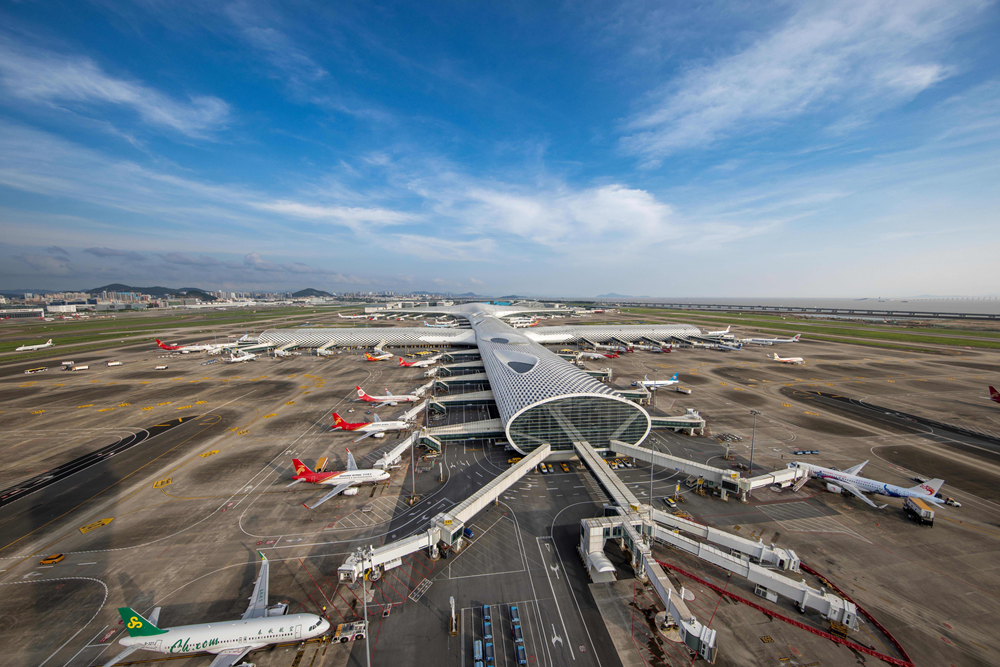
Airports are important channels and hubs for cross-border e-commerce and intelligent manufacturing “going global”.
The upgrade of Shenzhen Airport is a layout to systematically enhance hub capacity around industrial needs.
In August this year, the construction of Shenzhen Airport’s T2 terminal area and North Cargo Zone project started. Among them, the North Cargo Zone, as a key project in the national “14th Five-Year Plan”, will add over 1.8 million tons of annual cargo and mail handling capacity upon completion.
At that time, based on its positioning as a location gateway composite international aviation hub, Shenzhen Airport will form a new pattern of “three terminal areas, three cargo zones, and three runways”. In the future, it will be able to meet the demand of an annual passenger throughput of 80 million and an annual cargo and mail throughput of 4.5 million tons, building a more efficient “air fast track” directly connecting “factory gates” to “cabin doors”, and providing solid logistics support for the industrial globalization of Shenzhen and the Greater Bay Area.
As the “top foreign trade city” in mainland China, Shenzhen’s annual cross-border e-commerce import and export volume reached 372 billion yuan last year, ranking first in the country for three consecutive years.
In the “Top 100 List of China’s Cross-border E-commerce Brand Influence (H1 2025)”, Shenzhen brands such as Insta360, Bambu Lab, and Ugreen accounted for 51 seats, ranking first in the country in terms of quantity.
Driving through Fuyong and Shajing near the airport, the dense logistics parks and shuttling trucks directly confirm its status as a key distribution center for cross-border e-commerce nationwide.
As a leading local logistics giant in Shenzhen, SF Airlines has built a global cargo network based in Shenzhen Airport. A relevant person in charge of SF Airlines said that the company transports a large number of business documents, electronic products, and mechanical equipment in Shenzhen. For example, its Shenzhen-India route has been operating stably for a long time, serving the export of domestic electronic products.
“Shenzhen Airport’s core advantage lies in its proximity to the source of goods, which supports strong demand for high-value-added air cargo,” Qi Qi analyzed.
Data shows that as of November, Shenzhen Airport’s cargo and mail throughput increased by 9.9% year-on-year, with international cargo and mail surging by 11.59% year-on-year. This impressive achievement is a direct reflection of the airport’s deep integration with the world factory in the Pearl River Delta. By accurately matching the logistics characteristics of products such as electronic components, which are “large in batches, strict in timeliness, and high in value”, Shenzhen Airport has become a key node ensuring the stable and efficient operation of the global supply chain.
The essence of airport expansion and upgrading is to closely serve the global layout of local advanced manufacturing and cross-border e-commerce. The construction of the third runway and the North Cargo Zone has further transformed Shenzhen’s industrial advantages into shipping hub advantages. In the future, high-value products such as locally produced chips and drones, as well as consumer electronic products of brands such as Anker and Insta360, will have a more efficient and stable channel for going global.
At present, Shenzhen Airport has 63 all-cargo flight destinations, including 43 international and regional destinations, with a network covering all five continents of the world. With this strong support, the airport’s annual cargo and mail throughput is expected to exceed 2 million tons for the first time in 2025.
“We will focus on expanding air transport business in high-growth categories such as cross-border e-commerce, lithium batteries, temperature-controlled pharmaceuticals, and high-end fresh products,” revealed the person in charge of SF Airlines. Next, the company will focus on improving the operational efficiency and connection reliability of international connecting transshipment at Shenzhen Airport, and strengthen the global distribution function of the Shenzhen hub.
Faced with the coordinated development pattern of the airport cluster in the Guangdong-Hong Kong-Macao Greater Bay Area, Qi Qi suggested that Shenzhen Airport should focus on serving local and surrounding industries, build itself into the “chief logistics officer of the global high-value industrial chain” in the freight sector, and strengthen its comprehensive logistics capabilities; in terms of passenger transport, it should deepen the domestic network and timely develop long-distance intercontinental routes that complement those of Hong Kong and Guangzhou.
Welcoming Guests: Shaping the “First Impression” of APEC Home-ground Diplomacy
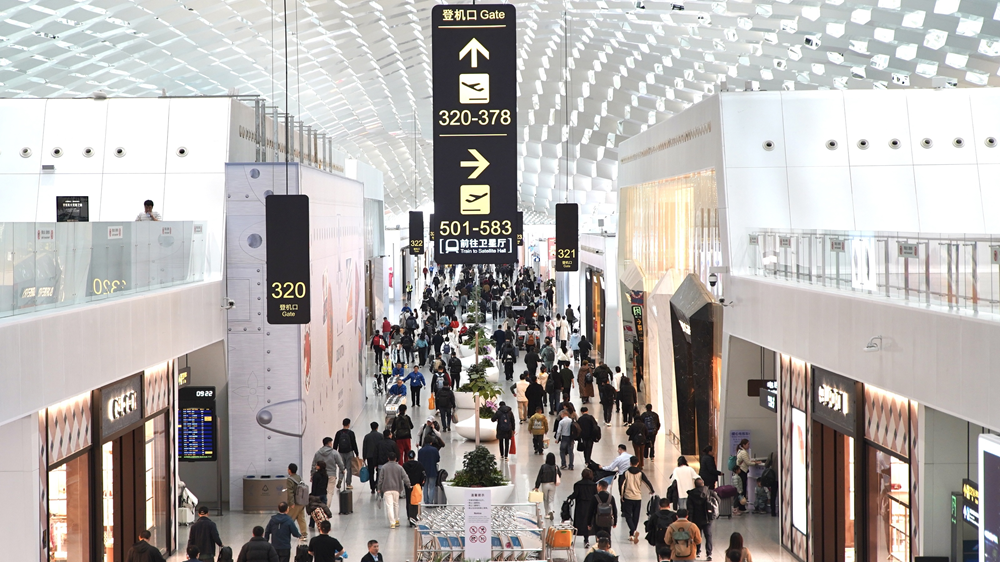
In November 2026, the 33rd APEC Economic Leaders’ Meeting will be held in Shenzhen.
This is the third time that China has hosted this international conference, and Shenzhen has become the third city in China to host APEC after Shanghai and Beijing. The hosting of the 2026 APEC meeting in Shenzhen means that the city will stand in the spotlight of the Asia-Pacific region and even the world.
Airports are the “first stop of the national gate” connecting the world. In October 2025, the promotional video released by the APEC Summit Preparatory Committee took the airport as the scene to show South Korea’s welcome gesture to global guests as the host country.
Next year, Shenzhen Airport will become the primary window for political and business guests from all over the world to perceive Shenzhen’s efficiency and appreciate China’s image. Its professionalism, intelligence, and vitality are expected to shape the “first impression” of the host city of this grand event among global guests.
Currently, Shenzhen is enhancing its “global accessibility”. Since the start of this year, Shenzhen Airport has opened and increased the frequency of 27 international and regional passenger routes, with a network covering 60 cities across all five continents.
Taking Shenzhen Airlines as an example, it has increased the frequency of flights from Shenzhen to Southeast Asian destinations such as Kuala Lumpur, Singapore, and Bangkok since the start of this year, and will add a route to Melbourne on December 22.
From January to November this year, the airport’s international and regional passenger throughput exceeded 5.7 million, a year-on-year increase of 23%. The expansion of these routes not only serves the daily vigorous economic and trade exchanges, but also pre-builds an efficient and convenient global “air corridor” for the arrival of high-density delegations from various countries during APEC, geographically strengthening the connection between Shenzhen and various member economies.
The newly launched runway, densified routes, and upgraded hub – this hardware leap of Shenzhen Bao’an International Airport carries the city’s goal of developing to a higher dimension, and demonstrates Shenzhen’s ability as the forefront of China’s reform and opening up to actively connect with the world and serve national diplomatic strategies.
Facing the 2026 APEC, an expanded, upgraded, intelligent, and efficient “air reception hall” is ready.