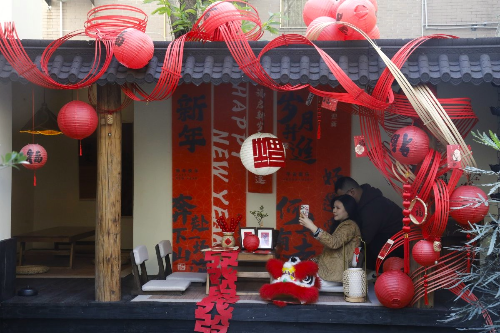
In the afternoon, warm sunshine filters through the bougainvillea-clad walls onto the flagstone paths of Guanghua Street, casting dappled light and shadows. Inside Shishan Story Tea & Wine House, the warm and unadorned wood-style decor creates a cozy ambiance. Patrons chat over cups of hot tea, their eyes occasionally drifting to the old photos of Shishan hanging on the walls. By day, this is a pleasant spot for tea-tasting and relaxation; by night, it transforms into a small theater for cross-talk and storytelling performances, doubling as a micro-exhibition hall preserving the neighborhood’s memories. This idyllic scene is a vivid reflection of the organic renewal of Shishan Old Street in Xiangzhou District under the guidance of the “Hundred Counties, Thousand Towns, Ten Thousand Villages” Project – where old buildings regain vitality, new business formats thrive, and the lives of both long-time residents and young newcomers are gradually transformed.
Comprehensive Supporting Services Address Operational Pain Points of Old Buildings
Today, the revitalization of this old building embodies the original aspiration of its operator Liang Xiaobo for the art of cross-talk. Previously, her shop in another old street had to close down. After a year of hiatus, with the overall planning and targeted support led by Shishan Sub-district and operated by state-owned enterprises Zhengyuan and Zhengxin, she resolved to settle here and embark on a new venture.
Shishan Story was formerly the Shishan Memory Exhibition Hall. On the basis of preserving the original texture of the old building, Liang Xiaobo connected six adjacent small rooms, integrating retro and national fashion design styles to cleverly blend historical exhibitions with commercial space. “Guests who come for tea during the day can visit the exhibition on the way, and at night, this place turns into a performance venue where people can drink and enjoy cross-talk. That’s how the true value of old buildings is activated,” she said.
Six months after opening, the small shop has gradually gotten on track, and the continuous improvement of the neighborhood’s infrastructure has made her even more gratified. “The previously dead-end road has now been fully opened, and signboards have been installed. When the intangible cultural heritage (ICH) space upstairs opens, this place will be upgraded into a more attractive multi-functional public space,” Liang Xiaobo frankly stated. All this is thanks to the thoughtful assistance of Shishan Sub-district – which not only helped her coordinate with fire departments to solve approval problems but also provided comprehensive supporting services to address many operational pain points of old buildings, making the shop a perfect blend of bustling daily charm and the unique nostalgic vibe of the old street.
Not far away, Fangyuanli & Dexian Café is writing another story of space revitalization. Stepping inside, the wooden space is tastefully adorned with green plants, exuding a tranquil Zen atmosphere that instantly relieves visitors of their fatigue. The first floor is filled with the aroma of coffee, and the DIY crystal bracelet area invites guests to sit and create. Upstairs, nine wood-style guest rooms feature floor-to-ceiling windows offering panoramic views of the old street, providing guests with an immersive accommodation experience.
This composite space renovated from an old state-owned enterprise dormitory could not have its walls completely demolished due to the limitations of its brick-concrete structure. Shopkeeper Chen Jiawei found an alternative approach: connecting independent units with multiple doorways to create a unique layout of “winding paths leading to secluded seclusion”. “The most troublesome aspects of renovating old buildings are overhead wires and fire safety issues,” he admitted. Fortunately, Shishan Sub-district provided one-on-one assistance to coordinate with relevant departments, tackling these “tough nuts” that would have taken months to resolve in just one month. Only one month into its soft opening, this hidden gem in the old street, with its laid-back and cozy vibe, has already won the favor of many customers.
Innovative “Jigsaw Puzzle-style Investment Promotion” Spawns “Development Partners”
The smooth settlement and operation of these distinctive shops are inseparable from the targeted support provided by Shishan Sub-district to merchants. It is reported that to vitalize the commercial vitality of the old street, Shishan Sub-district took the initiative to coordinate with market supervision authorities, opening up commercial registration channels for over 180 house numbers, and providing thoughtful services to support merchants in settling down during the exploration of activating historical and cultural blocks.
To address pain points such as chimneys and sewage discharge of catering businesses that are prone to triggering neighborhood disputes, the construction team of Shishan Old Street intervened in advance, collaborating with market supervision, housing and urban-rural development, fire rescue, culture and tourism departments to provide compliance guidelines. Difficulties in fire safety renovation and approval have also been resolved one by one with the coordination of Shishan Sub-district.
In terms of business format cultivation, Shishan Sub-district innovatively launched the “jigsaw puzzle-style investment promotion” model, fostering a positive cycle between the operator micro-ecosystem and the sharing economy. “We have abandoned the rigid planning models of the past, and leveraged the demonstration effect of successful operators to drive the agglomeration of upstream and downstream business formats, forming an endogenous development industrial chain,” said Zhao Lingxin, Deputy Secretary of the Party Working Committee and Director of the Office of Shishan Sub-district, giving an example to reporters. The visual design and interior decoration of Shishan Story Tea & Wine House were undertaken by the nearby 106 Café and the opposite Muzhili Café respectively, with businesses naturally forming “development partners”.
Such collaboration is not an isolated case; merchants in the neighborhood are developing synergistically in diverse forms: Guanse Art Gallery and Muzhili Café have jointly launched DIY handcraft courses; Shuizhu Rourou Restaurant and Jiujiu Ice Cream Parlor have carried out cross-category catering cooperation… Independent operators have spontaneously linked up to form an ecological closed loop of resource sharing and customer flow mutual guidance, continuously injecting vitality into the organic renewal of Guanghua Street.
As a newly settled homestay operator, Chen Jiawei also plans to jump on this “collaboration express”: “We don’t offer light meals in our store. In the future, we can recommend customers to nearby catering merchants, while undertaking their accommodation and coffee-drinking needs to achieve mutual benefit and win-win results.”
Activating Inheritance and Innovatively Cultivating Local Culture
Targeted services and business format linkage have awakened a brand-new look of Guanghua Street, while the activation, inheritance and innovative cultivation of local culture have endowed this old street with core driving forces for long-term development. Focusing on the cultural revitalization of the old street, Shishan Sub-district has, on the one hand, collaborated with cultural and historical experts to sort out the cultural context of the streets and alleys, organically integrating cultural symbols such as Zhuhai’s history and classic Hong Kong film IPs into the neighborhood; on the other hand, it has created an ecological space where “greenery greets you around every corner and flowers catch your eye wherever you look”, planted more bougainvillea, preserved historical traces such as ancient wells and retaining walls, and launched the Zhuhai Historical and Cultural Tourist Trail on Anping Road. Five small lion IPs named “Shishan Shan” are scattered in the alleys, which not only activate the “customer retention” code of the neighborhood but also outline its artistic, elegant and soothing “slow life” temperament.
In addition, Guanghua Street is about to be designated as a “Film-friendly Block”. This old street, which holds the memories of old Zhuhai, has a strong film and television gene of its own. Chunfang Barber Shop and Xiangshan Park were among the filming locations of Shaolin Soccer, which has long attracted many tourists to visit and take photos. Relying on this unique historical texture and cultural heritage, Shishan Sub-district has continuously coordinated with film and television crews for shooting needs, providing one-stop services for settled teams; at the same time, it has amplified the advantages of the romantic economy of wedding photography on Xiamei Road, connecting characteristic spots along the line to create a love-themed check-in route. The in-depth integration of film and television creation with cultural and tourism consumption is transforming this old street into a new landmark with both cultural heritage and traffic vitality.
At present, the business format layout of the neighborhood has become increasingly clear, with a total of 38 “slow-format” cultural and tourism merchants successfully settled. Among them, Xiamei Road focuses on daytime coffee and light meals, Renmin Road gathers nighttime craft beer pubs, and the areas along Anping Road and Xiamei Road are concentrated with characteristic business formats such as art galleries and handcraft workshops. To address the parking difficulty concerned by citizens and tourists, Shishan Sub-district is taking multiple measures to alleviate the parking pressure in the neighborhood, such as adding harbor-style parking spaces, opening the parking area of Shishan Civic Art Center, and renovating old residential areas to add parking lots. The upcoming “Street Strolling” check-in activity will guide tourists to explore distinctive small shops in the streets and alleys through hand-drawn maps, bringing a fun “treasure-hunting” consumption experience.
From idle old buildings transformed into internet-famous check-in spots, and from dilapidated streets and alleys reborn as characteristic cultural and tourism blocks, the “slow growth” of Guanghua Street is a vivid epitome of Shishan Sub-district’s in-depth promotion of the “Hundred Counties, Thousand Towns, Ten Thousand Villages” Project. Through the triple efforts of targeted services, business format cultivation and cultural revitalization, the old street has not only retained the bustling vibe full of urban memories but also radiated the vigorous vitality of new business formats, providing a replicable new model for the activation of historical blocks. Wandering through the alleys with dappled light and shadows, the fresh atmosphere of literary and artistic small shops permeates the streets. This “slow-paced” neighborhood is quietly telling the story of the rebirth of Zhuhai’s old streets.