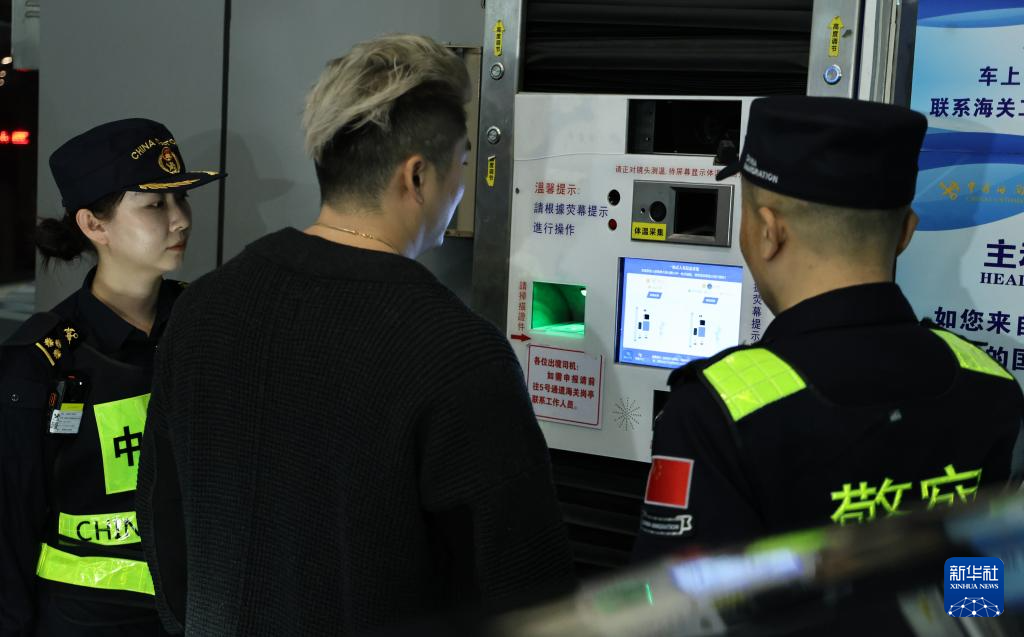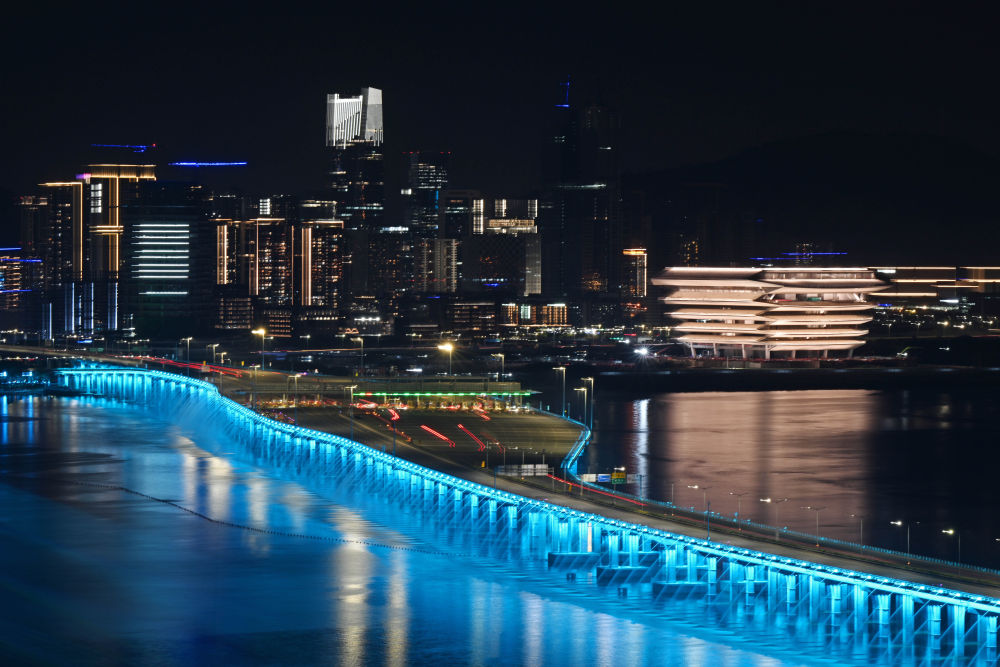
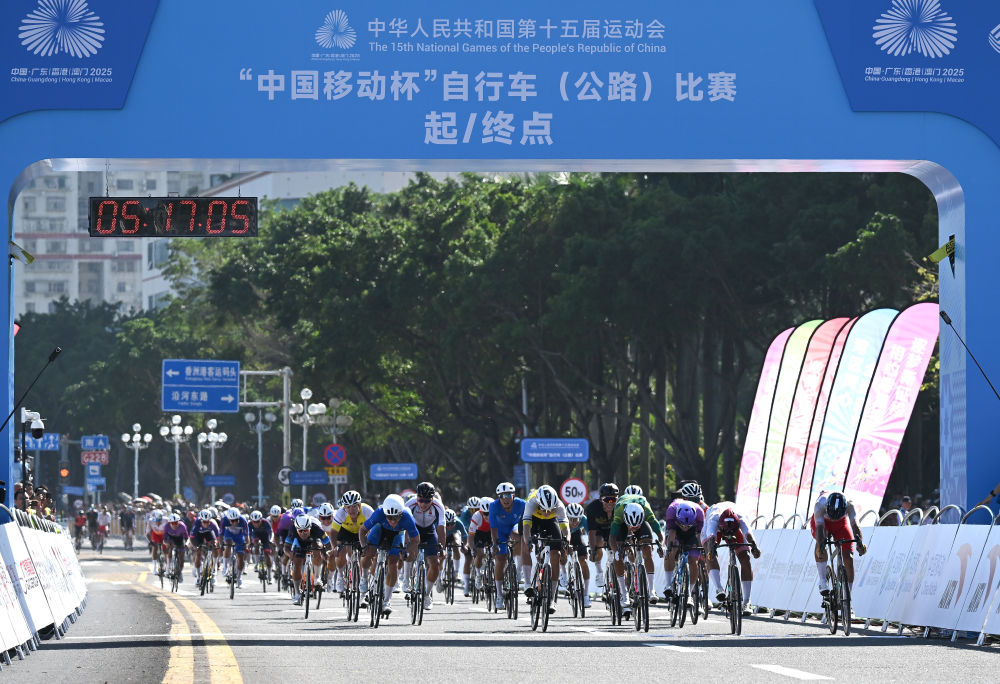
Cyclists raced continuously past landmarks including Zhuhai’s Lovers’ Road, the Hengqin Guangdong-Macao In-Depth Cooperation Zone, Macao’s cross-harbor bridges, and Hong Kong Disneyland, completing multiple cross-border customs clearances. Runners departed from Nanshan District, Shenzhen, crossed the Shenzhen Bay Highway Bridge to enter the racecourse in Yuen Long District, Hong Kong, and passed through the Shenzhen Bay Port twice without pausing.
Behind the successful hosting of these two cross-border events—road cycling and marathon—during the 15th National Games lies the efficient and coordinated support from host cities across competition organization, security, medical services, transportation, and other key areas.
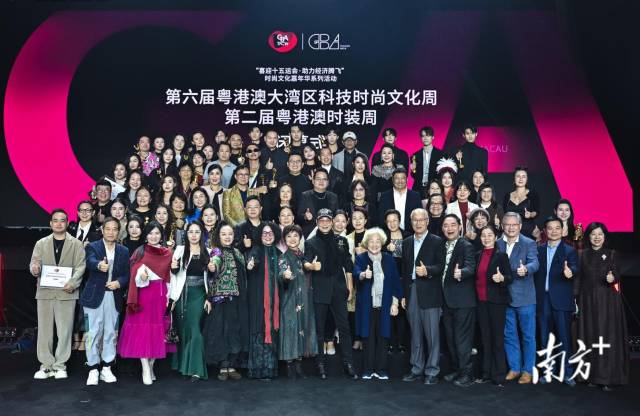
With sports as a bridge, Shenzhen, Zhuhai, Hong Kong, and Macao are not isolated cities—they share a common identity: the Guangdong-Hong Kong-Macao Greater Bay Area (GBA).
As early as 1992, the Hong Kong-Shenzhen International Marathon attempted to connect the two cities separated by a river. At that time, runners could use a “customs clearance card” to complete manual verification at the port. “The mid-race pause still disrupted the running rhythm,” recalled Wu Huiyang, a Hong Kong participant back then.
Today, “super projects” such as the Hong Kong-Zhuhai-Macao Bridge and the Shenzhen-Zhongshan Corridor have accelerated the GBA’s “hard connectivity.” Meanwhile, “soft connectivity” arrangements—including the “Hong Kong vehicles going north” and “Macao vehicles going north” policies, as well as the “cooperative inspection and one-time release” model at Hengqin Port—have closely linked the cities, making the rhythm of integrated development in the GBA smoother than ever.
Technological applications have strengthened the foundation for integrated development. During the National Games’ cross-border events, technologies such as facial recognition, wireless positioning, and radio frequency identification (RFID) enabled “seamless customs clearance.” Statistics show that approximately 40% of the core technologies used in the 15th National Games originated from Hong Kong, with a large number of technological R&D achievements—rooted in Hong Kong but applied and marketed in the mainland—showcased collectively through the platform of the National Games.
Facilitated mobility is accelerating the connection of lives across the Bay Area. During the National Games, spectators from across the country experienced the convenience of the GBA’s “one-hour living circle.”
Kuang Jia, a baseball enthusiast studying in Wenzhou, traveled to Zhongshan to watch the games. On the same day, she tried crispy grass carp, a local specialty of Zhongshan. The next day, she took a “one-day tour” of Macao during her free time. After the game on the evening of the 14th, she rushed from Zhongshan to Shenzhen for late-night snacks, crossed the border to Hong Kong early the next morning, and returned to Zhongshan that night to watch more games. In just a few days, she shuttled between Guangdong, Hong Kong, and Macao multiple times.
“Taking the high-speed rail from Zhongshan to Zhuhai and then to Macao is very convenient, and the traffic flow on the Shenzhen-Zhongshan Corridor is also fast. I feel that ‘customs clearance’ has become an ordinary part of daily life for residents of Zhongshan and Zhuhai,” said Kuang Jia.
Closer distances have led to more frequent visits and stronger bonds. During the National Games, participating teams from Guangdong, Hong Kong, and Macao felt the home-court atmosphere at various venues. Young volunteers nicknamed “Little Dolphins” from the three regions enhanced their friendships through cooperation, serving as a vivid example of youth exchanges in the GBA.
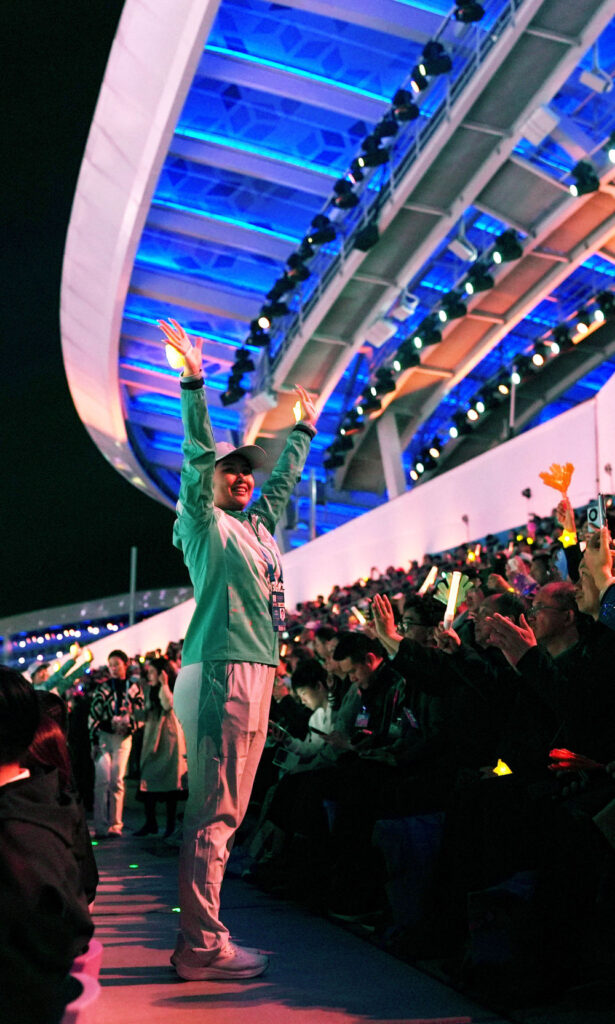
Chen Kexin, a volunteer from Hong Kong and a student at Guangdong Polytechnic Institute, said she was particularly proud to contribute to this national sports event held in her hometown.
After the games, the Hong Kong softball team left a thank-you note for the volunteers, which read: “Thank you for your hard work and smiles over these days. We hope you will continue to be happy and smooth in all your endeavors.”
In the baseball ranking match of the National Games, the Hong Kong team finished 8th, achieving its best result in the history of the National Games. “Both relatives and friends from Hong Kong and local spectators cheered for us, making us feel the warmth of the home court,” said Au Hok-leung, the team’s head coach.
Cheung Chi-kong, President of the One Country Two Systems Research Institute in Hong Kong, noted that the co-hosting of the 15th National Games by Guangdong, Hong Kong, and Macao has accelerated the flow of people, goods, and information among the three regions, promoted cultural integration, and demonstrated a new atmosphere of mutual learning among diverse cultures under the “one country, two systems” principle.
Wu Jian, Director of the International Cooperation Department of the General Administration of Sport of China, stated that the 15th National Games, co-hosted by the GBA, has created a positive atmosphere where Hong Kong and Macao share the joy and glory of the grand event with the mainland. “In the future, we will continue to use sports as a bridge to write a new chapter in sports for the construction of the GBA and the practice of ‘one country, two systems’.”