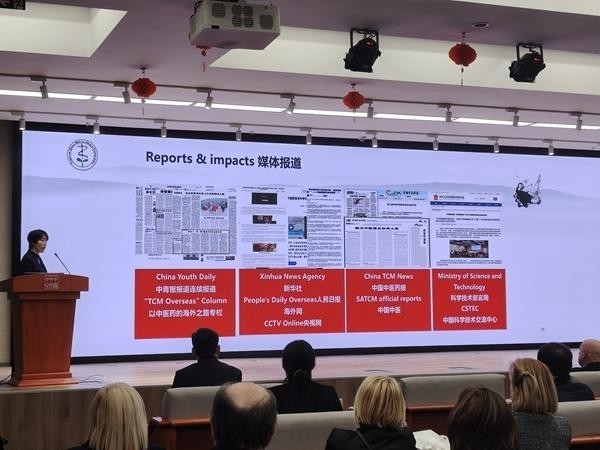
The 6th International Advanced Training Course on Clinical Practice and Research Progress of Traditional Chinese Medicine, organized by the Institute of Clinical Basic Medicine of CACMS, took place in Belgrade, Serbia, from December 6 to 18. The program attracted nearly 200 physicians, professors and researchers from 25 countries including Serbia, Slovakia and Poland. Through expert lectures and practical workshops, they conducted in-depth exchanges on the latest clinical practice and research advances in TCM.
This is a relay race transcending time and space.
Eight years ago, the Institute of Clinical Basic Medicine of CACMS launched the first International TCM Training Course in Beijing. Relevant vivid scenes of foreign doctors coming to China to learn TCM were documented in a series of reports, including Foreign Doctors Learn TCM in China, Western Medicine Practitioners Study TCM in China and Overseas Western Physicians’ Perspective on TCM: A Young New Face.
In 2025, this relay has extended from China to overseas. This mutual engagement across time and space vividly illustrates a profound shift in the internationalization of TCM: moving away from “one-way knowledge transfer” towards “in-depth synergy”.
Professor Momir Dunjic, President of the Serbian Society of Integrative Medicine, has witnessed this transformation firsthand. Eight years ago, he was a participant of the first training course; this time, he joined the event as a collaborating expert. Having grown from an eager learner of TCM to a joint promoter of the discipline, he sighed with emotion, “It feels like a leap and overlap across time and space.”
Initiated in 2017, the International Advanced Training Course on Clinical Practice and Research Progress of TCM has been successfully held six times, training a total of more than 200 medical professionals from over 20 countries.
The development of this program coincides with a critical period for the implementation of China’s 14th Five-Year Plan. During this period, a series of policy documents have been issued successively, including the Development Plan for Promoting the High-Quality Integration of TCM into the Belt and Road Cooperation (2021-2025) and the 14th Five-Year Plan for the Development of Traditional Chinese Medicine. These documents clearly stipulate supporting TCM research institutions to jointly build Belt and Road TCM Joint Laboratories with relevant institutions in Belt and Road partner countries, facilitating the integration of TCM into the higher education systems of these countries, strengthening the cultivation of international interdisciplinary TCM talents, and implementing special programs for international TCM cooperation. All these have laid a solid foundation for the high-quality global outreach of TCM.
Against this backdrop, the program has achieved a leap from “sowing seeds” to “taking root”. Professor Zhao Jing, the program director and researcher at the Institute of Clinical Basic Medicine of CACMS, stated to reporters that the program originated from non-governmental exchanges. In the early stage, five consecutive offline training courses were held, which helped build a collaborative network with more than 30 universities and institutions, including the University of California, Los Angeles (UCLA), the University of Southampton, Jagiellonian University in Poland, the Serbian Society of Integrative Medicine and Hong Kong Baptist University. Gradually, an international training platform covering more than 10 countries and regions has taken shape.
A more profound change lies in the cooperation model. Over the past eight years, the internationalization of TCM has evolved from the one-way “going global” of knowledge dissemination to deep “integration in” with local forces. The program team has co-authored 31 Chinese and English academic papers on the international development and promotion of TCM with participants from various countries. These papers include reflections and recommendations on the current development status and challenges of TCM in 18 countries across four continents, comparative analyses of the development of TCM therapies in different countries, thoughts on international TCM education, and explorations of implementation science for better international promotion of TCM. Notably, with the support and guidance of the program, Brazilian participants successfully promoted the national approval of Brazil’s first undergraduate academic programs in acupuncture and tuina after returning home, elevating TCM to a new level in Brazil’s higher medical education.
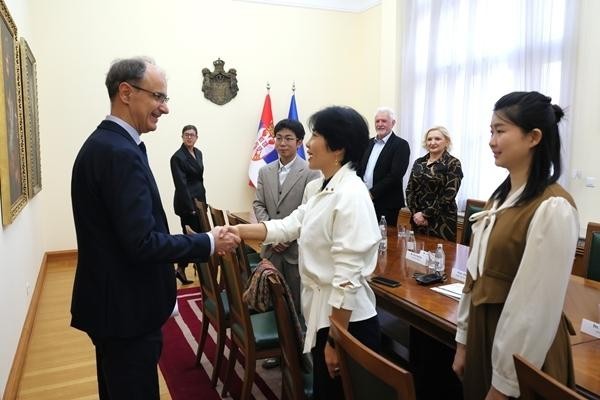
During the holding of the 6th International Advanced TCM Training Course in Serbia, the Eurasian Society of Integrative Medicine was established with the aim of further promoting TCM. Moreover, the Chinese delegation was received by Serbian Prime Minister Miloš Vučević, a specialist in internal medicine, who offered his suggestions on the application and promotion of TCM in Serbia. Marking the 70th anniversary of China-Serbia friendship, the successful hosting of the program in Serbia ushers in a new chapter of bilateral cooperation in the field of TCM.
At the opening ceremony of this training course, Bela Balint, Minister of Science, Technological Development and Innovation of Serbia, revealed that Serbia plans to set up a National Center for Integrative Medicine at the University of Belgrade in 2026. Meanwhile, Serbia is discussing with China the joint establishment of a laboratory to advance modern research in cutting-edge fields such as personalized herbal medicine, bioengineering and artificial intelligence.
At the seminar held in Serbia, members of the program team, together with attending experts and participants, discussed the collaboration process between TCM and Western medicine in response to the most common diseases and health issues. They jointly deliberated on when, by whom and how TCM assessment and acupuncture treatment should be introduced in the diagnosis and treatment process, as well as the efficacy evaluation indicators applicable to such interventions. “This may seem simple, but it is a crucial step from ‘I speak and you listen’ to ‘we decide together’,” said Zhao Jing. “It has turned integrative medicine from a concept into practical cases that local doctors face every day.”
Reflecting on the eight-year journey, Zhao Jing was filled with profound emotions. “Eight years ago, our priority was to deliver good lectures, ensuring that participants from diverse cultural backgrounds could understand, accept and take TCM knowledge back to their countries for dissemination. Today, we work more closely with partners to jointly address medical challenges faced by different countries and explore sustainable development and cooperation models. To sum it up in one sentence: we have shifted from ‘telling good stories about TCM’ to ‘creating a new chapter of integrative medicine in clinical practice together with local colleagues’.”
In Zhao Jing’s view, genuine international communication is not about how much knowledge is exported, but about Chinese experts and their partners co-creating a new, shareable and synergistic working language and process. “It means that integrative medicine is no longer just the personal experience of individual physicians, but is becoming a discussable and optimizable part of clinical practice guidelines. International cooperation on TCM is steadily moving into a new stage of pragmatic collaboration, with the goal of solving common clinical problems, departing from mere ideological exchanges and one-way knowledge transfer.” Zhao Jing added.