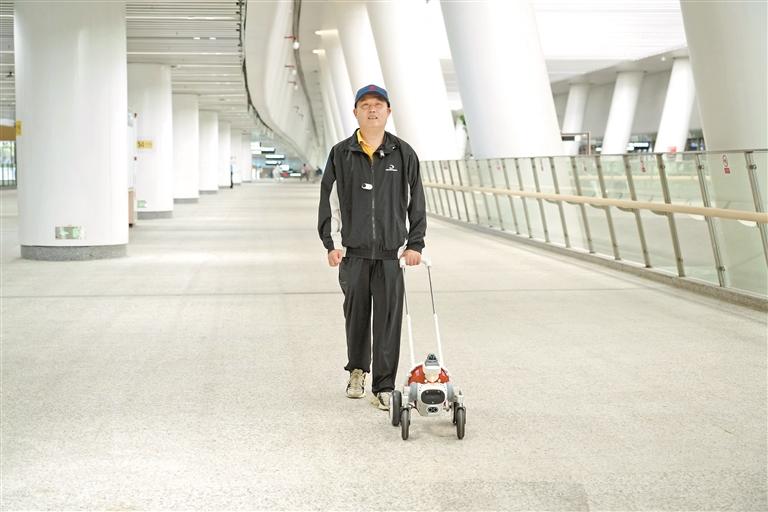
To support the 12th National Games for Persons with Disabilities and the 9th National Special Olympics, Shenzhen Metro piloted the deployment of the smart guide dog Xiaosuan at the Huangmugang Transportation Hub on December 13. This initiative marks the world’s first application of such technology in the rail transit industry, offering innovative tech-enabled convenience for visually impaired individuals traveling via metro.
At the demonstration site of the smart guide dog at Huangmugang Hub, this AI-powered device integrates cutting-edge technologies including multi-modal 3D voxel neural network composite sensing, integrated indoor-outdoor planning and control, and vision-language large models. Responding to voice commands from visually impaired passengers, it autonomously executes core functions such as path planning, precise navigation, intelligent obstacle avoidance, tactile paving tracking, voice interaction, and visual recognition, guiding passengers to their intended destinations and embodying the humanistic care of Shenzhen driven by technological innovation.
Service points for the smart guide dog have been set up next to the accessible elevators at Exits 13 and 14 of the hub. The device has successfully passed dedicated safety tests and field evaluations. During the first month of the trial, dedicated staff will be assigned to ensure the safety of visually impaired passengers. Upon the successful completion of the pilot program, the system will shift to fully automated operation and be promoted at selected metro stations across the city.
To date, all 485 metro stations in Shenzhen’s entire metro network have achieved full coverage of accessible facilities, including tactile paving, Braille signage, and accessible elevators. Over 1,200 volunteers provide services daily, contributing more than 800,000 hours of volunteer work annually.