The “Double Hundred Action” is not merely about universities serving local areas, but a win-win situation for university-local cooperation—it not only injects technological and talent momentum into local development but also promotes the development of the universities themselves.
In recent years, Wuyi University and Jianghai District have continuously deepened the connotation of the “Double Hundred Action”, provided a “Jianghai Model” for the high-quality development of the “Hundred-Thousand-Ten Thousand Project”, and made the flower of university-local cooperation continue to bloom in the land of southern Guangdong.
Anchoring Industrial Demands to Build a New Ecology of Industry-Education Integration
The core of the “Hundred-Thousand-Ten Thousand Project” is industrial revitalization, and the key to the “Double Hundred Action” lies in precise empowerment. Based on Jianghai District’s key industrial layouts such as intelligent manufacturing, robotics, and safety and emergency response, the School of Mechanical and Automation Engineering of Wuyi University has built a multi-level and full-chain industry-education integration system with “enterprise demand orientation and collaborative talent training as the core”.
In October last year, Wuyi University signed a contract with Jianghai District to launch university-local cooperation. Centering on Jianghai District’s “1+3+2” characteristic industrial system, the cooperation has expanded dimensions in fields such as emerging industry planning, safety and emergency talent training, and urban-rural greening and beautification.
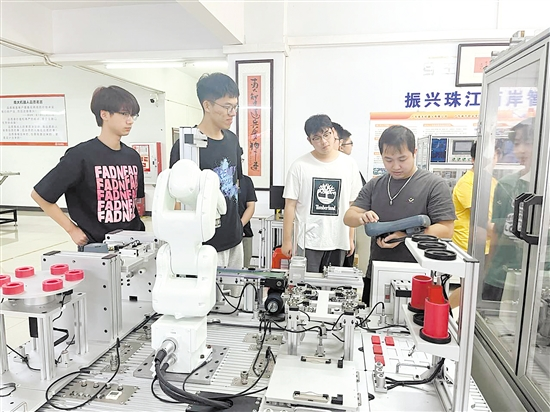
Wuyi University has long maintained close cooperation with Jianghai District and key enterprises in the district. The School of Mechanical and Automation Engineering has co-built industry-university-research bases with enterprises such as Desen Intelligent Equipment and Nanda Robotics, and innovatively launched three types of cooperation models: “industrial colleges, comprehensive experimental classes, and 3+1 customized classes”, introducing real enterprise projects and core technologies into teaching links. Last year, all 6 graduates who cooperated with Desen Intelligent Equipment from the college stayed in the company. This year, the two sides further upgraded their cooperation and opened a year-round customized comprehensive experimental class.
“The word ‘application’ in application-oriented undergraduate universities must ultimately be reflected in serving local industries,” said Liang Shufen, deputy dean of the School of Mechanical and Automation Engineering of Wuyi University. “We promote enterprises to transform from ‘end receivers’ of talent training to ‘full-process participants’, aiming to make university majors follow the industry and curriculum content revolve around technology, so as to accurately meet the industrial needs of Jianghai District such as safety and emergency response and intelligent manufacturing.”
Relying on the industrial advantages of the Jiangmen Safety and Emergency Industrial Park (the first provincial-level safety and emergency characteristic industrial park), Wuyi University will fully promote the construction of the China-Pacific Islands Disaster Prevention and Mitigation Cooperation Center and the discipline of emergency management and technology, to cultivate and deliver innovative, compound, and application-oriented safety and emergency talents for Jianghai District. At the same time, in response to the demand for the energy storage industry in Jianghai District, the university has co-built an energy storage laboratory with local enterprise Xiaobu Technology, and formed a stable talent delivery and technical support channel with Jianghai Power Supply Bureau, providing all-round services for local industrial upgrading.
Focusing on Talent Cultivation to Consolidate the Talent Pool for Grassroots Development
The effective implementation of the “Hundred-Thousand-Ten Thousand Project” is inseparable from solid talent support. Focusing on the tasks of “two strengthenings, two highlights, two participations, and one provision” of the “Double Hundred Action”, Wuyi University has set up a service team stationed in Jianghai District to provide talent and scientific and technological innovation resources support for the high-quality development of Jianghai District.
With “deep integration of industry and education and collaborative talent training between schools and enterprises” as the core, the School of Mechanical and Automation Engineering of Wuyi University, based on regional industrial needs and relying on local pillar industries and strategic emerging industries, has deepened the school-enterprise “dual-subject” collaborative talent training mechanism. Through the “3 years of on-campus study + 1 year of enterprise practice” model, the college has built a trinity training system of “theoretical foundation—engineering practice—innovation ability”, cultivating talents with both theoretical depth and practical ability.
Enterprises in Jianghai District participate in the curriculum setting, teaching implementation, and evaluation feedback of the School of Mechanical and Automation Engineering of Wuyi University throughout the process. In the curriculum system, the college integrates real enterprise cases, directly connecting with the forefront of the industry; for graduation projects, the mechanism of “enterprises setting questions, teachers and students solving questions, and schools and enterprises evaluating questions” is implemented to ensure that what students learn is highly consistent with what enterprises need.
The college has also set up a number of scientific research teams in polymer materials, robotics, intelligent welding, etc., with 4 national-level talents leading the teaching. Doctoral teachers go deep into the front line of enterprises—not only taking students to solve production problems but also integrating the latest industrial trends into classroom teaching, realizing a virtuous cycle of “scientific research feeding back teaching and teaching supporting the industry”.
“We are committed to cultivating future engineers with theoretical foundation, R&D capabilities, and professional literacy, taking ‘high-quality application-oriented engineers’ as the goal and deeply cultivating undergraduate application-oriented talent training,” said Li Xinmo, dean of the School of Mechanical and Automation Engineering of Wuyi University. “Through the ‘three-axis and five-stage’ model, we cultivate students in a phased and progressive manner from three dimensions: professional literacy, engineering ability, and professional knowledge. Coupled with the tempering of real enterprise scenarios, students can quickly adapt to enterprise needs upon graduation. This is also our core starting point for serving the grassroots talent construction of the ‘Hundred-Thousand-Ten Thousand Project’.”
In response to the pain points of local enterprises such as “difficulty in recruiting and retaining talents”, the college promotes the two-way efforts of “localization” and “precision” in talent training. By co-building off-campus practice bases with enterprises in Jianghai District, a large number of students are sent to participate in production internships and cognitive internships every year, allowing students to feel the industrial atmosphere of Jiangmen and recognize local development through practice in local enterprises. At the same time, it jointly implements the “three-time double selection” mechanism with enterprises, greatly improving the talent retention rate of enterprises. This “customized” training model not only saves talent training costs for enterprises but also enables students to achieve “employment upon graduation and competence upon employment”.
The college also attaches importance to science popularization education and basic education assistance, organizing teachers to carry out science and technology festivals and popular science lectures in schools such as Swan Bay Primary School, extending the tentacles of talent training to the basic education stage. At the same time, through the alumni association platform, it links outstanding alumni enterprises, builds a talent return channel, and encourages graduates to stay in Jiangmen and serve Jiangmen, forming a talent closed loop of “training—employment—feedback”.