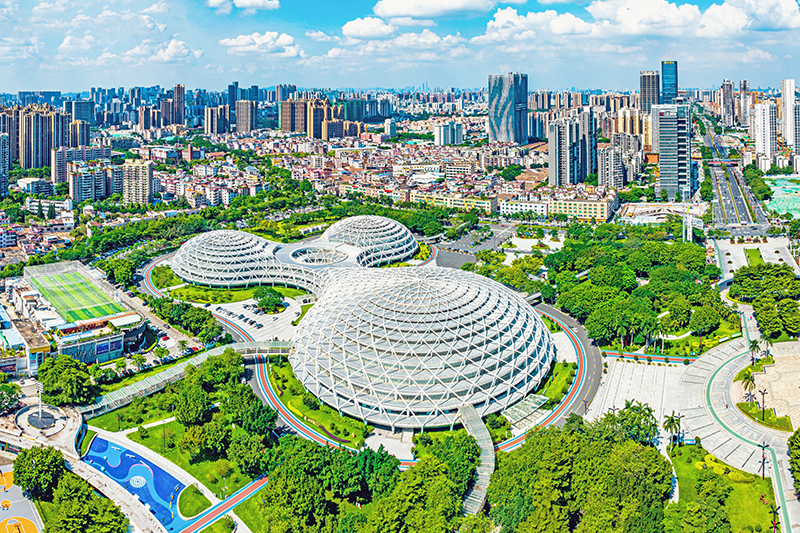
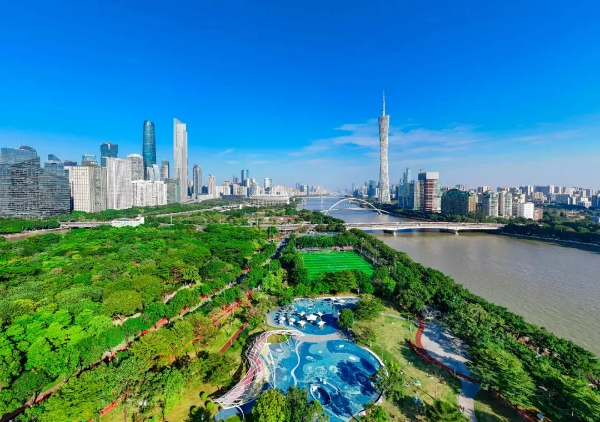
Along the banks of the Pearl River and at the foot of Yuexiu Mountain, a vivid practice of high-quality development in the old urban area is unfolding. As the central district of Guangzhou, Yuexiu District bears the mission of “building a leading area for injecting new vitality into old cities and creating a high-energy core area of an international metropolis.” Since the launch of the province-wide “Hundred-Thousand-Ten Thousand Project,” Yuexiu has anchored on the goal of “starting and taking steps in the first year, achieving initial results in three years,” breaking through with reforms and empowering with innovations, forging a new path for high-quality development in the old urban area. A long scroll of deep integration of “industry-city-people” bursting with vitality is unfolding, sprinting toward “initial results in three years.”
Industrial Upgrading: From “Millennium Commercial Capital” to “Innovation Highland”
Yuexiu is the center of Guangzhou that has never relocated for over 2,200 years, the core of the millennium commercial capital, and even more so an innovation highland for industries. Yuexiu actively integrates into Guangzhou’s “12218” modern industrial system, promoting “breeding new from the existing” in emerging industries, and focusing on the “first track” of biomedicine and health. It has gathered 15 top-tier hospitals, including 7 national top-100 elite hospitals, 5 national key laboratories in biomedicine, multiple academicians, and over 10,000 high-level talents.
The deep integration of “industry-city-people,” with advantages of resource superposition and linkage, is fully embodied in Yuexiu. In recent years, it has accelerated the construction of the Yuexiu Guangdong-Hong Kong-Macao Greater Bay Area Life Health Industry Innovation Zone, promoting the integration of production, education, and research in medical health services, and building a full-chain industrial ecosystem of “R&D-transformation-manufacturing-services.” By unleashing the efficiency of innovation, transformation, talent, and financial services, it has built 14 characteristic life health parks, created 11 industrial service platforms such as the Guangzhou Innovative Drug Clinical Trial Service Center, jointly built the “Yuexiu Yaozhou” brand with the provincial drug regulatory bureau, and transformed 43 scientific research achievement projects relying on platforms like the Sun Yat-sen University Transformation Center. In 2024, the industrial added value exceeded 400 billion yuan, ranking second in the city, with the energy level of industrial clusters leaping forward significantly.
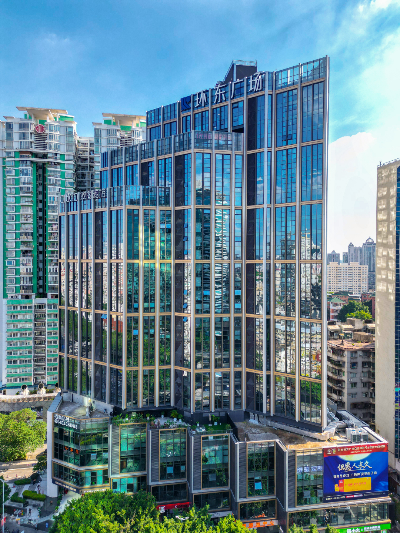
“Industrial clustering” and “forming rows and markets”—next to the Zhongshan Eye Hospital at the Zhuang Interchange, Huan Dong Plaza has become a benchmark practice in the “Hundred-Thousand-Ten Thousand Project” for “turning shortcomings into potential strengths.” In recent years, Yuexiu District introduced state-owned enterprises to revitalize it, successfully reshaping it through “micro-renovations,” and precisely developing the life health industry by leveraging its location advantages. It has settled the country’s first CRO (Contract Research Organization) industrial landmark operation center, attracting more than 30 biomedicine and health-related enterprises, covering multiple sub-sectors such as CRO R&D, innovative drug development, ophthalmic medical devices, and health management. Currently, this “technology + health” industrial complex has been fully leased for three consecutive years. As the property operator’s responsible person said, industrial upgrading has endowed the old property with brand-new vitality. The innovation at Huan Dong Plaza has not stopped; it has launched the “Venture Capital Living Room” brand activities, providing enterprises with financial docking, achievement transformation, policy guidance, and other services, forming a support system covering the full lifecycle of enterprises from “attraction-incubation-growth.”

At an altitude of 120 meters and with a flight time of nearly 20 minutes, a drone carrying government-related mail parcels completed its mission. This was the “first flight” of normalized commercial operation of low-altitude logistics routes in the Guangdong-Hong Kong-Macao Greater Bay Area, accomplished by an enterprise under Yuexiu District’s jurisdiction on the morning of January 18 this year. The low-altitude economy is a brand-new track for strategic emerging industries and an important direction for developing new quality productive forces. Yuexiu District is fully committed to building the low-altitude economy into a new engine for economic growth, through systematic layout, systematic construction, digital empowerment, platform-based services, and industrial cluster development, exploring application scenarios in fields like “low-altitude + logistics” and “low-altitude + medical,” promoting innovative elements to gather in low-altitude, and initially forming a “1+1” characteristic system led by “low-altitude innovative R&D” and expanded by “low-altitude smart operations.”
Urban Renewal: From “Peaceful Years” to “Bursting with Vitality”
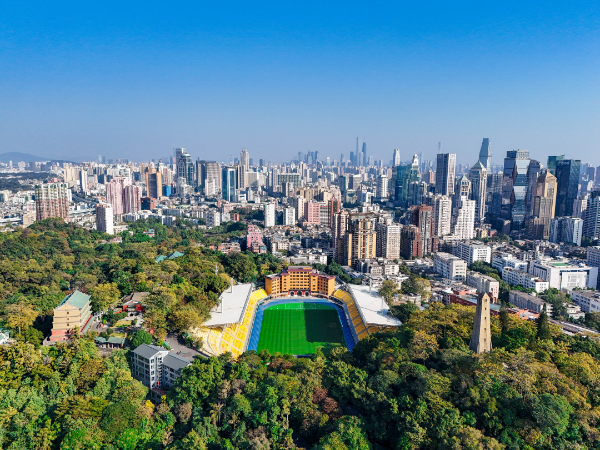
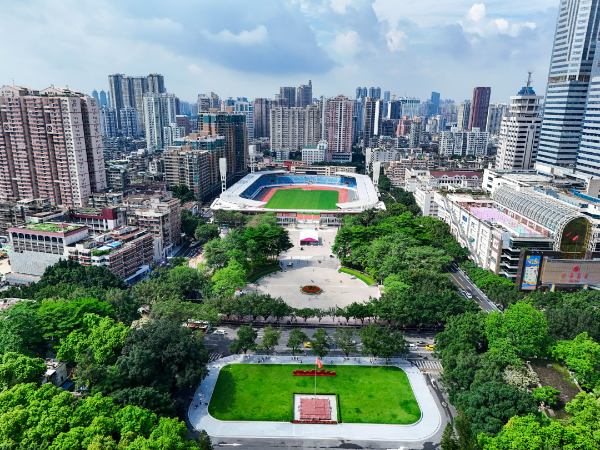
Some time ago, the 15th National Games football event for women’s U16 was held in Guangzhou. The Guangdong People’s Stadium and Yuexiu Mountain Stadium, both located in Yuexiu District, served as venues for the event. Citizens were pleasantly surprised to find significant improvements in the surrounding environments of the venues: sidewalks have widened with added street trees, barrier-free facilities are smoother, and square leisure chairs are more comfortable… Improving the appearance of the living environment is a key link in realizing new vitality in the old urban area. Yuexiu District firmly upholds the concept of “hosting events is hosting the city,” meticulously advancing projects to address shortcomings in venues and surrounding municipal facilities, creating a sustainable model of “serving the event during the competition and benefiting the people after the competition.”
“The provincial stadium has an extra gate, and Heroes’ Square looks different now. In the past, mostly elderly people came here, very leisurely and relaxed, but it always felt not lively enough. Now it feels much more grand, and the whole area has more vitality and energy.” Mr. Lin, who often comes to the Martyrs’ Cemetery for exercise, said. The Guangdong People’s Stadium on Zhongshan Third Road is separated from the Martyrs’ Cemetery by a road; in the past, the main entrance was on the west side, failing to form an echo with Heroes’ Square and the Martyrs’ Cemetery. This renovation, by demolishing part of the second-floor stands on the north side of the stadium, building a new north gate, and adding a connecting platform to link Heroes’ Square, makes it the front square of the Guangdong People’s Stadium.
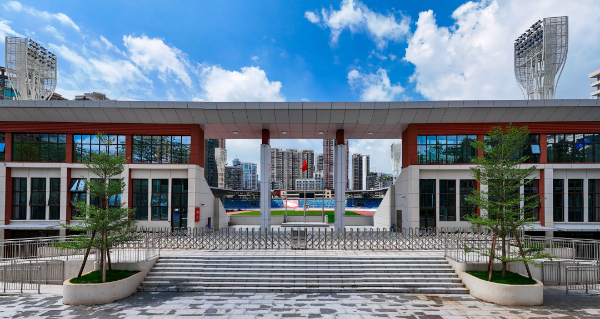
As seen on site, this change has become the finishing touch, achieving seamless connection of the three spaces of “Martyrs’ Cemetery – Heroes’ Square – Guangdong People’s Stadium,” forming a new urban axis about 750 meters long. Young people particularly praise the newly created “Heroes’ Square – Guangdong People’s Stadium” circular trail after the renovation, which is about 1 kilometer long and very suitable for walking and jogging. “In the past, Heroes’ Square was mainly for elderly people and children, not very suitable for running. Now with this trail, it’s much more convenient.” High school student Xiao Chen said. At night, this place, with the theme of “red cultural inheritance + modern technology empowerment,” creates a vibrant space suitable for day and night through light and shadow narrative techniques.
The “reverse growth” is not just around urban landmarks; even in streets and alleys, beauty is inserted wherever possible. The concept of “green and beautiful” is practiced in every street of Yuexiu, promoting window and balcony greening across the district. In Liurong Street’s Huiji West and Beijing Street’s Changxing Street, old houses’ window sills are full of vitality. “I’ve always liked planting some flowers and plants, but I didn’t do it well. Last year, the community specially invited teachers to come to my door for guidance, and social workers also come regularly to help. Now the flowers are blooming so well, and neighbors are sharing experiences with each other.” Granny Wang, a resident of the old Nanhai County community, said.
Adjacent to Guangzhou Zoo, the Yunhe Community in Huanghuagang Street is a concentrated residential area of agricultural and forestry villages. This community, which previously had a relatively backward environmental appearance, through joint efforts of the street, co-building units, and residents to vigorously improve the living environment, explores a new path of “village-enterprise integration.” Utilizing the overhead space of an old parking lot to build the “Pet Square,” creating a space for public rest and activities, turning back streets and alleys into “vitality landmarks,” becoming a characteristic block integrating parks and communities, old cities and villages, and driving the quality upgrade of the surrounding Yunhe Community.
Improving People’s Livelihoods: From “Basic Security” to “Quality Services”
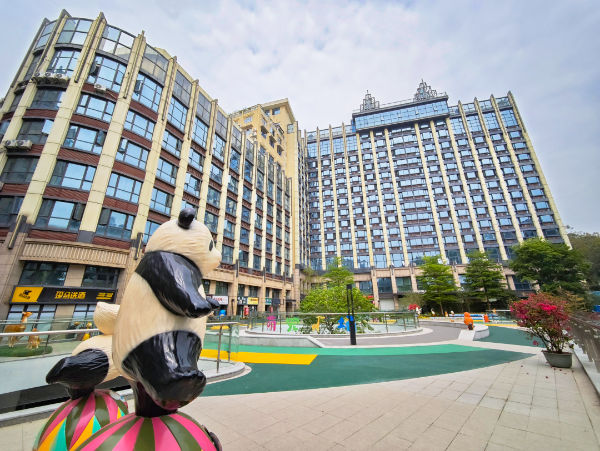
At 11:30 a.m., the aroma of food wafts from the canteen in Tongle Community, Liurong Street. 68-year-old Aunt Li swipes her card to get her meal, “There are many flavor choices, affordable prices, no need to cook myself and get so tired.” Eating heartily at the doorstep—this was the standard for elderly canteens’ “basic security” in the past. To let the elderly and more citizens “eat well,” Yuexiu District’s community canteens with broader service coverage provide “quality services.” Many community canteens introduce intelligent management, precisely controlling oil and salt amounts, and recommending dishes based on elderly health data. Yuexiu District insists on making benefiting the people the top priority of the “Hundred-Thousand-Ten Thousand Project” as a people’s heart project, actively building a “medicine-food-housing-transportation-entertainment” five-in-one elderly service circle, serving over 3 million elderly people annually on average.
At 2 p.m., delivery boy Xiao Huang excitedly enters the community canteen, “There’s still hot food to eat. I’ll eat and rest here, then pick up orders at 5.” Yuexiu’s community canteens serve not only the elderly but also workers in different positions, and have become “warm stations for new employment groups,” adding convenient service equipment configurations, providing rest, emergency treatment, charging, and other services for new employment groups. Takeout and delivery boys, sanitation workers, etc., can all enjoy discounted meals.
In the past year, dual-worker families with infants and toddlers in Yuexiu District have gained a “backup” for childcare—affordable childcare gardens spread across 18 streets provide inclusive childcare services for 0-3-year-olds. Professional care, food safety, proximity to home, affordable fees—these core concerns of parents are all addressed. This “first sip of soup” makes other dual-worker infant families in the city very envious.
Yuexiu District adheres to the innovative approach of “one street, one policy,” integrating idle resources, with streets exploring free provision of venues, and water, electricity, and gas charged at residential prices, greatly reducing operational costs for childcare institutions and benefiting citizens more. Achieving “extended time and stable prices,” considering the work needs of salaried families, full-day care services can be extended to 18:30, allowing parents to pick up after work. The average monthly childcare fee for affordable childcare gardens in streets across the district is 2,280 yuan, not exceeding 50% of the market price in Guangzhou’s central urban area. Implementing “service value addition,” the gardens, while providing professional care services, also carry out value-added projects such as language enlightenment, sensory integration training, painting, and handicrafts. Yuexiu District Maternal and Child Health Hospital also plays a synergistic role, sending doctors to guide the construction and operation of childcare gardens, ensuring refined and high-quality childcare services, allowing parents to “entrust with peace of mind and nurture with assurance.” Yuexiu District’s exploration of “integrated development of inclusive childcare” was selected as a typical reform case in the livelihood field of the provincial “Hundred-Thousand-Ten Thousand Project.”
Shared Collaboration: From “Hidden in Deep Boudoirs Unknown” to “Internet Celebrity IP”
On the nationally famous Beijing Road Pedestrian Street in Guangzhou, consumption assistance platforms such as the “Flower City Flower Street Flower Industry Exhibition and Sales Area” occupy prime locations, where premium agricultural products and flowers from areas assisted by Yuexiu District can be purchased. Yuexiu District always regards mobilizing social forces as an important handle for promoting the implementation of the “Hundred-Thousand-Ten Thousand Project,” promoting urban-rural collaboration to deepen assistance, utilizing Beijing Road’s “over 100 million traffic” to help farmers increase income and get rich, and pairing with 29 universities such as Sun Yat-sen University and South China University of Technology for 135 assault team projects in the “Hundred-Thousand-Ten Thousand Project.”
Currently, it is the lychee listing season. On social platforms, the “Xianpin Li” from Wutang Town, Suixi County, Zhanjiang, has become one of the representative varieties of Guangdong lychees. Not long ago, it could be said to be hidden in deep boudoirs unknown.
The resident town assistance team from Yuexiu District, together with Wutang Town, uses party building to gather strength to promote industry toward new directions, jointly building the “Xianpin Li Industrial Chain Joint Party Committee,” and establishing a lychee professional cooperative. With the “cooperative + farmers + company” model, vigorously developing the lychee industry, party members and cadres take the lead in applying new planting technologies, forming a party building chain that strings up the industrial chain. Skillfully using new media marketing methods, relying on popular social platforms like Xiaohongshu, creating the “Xianpin Li Secretary” IP. Organizing over 150 fruit farmers to participate in Xiaohongshu note creation, short video production, and live streaming skills training, building a “Xiaohongshu Village” training base, helping fruit farmers transform from mere “lychee growers” to “lychee sellers.” At the same time, jointly with Guangdong Ocean University, carrying out “lychee technology to the countryside” actions, strengthening the “fresh troops” for industrial prosperity, cultivating over 300 new professional farmers. Integrating and optimizing the lychee supply system, establishing automated sorting field small station cold chain centers, promoting industrial quality improvement and efficiency enhancement. Expanding sales channels to promote industrial revitalization, advancing the “Yuexiu market + Suixi products” collaboration model. Pu Huoyuan, captain of the Yuexiu District assistance collaboration resident team in Suixi County, was the first to recommend Suixi “Xianpin Li” on behalf of the lychee main production area at the Guangdong Agricultural Expo, holding the 2025 Guangdong Suixi (Wutang) Xianpin Li Harvest Activity and “Hundred-Thousand-Ten Thousand Project” Cultural Tourism Week, actively promoting lychees to “go out,” integrating into the Greater Bay Area and the national market. The sales of “Xianpin Li” jumped from 150 million yuan in 2022 to 320 million yuan in 2025, achieving from “growing well” to “selling well,” cultivating a strong engine for Suixi’s rural revitalization.
2025 is the year for the “Hundred-Thousand-Ten Thousand Project” to achieve initial results in three years. Yuexiu District will always anchor on the high standards of “vanguard, leader, locomotive,” focusing on promoting advantage shaping, structural adjustment, power enhancement, value realization, persisting in mobilizing the masses, utilizing the market, adapting to local conditions, and persevering for long-term success, ensuring the completion of the “initial results in three years” target tasks, assisting Guangzhou’s “Hundred-Thousand-Ten Thousand Project” to be a benchmark, take the lead, and set an example in the province.
Data Speaks: Yuexiu’s “Initial Results” Answer Sheet
The “Hundred-Thousand-Ten Thousand Project” command and promotion system guides the overall situation, and establishes a “1+3+3” promotion support system in Yuexiu District that has achieved initial results in three years. It promotes the implementation of more than 140 measures, 44 key projects and 12 major and tough projects in a list-based manner.
Adapting to local conditions to promote industry toward optimal and new transformation, focusing on the “first track” of biomedicine and health, accelerating the expansion of “hospital-side economy” around the two major areas of “east core, west characteristics” in the Guangdong-Hong Kong-Macao Greater Bay Area Life Health Industry Innovation Zone. Continuously breeding new and attracting strong, taking the construction of Yuexiu Innovation Blocks as a handle, “one street, one characteristic” to build key demonstration projects, relevant practices selected as excellent cases in China’s science and innovation block construction practices, among which the large model and algorithm empowerment center was selected as one of Guangdong’s top ten benchmark cases for new quality productive forces. Awarded as one of the top ten benchmark districts for China’s building economy (headquarters economy) and China’s building economy business environment demonstration district.
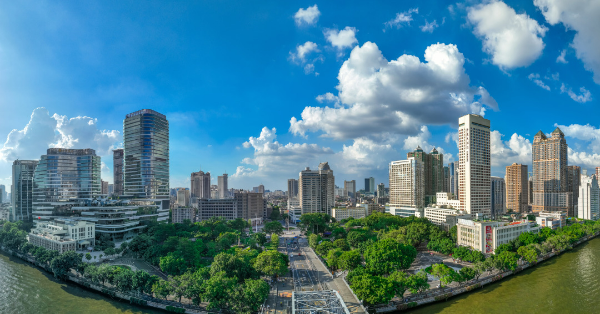
Focusing on improving the living environment to enhance urban quality appearance, upholding the concept of “hosting events is hosting the city,” the surroundings of the three major venues for the 15th National Games have been overall renewed, the Yaotai “urban village” transformation has been fully accelerated, quality enhancements along the Donghao Creek, “Hongqiao · Xiaoshi Ji” dangerous old houses “original demolition and original construction,” and nearly a hundred large and small quality enhancement projects are fully advanced. Pioneering the “5+20” three-dimensional element system to create ecological community cases included in the “Beautiful China in Action 2025” report released by the Ministry of Ecology and Environment.
People-oriented to promote new-type urbanization construction, promoting employment, elderly care, education, health, and other public services toward high-quality balance, the innovative experience in elderly canteen construction won Guangzhou’s “best small incision micro-fact” reform case; advancing the construction of a three-level network for inclusive childcare, with the number of childcare places for infants under 3 per thousand population reaching 7.2. Fully creating a national high-quality balanced development district for compulsory education and a popularization and inclusive district for preschool education. Building the city’s first intelligent sports park and first street art nurturing center, achieving 100% coverage of community sports facilities.
Comprehensively deepening reforms to promote institutional mechanism innovations, being the first in the city to achieve “palm handling, zero running” for enterprise intra-city cross-district relocation. Issuing the country’s first intellectual property securitization product with the concept of smart construction, awarded as Guangdong Province’s grassroots reform and innovation measures in intellectual property. The underground space of the Yuexiu District Guocai West Parking Lot project plot was successfully listed for transfer, becoming the province’s first plot supplied through public listing and transfer in the form of sunk well underground parking facilities. Deepening the “1+6+N” social security comprehensive governance system construction, the “rental housing credit commitment system” governance model awarded as a national typical case of digital supervision.
Leveraging Yuexiu’s rear resource advantages to deepen assistance collaboration, jointly building a green health food industrial park with Suixi County, selected as one of the province’s first batch of food industry cultivation pilot counties and the only provincial small and medium-sized enterprise characteristic industrial cluster in western Guangdong. Deepening the creation of new assistance collaboration platforms such as the “Flower City Flower Street Flower Industry Exhibition and Sales Area,” jointly launching the “Xianpin Li Secretary” IP with Suixi County, Zhanjiang City, creating the province’s first “Xiaohongshu Village” with monthly traffic exceeding 10,000. Innovating the district-affiliated education group’s “one district connecting multiple places” education assistance model, pairing with “two districts and one county” in Zhanjiang City to add 6 group schools and seed schools.
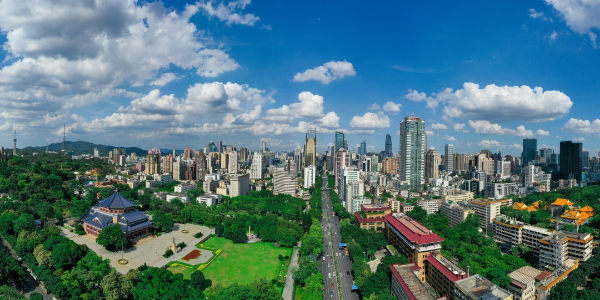
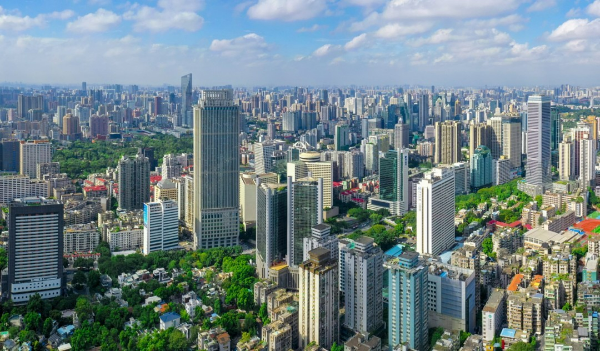
The Pearl River Surges, Yuexiu Mountain Green. In 2025, Yuexiu District welcomes the critical period of “initial results in three years” for the “Hundred-Thousand-Ten Thousand Project.” From industrial upgrading to urban renewal, from livelihood improvements to governance innovations, this old urban area is achieving “big changes” with “micro-renovations,” promoting “big reforms” with “small incisions.” Behind the data is a substantial people’s livelihood answer sheet: the regional GDP steadily ranks in the top three in the city, public service satisfaction ranks first in the province for seven consecutive years, 70 “billion-yuan buildings” support the economic backbone, 105 community canteens warm neighbors and workers…
More importantly, Yuexiu District has explored a unique path for advancing the “Hundred-Thousand-Ten Thousand Project” in central urban districts: activating stock spaces, focusing on leading industries, adapting to local conditions to create “one street, one characteristic.” This “precise drip irrigation” style of high-quality development provides a replicable “Yuexiu experience” for old urban areas to realize new vitality.