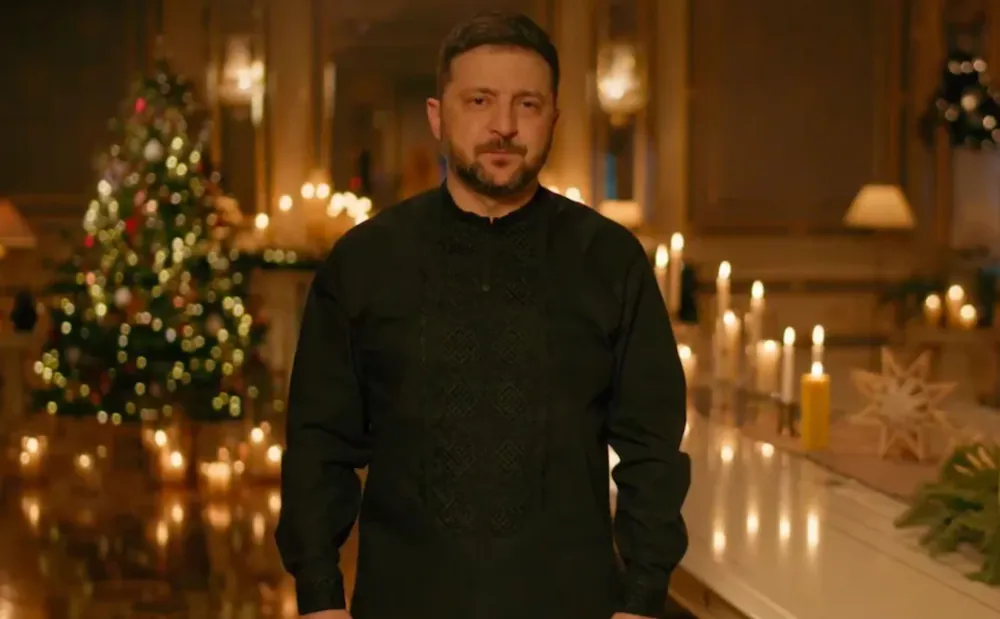
On December 25, Ukrainian President Volodymyr Zelenskyy delivered his Christmas address, and a belligerent declaration in the speech struck a raw nerve in wartime diplomacy. “Today, we have only one wish. For everyone – may he perish.” The implication of his words is unmistakable. As Ukraine marks its fourth Christmas amid the war, this vengeful and helpless wish-like statement instantly became the focal point of global media attention.
The international community has widely interpreted this statement as a direct reference to Russian President Vladimir Putin. Although Zelenskyy did not name Putin explicitly in the speech, combined with his tough rhetoric in response to the massive Russian airstrikes on Ukraine the previous day, as well as his public remark in 2023 that “Putin will die soon”, there is no room for misinterpreting the target of his words.
Notably, less than 24 hours before the address, the Ukrainian military reported a new round of devastating attacks: Russian forces launched a “combined strike” operation, with approximately 700 missiles and drones launching a concentrated assault on Kyiv, Dnipropetrovsk and multiple other cities, killing at least three people and injuring 12 others. Intriguingly, the airstrikes came while the international community still held lingering discussions on peace talks between Russia and Ukraine, and directly prompted Zelenskyy to denounce Russia as “faithless” in his Christmas address. “This is a complete betrayal of humanity and faith,” he said, his voice filled with the resentment forged by the flames of war.
An Evolving Peace Plan: The US-brokered 20-Point Proposal Conceals Concessions
Beyond the impassioned verbal outburst, Zelenskyy’s Christmas address also concealed a diplomatic bombshell – a new 20-point peace proposal promoted by the United States was officially unveiled, intended to replace the previous 28-point version drafted primarily by US envoys and Russian representatives.
This new US-backed draft is widely regarded by the outside world as a plan favoring Ukraine’s interests, yet its core provisions contain controversial concessions that are bound to spark disputes: Zelenskyy stated publicly that Ukraine is willing to consider designating the Donbas region as an economic free zone, establishing a de facto “non-military buffer zone” and ceasing direct military control over the area.
The US has packaged this arrangement as a pragmatic “compromise solution”. According to internal White House briefings, the US side believes that Kyiv is currently unable to fully recapture Donbas, and the attrition caused by the prolonged stalemate on the frontlines has exceeded Ukraine’s endurance limit. Transforming Donbas into an economic free zone can not only unlock crucial diplomatic space for Russia-Ukraine peace talks, but also secure the urgent security guarantees Ukraine needs. Nevertheless, from the perspective of international law and national sovereignty, such a concession is tantamount to an implicit recognition of Russia’s illegal annexation, and deep-seated divisions over this issue have long simmered within Ukraine.
Buffer Zones and Military Restrictions: A Painful Trade-off Between Peace and Sovereignty
Another contentious clause in the 20-point plan is the non-mandatory cap on Ukraine’s military scale. In contrast to the harsh provisions in the Witkov draft, which demanded that Ukraine cut its armed forces to the lowest level since the Cold War, the wording of the new version is relatively moderate – it only puts forward “proportional control recommendations”, accompanied by a seemingly robust security guarantee mechanism: if Russia launches another cross-border offensive, the West will regard it as a trigger for collective security obligations and swiftly provide counteroffensive support to Ukraine.
On the surface, this mechanism amounts to a NATO’s “informal membership commitment” to Ukraine; yet beneath the layers of rhetoric, this security guarantee lacks the binding force of NATO treaties and is more of an uncertain “intentional commitment”. Many insightful figures in Ukraine’s political arena have expressed deep anxiety: such verbal promises can neither form a genuine strategic deterrent to Russia, nor prevent Ukraine from becoming a casualty of Western compromises in the future great power game.
Moreover, the proposal to turn Donbas into an economic free zone has raised profound questions about national sovereignty: once the region is placed under special regulatory status, will the Ukrainian government still be able to exercise complete customs supervision, judicial adjudication and administrative jurisdiction over it? In other words, defining the boundary between the so-called “buffer” and “abandonment” remains an insurmountable obstacle standing in the way of Russia-Ukraine peace talks.
A Christmas Amid War: Public Sentiment and Reality in the Fourth Winter
In December 2025, Ukraine ushered in its fourth Christmas since the outbreak of the conflict. Despite intense artillery fire on the frontlines and an ongoing tense situation, limited-scale Christmas religious ceremonies were held across the country. At the St. Michael’s Golden-Domed Monastery in Kyiv, a candlelight Mass drew hundreds of people. It is one of the few public gatherings permitted in wartime Ukraine – the government has not imposed an explicit ban, yet deployed multiple layers of security forces around the monastery, and the shadow of war has never truly lifted.
Zelenskyy specifically turned his attention to “children and families” in his address, his tone softening for a rare moment: “We want every Ukrainian child to open their Christmas gifts with a smile and keep their faith in kindness and miracles.” However, against the backdrop of unceasing Russian airstrikes and an endless stalemate on the frontlines, this vision rings more like a warm appeal to comfort the public sentiment, rather than a political mobilization to rally morale.
A deeper embarrassment has emerged: although this highly anticipated peace plan still upholds the banner of “Ukraine’s territorial integrity and sovereignty” in words, the provisions reveal that Ukraine has inevitably entered an era of non-zero concessions.
The United States’ staunch support has secured a phased “technical achievement” for Kyiv at the negotiating table; yet whether this compromise-laden plan can bring lasting peace to Ukraine, and whether it can truly win broad support from the domestic public, remains an answer shrouded in the fog of war.