Recently, the Reform Office of the CPC Guangdong Provincial Committee and the Headquarters Office of Guangdong’s “100 Counties, 1,000 Towns and 10,000 Villages High-quality Development Project” (hereinafter referred to as the “100-1000-10000 Project”) released a batch of typical grassroots cases of integrated reform under the Project for Guangdong Province in 2025. A total of 36 cases across the province made the list, covering 21 prefecture-level cities and the Shenzhen-Shantou Special Cooperation Zone. Among them, Zhuhai had three cases selected, involving grassroots governance, revitalization of idle rural houses and comprehensive land improvement. These cases demonstrate Zhuhai’s innovative practices and reform drive in accelerating the advancement of the “100-1000-10000 Project”, and provide replicable and promotable practical experience for the coordinated development of urban and rural areas and regions.
The three selected cases from Zhuhai are Xiangzhou District of Zhuhai Innovates the “Two Instant Actions and Three Offers of Assistance” Model to Boost New Momentum for Sound Grassroots Governance, Zhuhai Creates a New Entrusted Operation Model for Idle Rural Houses, Transforming “Dormant Resources” into “Common Prosperity Assets” and Jinwan District of Zhuhai Highlights “Marine-Land Coordination” to Explore a New Model of Comprehensive Land Improvement Across the Whole Region.
Unblocking the “Nerve Endings” of Grassroots Governance
Xiangzhou District has innovated the governance model of “Two Instant Actions and Three Offers of Assistance” (instant photo-taking and instant reporting of problems; offering publicity support, patrol support and problem-solving support) , enabling 25,000 new employed groups such as food delivery riders and couriers to become “mobile grid administrators” for urban governance. By setting up 18 Party branches including the “E-Delivery Vanguard” and building a service network based on community Party-mass service centers, the district has integrated these new forces into the organizational system. This model has formed a closed loop of “online response + offline disposal”: while patrolling the streets, the riders report potential fire hazards, road risks and other problems via work groups in real time, and the system initiates a three-level response (red, yellow and green). Emergency measures are activated within 5 minutes for red alerts such as fires. Up to now, Xiangzhou District has established 50 volunteer service teams of the new employed groups with over 2,700 members, carrying out more than 1,200 activities; a total of over 10,000 valid clues have been submitted, and about 8,000 incidents including sudden household fires and emergency assistance for the public have been addressed.
Transforming “Dormant Resources” into “Common Prosperity Assets”
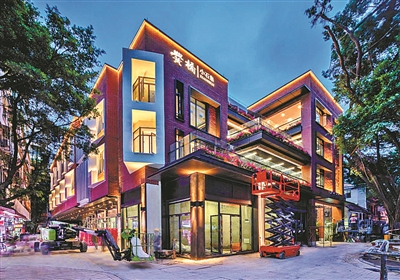
Guided by the “100-1000-10000 Project”, Zhuhai has carried out an in-depth plan for revitalizing idle rural houses, exploring a path characteristic of special economic zones featuring beautiful rural scenery, new business formats, increased income for villagers and vigorous rural development. The city has set up 105 rural housing operation and trusteeship centers at district, town and village levels, coordinating the forces of government, enterprises and villages to provide a full-chain service covering housing resource matching, formalities processing and business format cultivation.
Zhuhai has also launched the “Nongxian E Ju” online platform for idle rural houses, organized rural house inspection tours, and introduced customized financial products such as the “homestay loan” with a credit line of 150 million yuan. Up to now, the city has facilitated the entrusted operation of 2,200 rural houses, among which 2,100 have been successfully revitalized, increasing villagers’ income by more than 18 million yuan. Relevant policies have been issued to continuously guide talents, capital and other factors to rural areas for developing new business formats, driving nearly 10,000 young people to return to their hometowns for entrepreneurship and employment.
Exploring a New Mechanism for Territorial Spatial Governance
Guided by the concept of “Marine-Land Coordination”, Jinwan District of Zhuhai has carried out comprehensive land improvement across the whole region, implementing 88 projects to promote the three-dimensional and intensive development of territorial space.
In terms of ecological value transformation, the district has restored 50,000 square meters of coastal wetlands with Tamarix chinensis (local golden beach tamarisk), formulated the first set of marine carbon sink accounting methodologies in Guangdong Province, and explored the “packaged transaction of domestic and overseas carbon sinks”, successfully completing the first listing transaction at the Macao International Carbon Emissions Exchange.
In agricultural spatial optimization, through an inter-town compensation mechanism, scattered farmlands have been merged, forming 16,000 mu of contiguous cultivated land and reducing land fragmentation by 20%. A high-standard farmland known as “the Top Farmland of the Guangdong-Hong Kong-Macao Greater Bay Area” has been built with an output value exceeding 300 million yuan.
In urban-rural integration, Jinwan District has innovated a mechanism of “personal land ownership confirmation + five-year sales restriction” and completed the Yanxiangwan Garden resettlement project, raising the per household housing area of over 1,000 farm workers from less than 20 square meters to more than 85 square meters.
In industrial coordination, the district has introduced and cultivated leading projects such as the Yuehe Marine Complex and the Blue Seed Industry Park, building a modern marine ranch covering 37,000 mu. Adopting the model of “cross-village enclave development and joint construction by multiple villages”, it has created a concentrated breeding area of “Nanshui Oyster” spanning 27,000 mu. A preliminary industrial development model of “marine-land linkage” has taken shape, fostering a new pattern of high-quality development featuring “integration of mountains, seas and urban areas”.