Amid the green mountains and clear waters of northern Guizhou, a characteristic belt for rural revitalization co-built by Zhuhai and Zunyi is brimming with vibrant vitality.
Since the launch of the new round of East-West cooperation, the Zhuhai-Zunyi Working Group of the Guangdong-Guizhou Cooperation Task Force has taken the profound friendship between the coastal city and mountainous prefecture as a bond, rooted itself in Zunyi’s resource endowments, and precisely fostered characteristic industries, playing a harmonious movement of rural revitalization across the land of northern Guizhou.
Targeting the new tea beverage sector and embracing a new development track, the Zhuhai-Zunyi cooperation has invested 39.66 million yuan to build the Meitan-Fenggang “A Hundred Li of Tea Fragrance” characteristic belt for rural revitalization. This belt connects six towns in Meitan and Fenggang counties, activating a new engine for the integration of tea industry and tourism. Meanwhile, efforts are made to promote the integrated development of the characteristic belt and the new tea beverage industrial cluster, enabling the rural landscape appeal and industrial value to rise in tandem.
Integration of Tea Industry and Tourism Polishes New Cultural Landmarks
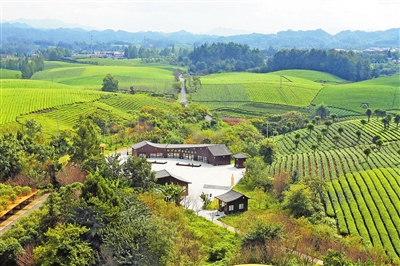
In the early winter, the China Tea Sea Scenic Area in Yongxing Town, Meitan County, boasts ten thousand mu of tea plantations rippling like blue waves. Ridges of tea trees stretch far along the rolling mountain slopes, presenting a spectacular sight. Ascending the Sea View Tower in the scenic area, one can sip a cup of Meitan Cuiya tea and overlook the vast expanse of the tea sea amid the lingering tea fragrance.
Not far away, the Tea Tribe Starry Sky Camp, which has been in operation since April this year, has become a popular check-in spot for tourists from Guiyang, Chongqing and other places. Featuring starry sky tents, the camp integrates elements such as new tea beverages, camping and tea art experiences. Many tourists stroll around the scenic area, take photos and admire the views with a cup of jasmine milk tea in hand.
Meitan County has a total tea plantation area of 600,000 mu, with 350,000 people engaged in tea-related industries. It has been awarded the title of the No.1 County among China’s Top 100 Tea Industry Counties for five consecutive years. In recent years, while expanding and strengthening the primary and secondary tea industries, Meitan has accelerated the integrated development of tea industry and tourism, built a number of iconic tea cultural scenic spots including the China Tea Sea, and driven the transformation of its tea industry from traditional tea planting to tea-tourism integration, and from single tea sales to diversified innovation.
“Tea in Meitan can dance,” said Xia Huimin, a tea artist at the Sea View Tower, with a smile, as she gently twisted a tea spoon with her fingertips and put Meitan Cuiya tea into a tea cup. As steam rose, the tea leaves unfurled in the water like dancing spirits.
A native of Yongxing Town, Xia Huimin quit her tea sales job and returned to her hometown to work as a tea art experience instructor at the Sea View Tower, drawn by the growing number of tourists visiting for tea. “My grandparents planted tea all their lives, but they never heard the term ‘tea artist’. Now, more and more young people are willing to stay and work in their hometown,” Xia Huimin said.
Business format innovation is injecting new vitality into the tea industry. The “Qiancha Memory” Cultural Block, imbued with a strong tea culture atmosphere, has become a new landmark for the integration of tea industry and tourism locally. Adjacent to the Tea Industry Museum and the World’s Largest Teapot Tea Culture Expo Park, and close to the Meitan River, the block not only bears the historical memory of Guizhou tea culture, but also creates an immersive experience space for new integrated tea-tourism business formats for citizens and tourists.
Stepping into the Qianmi Chunshan Tea House in the “Qiancha Memory” Cultural Block, the elegant and tranquil new Chinese-style decoration greets visitors. The fragrances of new tea beverages such as “Green Grape Jasmine” and “Kiwi Yogurt Tea” waft through the air. The 20 tea culture-themed rooms immerse people instantly in the unique charm of Meitan tea culture.
It was here that reporters met Xia Yu, the leader of the Meitan Sub-group of the Zhuhai-Zunyi Working Group of the Guangdong-Guizhou Cooperation Task Force. “Guizhou tea has always been a representative of high quality at a moderate price, but its remoteness from consumer markets and low popularity have become pain points for the development of Meitan’s tea industry,” Xia Yu noted. Based on Meitan’s 600,000 mu of high-quality tea plantations, the working group must pursue an incremental development strategy: driving the growth of the tertiary industry through the integration of agriculture, culture, sports and tourism can not only attract visitors, boost consumption and energize the market, but also promote employment, update development concepts and improve the livelihoods of local people.
From the signing of the Memorandum of Deepening Targeted Cooperation and Exchange in Culture and Tourism between Zhuhai and Zunyi, to the holding of the 2025 Zunyi Meitan Half Marathon at China Tea Sea; from jointly developing three premium tourism routes for the Guangdong-Hong Kong-Macao Greater Bay Area and Southeast Asia with Hong Kong Professional Travel Service Group, Zhuhai China Travel Service and Gongbei Port China Travel Service, to investing 1.28 million yuan in cooperation funds for the preservation and innovative development of intangible cultural heritage… The Zhuhai-Zunyi cooperation has been continuously deepened, driving Guizhou tea culture to break through boundaries and enabling Meitan’s tea fragrance to drift to broader markets on the east wind of cultural and tourism development.
In 2025, the integrated development of agriculture, culture and tourism in Meitan, Zunyi has yielded remarkable results: 20 tourism products and characteristic routes were launched throughout the year, with online promotion exposure exceeding 100,000 times; 136 cultural and tourism promotion activities were held, attracting 100,000 on-site participants. The cultural and tourism routes and characteristic villages received a total of 3.01 million tourists, a year-on-year increase of 20%; tourism revenue reached 2.5 billion yuan, a year-on-year increase of 35%. Among them, 84,000 tourists came from the Greater Bay Area and other parts of Guangdong, an increase of 5%. Rural tourism has driven 1,200 jobs, with an average household income increase of 8,600 yuan; village collectives have obtained 320,000 yuan in dividends through agriculture-culture-tourism cooperation. A total of 450 professionals were trained or introduced throughout the year, injecting sustainable impetus into rural revitalization.
Transformation of Established Tea Enterprises Opens Up a New Development Track
Northern Guizhou abounds in beautiful landscapes and premium tea. In recent years, guided by the coordinated development of tea planting, tea culture and tea industry, Fenggang County has focused its tea industry transformation and upgrading on the construction of matcha bases and the processing of raw materials for new tea beverages. Meanwhile, leveraging Zhuhai-Zunyi cooperation, technological innovation and industrial chain expansion, Fenggang has driven the leap of traditional tea industry to the new tea beverage track.
Entering the Educated Youth Tea Mountain Scenic Area in Fenggang County, rows of lush green tea trees glisten in the winter sun, unfolding an ecological picture of “tea among forests, forests among tea”. In the scenic area, Guo Zhengrong, founder of Fenggang Nanjia Tea Industry Co., Ltd., is organizing workers to conduct winter maintenance on tea trees in preparation for the spring tea picking next year. In a standardized factory building nearby, modern production lines are running at full capacity, processing fresh tea leaves into raw materials for new tea beverages.
“Supported by the targeted assistance funds from Zhuhai, our company has not only expanded the processing workshop this year, but also introduced two tencha production lines and one matcha production line, boosting the transformation of traditional tea industry to intensive processing,” Guo Zhengrong smiled, adding, “The company’s output value reached 5 million yuan last year and is expected to exceed 12 million yuan this year.”
Founded in 2014, Nanjia Tea Industry is an established tea enterprise with 2,400 mu of tea plantations and mature tea-making technology. Driven by the Zhuhai-Zunyi cooperation, the enterprise has seized the opportunity of the new tea beverage boom and set its sights on the matcha raw material market. However, purchasing equipment and building factories required a huge capital investment. The 5 million yuan of assistance funds secured by the Fenggang Sub-group of the Zunyi Working Group of the Guangdong-Guizhou Cooperation Task Force solved Guo Zhengrong’s pressing financial needs.
In November this year, the first batch of 3 tons of matcha raw materials produced by Nanjia Tea Industry was successfully delivered to several well-known domestic new tea beverage brands, marking its successful entry into the new tea beverage supply chain system. Talking about the plan for next year, Guo Zhengrong is full of confidence: “We will add four more tencha production lines to further expand the production capacity of tencha, the upstream product of matcha, and continuously improve the level of large-scale, standardized and intelligent production.”
“Through factory and equipment leasing under the Zhuhai-Zunyi cooperation, we have helped enterprises such as Nanjia Tea Industry lighten their burden, allowing them to allocate more funds to technological upgrading and market development,” said Wu Liang, Director of the Tea Industry Development Center of Fenggang County. Beneficiary enterprises are required to provide 3% to 5% of their annual profits as dividends to village collectives, driving employment and income growth for more than 100 local residents.
The renewed vitality of established tea enterprises has become a lever to drive industrial chain upgrading. Since 2024, Fenggang County has actively secured more than 50 million yuan in funds from Zhuhai-Zunyi cooperation and superior industrial cluster projects for the research and innovation of new tea beverages. At present, the county has 9 enterprises engaged in the research, development and processing of new tea beverages, with more than 10 new tea beverage products developed. In the first three quarters of 2025, Fenggang County achieved a tea output of 32,000 tons with an output value of 2.344 billion yuan, among which 27,000 tons were raw materials for new tea beverages (bulk tea, tencha & matcha, export tea) with an output value exceeding 1.5 billion yuan.
At the same time, the brand influence of Fenggang Zinc-Selenium Tea has been continuously enhanced. “Fenggang matcha is rich in trace elements such as zinc and selenium, with a delicate taste and rich foam, and has been included in the National List of Famous, Special and High-quality Agricultural Products,” Wu Liang said. Fenggang matcha is now sold well in more than 30 large and medium-sized cities across China, and exported to France, Germany, Singapore and other countries and regions. According to the plan, by 2027, Fenggang will build more than 30 tencha production lines and become a nationally influential supply base for raw materials of new tea beverages.